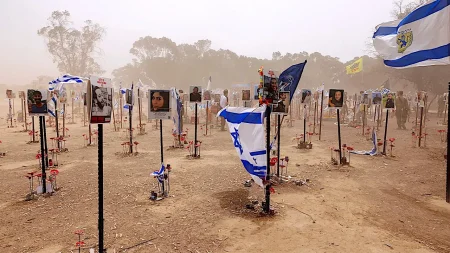






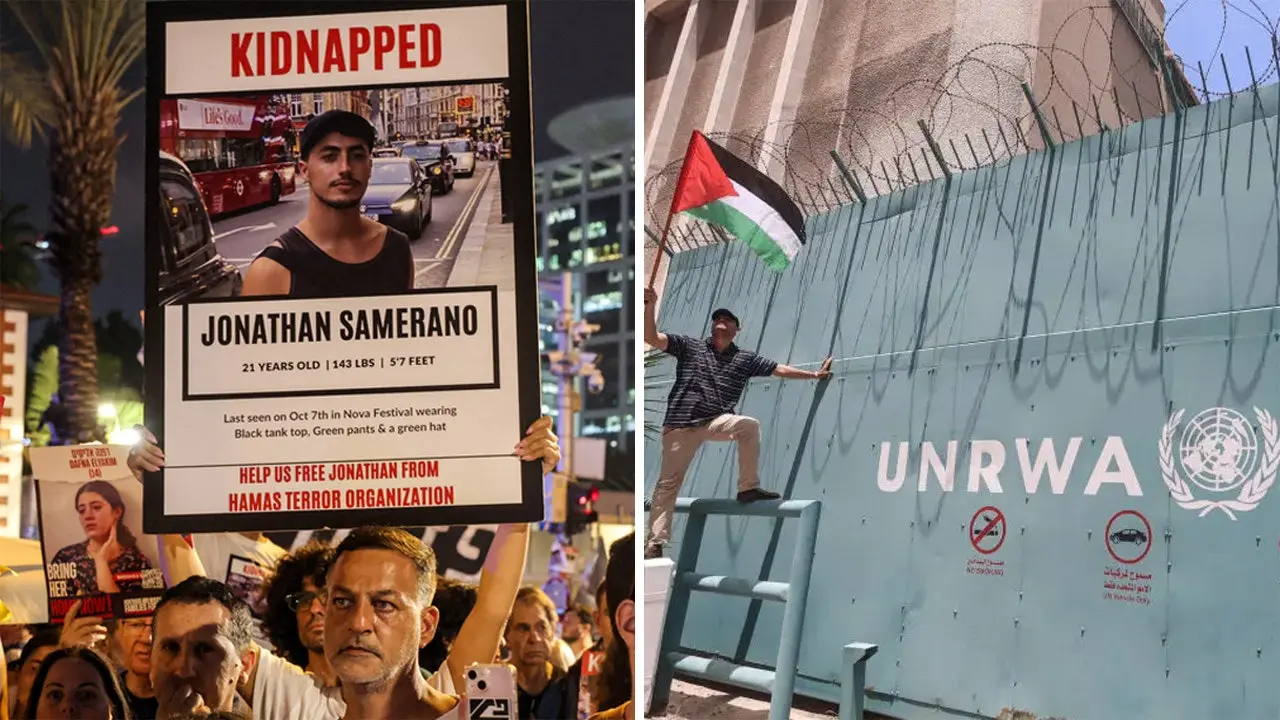
In the relentless aftermath of the October 7, 2023, attacks, the search for meaning and accountability often leads down paths that intertwine personal tragedy with geopolitical conflict. This is the case for the family of Yonatan Samerano, a 21-year-old Israeli who had gone to the Nova music festival to celebrate life, only to find himself fleeing for it as Hamas terrorists swept across the border. Samerano was murdered outside Kibbutz Be’eri, shot down by terrorists as he tried to escape the carnage. But for his family, the nightmare did not end with his death. For 625 days, they did not know where he was, waiting in agony as his body was held somewhere beyond their reach. When his remains were finally returned during the last stage of hostage releases, the family learned a devastating truth: their son’s body had been picked up by workers from the United Nations Relief and Works Agency for Palestine Refugees in the Near East, placed in an UNRWA vehicle, and taken into Gaza. The organization that is supposed to represent humanitarian neutrality had, according to an Israeli civil rights attorney, become part of the machinery that denied a grieving family closure. Now, the Samerano family is fighting back in court, and their legal battle has become a lightning rod for the broader global reckoning over UNRWA’s future in Gaza.
At the center of this fight is Nitsana Darshan-Leitner, the president of the Shurat HaDin Law Center, an Israeli civil rights organization known for pursuing justice against terror-related entities. Darshan-Leitner told Fox News Digital that the lawsuit she filed with the District Court of Jerusalem on behalf of the Samerano family is rooted in a simple but powerful demand: accountability. According to Darshan-Leitner, after terrorists killed Samerano, UNRWA workers took his body, placed it in an agency vehicle, and drove it into Gaza as part of the wave of stolen dead and living hostages. Yet UNRWA never revealed where the body was being held, never cooperated with Israeli authorities, and never admitted that its own workers were involved. “Although the kidnapping was by UNRWA’s workers,” Darshan-Leitner said, “UNRWA never revealed the place of the body, never cooperated with Israeli authorities to tell them where Yonatan Samerano was held and never admitted that it was done by its workers. And therefore we decided to sue UNRWA on behalf of the family.” The lawsuit seeks punitive damages of NIS 24 million—nearly $8 million—under Israel’s Compensation for Victims of Terrorism Law. But the legal road has been far from smooth. UNRWA, like many UN bodies, has long claimed diplomatic immunity under the Charter of the United Nations and the Convention on the Privileges and Immunities of the United Nations. Darshan-Leitner argues that this immunity should not apply when an organization is complicit in terrorism. “The charter specifically prohibits any act of violence, let alone terrorism,” she said, adding that because “UNRWA was aiding and abetting terror organizations and participating in acts of terrorism, they can no longer enjoy the immunity granted by the treaty.”
The legal landscape shifted in December when the Israeli Knesset passed legislation stripping UNRWA of its diplomatic immunity, a move that also allowed the Israeli government to expropriate UNRWA properties within East Jerusalem. That change opened the door for the Samerano family’s case to move forward. When the deadline for UNRWA to file its defense arrived last week, the agency asked for a 45-day extension—a request that Darshan-Leitner framed as another delaying tactic in a long history of dodging responsibility. UNRWA itself did not respond to requests for comment about its immunity status or the litigation. But the silence from UNRWA has not meant silence from the United Nations. Stéphane Dujarric, spokesperson for Secretary-General António Guterres, told Fox News Digital that the UN chief has consistently stated that the Knesset law and its amendments are inconsistent with the status and international legal framework applicable to UNRWA. Dujarric insisted that the source of UNRWA’s immunities is vested in the UN Charter and the Convention on the Privileges and Immunities of the United Nations, which remain applicable. At the same time, Guterres has acknowledged that any UNRWA personnel shown to have participated in the October 7 attack must be held accountable. “Whenever we have been given information by the Israeli government on such individuals, we have acted,” Dujarric said. For the Samerano family, however, words of accountability ring hollow when they still had to fight for answers about their son’s body for over 600 days.
The lawsuit has become a flashpoint in a much larger debate about whether UNRWA can continue to operate in Gaza after October 7. For months, evidence has been mounting that Hamas has deeply infiltrated the agency, turning what should be a humanitarian mission into something that many now view as an enabler of terror. The USAID Office of Inspector General and NGO Watch have both continued to uncover signs of Hamas ties within UNRWA’s ranks, and several donor countries have responded by cutting off funds. Finland, Sweden, and the United States have now fully stopped issuing money to the organization. The Board of Peace, the body charged with reconstructing Gaza, has publicly stated that UNRWA will have no role in the future of the Strip. That position appeared to be challenged by an Associated Press report in September, which claimed that Board of Peace members had been more open to working with UNRWA than it seemed, citing confirmation that board members had met multiple times with UNRWA officials. But the Board of Peace shot back, posting on X that its policy regarding UNRWA’s involvement in Gaza is unchanged. “We will only work with trusted partners who will deliver for the people of Gaza and contribute to a deradicalized Strip,” the board said. “UNRWA fails on those litmus tests.”
The Biden administration’s stance has been similarly pointed. A U.S. official told Fox News Digital that the evidence continues to mount that UNRWA has become a vehicle for instability, violence, and radicalization, and that it has no place in Gaza’s future humanitarian operations. The official expressed confidence that there are many capable and dedicated service providers in Gaza today who, after robust vetting and background checks, could meet the high standards required to deliver critical goods and services to the Palestinian people. The official also suggested that UNRWA itself will not be essential or necessary after an orderly wind-down. That sentiment stands in stark contrast to the steadfast support coming from UN Secretary-General António Guterres. In remarks delivered at the Ministerial Meeting on UNRWA on September 24, Guterres described UNRWA as “a critical stabilizing presence” in Gaza. He condemned the October 7 attacks by Hamas and other armed Palestinian groups in the strongest terms, and noted the terrible loss and hardship endured by UNRWA’s own personnel in Gaza, with nearly 400 members of its workforce killed and hundreds of its premises inaccessible, severely damaged, or destroyed. But Guterres also accused what he called “a ceaseless political campaign” of trying to manipulate public perceptions, undermine UNRWA’s ability to operate, and deny the rights of Palestine refugees. He called on UN member states to take immediate action to support the organization politically and financially and to protect its mandate.
Darshan-Leitner sees things through an entirely different lens. For her, allowing UNRWA to continue operating inside Gaza is a catastrophic mistake. The agency, she argues, has spent years indoctrinating Palestinian refugees and allowing terror organizations to infiltrate its schools and educational facilities. UNRWA facilities, she said, served Hamas as bases, launchers, and missile storage places. This not only endangers the lives of civilians in Gaza but also guarantees that there will be collateral damage when Israel retaliates against attacks originating from areas that should be protected humanitarian zones. “If the Board of Peace wants to re-educate the people to get rid of the terrorist system, to separate between the terrorists and the citizens of Gaza, it cannot do it when UNRWA is around because UNRWA is embedded in Hamas…UNRWA is Hamas,” Darshan-Leitner said. “So letting UNRWA take care of the humanitarian needs of the population in Gaza is a fatal mistake.” The Samerano family’s lawsuit is more than a legal claim for damages; it is a human cry for truth and responsibility. It asks the world to look at UNRWA not as a neutral aid agency, but as an institution whose actions have real, painful consequences for ordinary people. And as the legal clock ticks on, with UNRWA seeking more time and the international community deeply divided, the family waits for the only thing that can ever bring them a measure of peace: recognition that their son was not a nameless victim, but a young man whose memory deserves justice.