





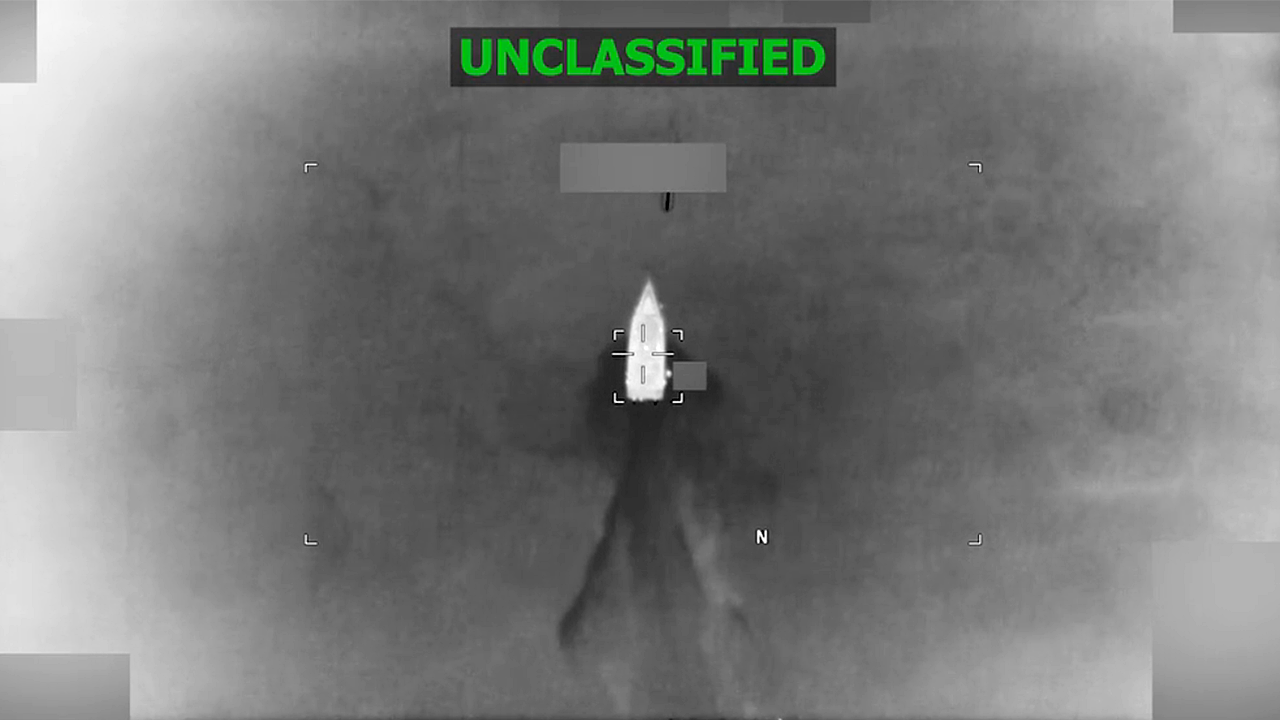
On a quiet stretch of the Caribbean, a small, high-speed vessel suddenly became the focus of a U.S. military operation that ended in fire and death. The U.S. Southern Command announced on Sunday that it had carried out a lethal strike against a boat it described as a go-fast vessel traveling along established narco-trafficking routes. The military released video showing the boat moving across the water before a massive explosion consumed it, leaving only smoke, debris, and the grim aftermath of a destroyed craft. For the four people aboard, there was no boarding, no arrest, no trial—just a violent end. The operation was directed by the Joint Task Force Western Hemisphere, a command specifically established to focus U.S. military efforts in Latin America and the Caribbean. In a statement, the military said it had acted on intelligence that the vessel was actively involved in narco-trafficking, though no evidence was provided to support the claim. The phrase “lethal, kinetic strike” used by the military conveys the deliberate nature of the action: this was not a warning shot or a maneuver to disable a boat. It was an attack meant to kill, and it succeeded. The four people killed were later described by the military as “narco-terrorists,” a term that has become central to the Trump administration’s campaign against drug trafficking in the Western Hemisphere.
The official account raises important questions about how the U.S. military is fighting its drug war. According to Southern Command, intelligence identified the vessel as a narco-trafficking asset operating in a region long used by smuggling networks to move illegal drugs from South America to the United States and elsewhere. Go-fast boats are small, powerful, and notoriously difficult to track, which is why they are favored by traffickers moving cocaine and other contraband through Caribbean and Pacific waters. But the military’s categorical assertion that everyone on board was a narco-terrorist obscures the reality that no one survived to be questioned, and no drugs were displayed as evidence. The Pentagon has repeatedly refused to release the identities of those killed in similar strikes, and it has also declined to provide photographic or physical proof that drugs were found at the scene. This lack of transparency has fueled concern among lawmakers, human rights advocates, and even some members of the military and intelligence community who worry that the United States is sliding into a pattern of extrajudicial killing far from any declared battlefield. There is no doubt that drug trafficking is a serious and devastating problem, but the methods being used to confront it—lethal strikes without due process, without public evidence, and without any apparent opportunity for surrender—represent a significant departure from previous counternarcotics efforts, which typically involved interception, boarding, and prosecution.
This latest operation is not an isolated incident but part of a rapidly expanding military campaign. The deaths in the Caribbean bring the total number of people killed in such strikes to more than 235 since September 2025, according to press reports and statements from the military. The strikes have taken place across the Caribbean and the eastern Pacific, targeting vessels suspected of carrying drugs or ferrying members of criminal organizations. The administration has framed these operations as a necessary and aggressive response to the growing influence of cartels and so-called narco-terrorists, arguing that traditional law enforcement approaches have failed to stem the flow of deadly drugs. Supporters of the campaign say that go-fast vessels are often crewed by armed traffickers who pose a threat to U.S. forces, and that the military cannot afford to allow them to escape. But critics counter that the government is using lethal force as a first resort, not a last resort. They point to the absence of any visible effort to detain the occupants of the vessel, the lack of independent verification of the intelligence that justified the strike, and the troubling pattern in which every person killed is automatically labeled a terrorist or a drug smuggler. The human cost of this approach is staggering, and it is being paid far from American shores, largely out of view of the public, by people who have no opportunity to defend themselves or to tell their side of the story.
The legal and moral objections to the campaign have grown louder as the death toll has climbed. Democratic lawmakers and several Republicans, including Senator Rand Paul of Kentucky, have raised serious concerns about the administration’s use of military force against individuals who have not been charged with any crime and who are being killed without the protections of the judicial system. Senator Paul has specifically questioned whether the United States is risking the lives of innocent people—fishermen, chance passengers, or travelers who happen to be on the wrong boat at the wrong time. Human rights organizations have gone further, denouncing the strikes as extrajudicial killings that violate both domestic law and international human rights standards. The government has attempted to justify the operations by characterizing the victims as enemy combatants or terrorists, but the evidence presented so far has been almost entirely classified, making independent oversight impossible. There are also unresolved questions about the legal authority under which these strikes are being conducted. The administration has not obtained any public authorization from Congress for a new war against drug cartels, and the 2001 Authorization for Use of Military Force, which was intended to justify action against those responsible for the September 11 attacks, has been stretched to cover a wide range of counterterrorism operations around the world. But applying that authority to civilian drug traffickers in the Caribbean is a significant expansion that many legal scholars view as deeply problematic.
The administration is now trying to extend this campaign from the seas to the land. Pentagon chief Pete Hegseth said during a visit to Panama in August that Colombia, Guatemala, and Honduras had agreed to allow the United States to carry out joint military operations against criminal groups on their soil. If true, that would mark a dramatic escalation of the U.S. military’s role in Latin American counter-narcotics efforts, moving from interdiction at sea to direct strikes against targets in sovereign nations. However, at least one of those governments, Guatemala, immediately denied that any such agreement had been reached, highlighting the political sensitivity and diplomatic complications surrounding the initiative. Ecuador, meanwhile, launched similar operations with the United States in March, and other countries may follow if the administration continues to pressure them. The push for land operations reflects a growing conviction within the Trump administration that the drug cartels have become powerful enough to threaten the stability of entire countries, and that only military force can dismantle them. But the prospect of U.S. strikes on land raises even more alarming possibilities: civilian casualties in populated areas, retaliation by cartels against American personnel, and the further militarization of countries already struggling with violence and corruption. The administration’s allies in the region are not unanimous in their support, and the secrecy surrounding these agreements makes it difficult for citizens of those nations to know exactly what their governments have committed to.
At its core, the growing U.S. military campaign against alleged narco-traffickers is a story about the value we place on human life, the meaning of justice, and the limits of executive power. The people killed in these strikes are not abstract numbers; they are individuals with families, histories, and circumstances that we may never know. Some of them may indeed have been dangerous criminals involved in feeding the insatiable demand for illegal drugs. But some may have been poor fishermen, young people seduced by money, or innocent passengers whose presence on a boat deemed suspicious by American intelligence was enough to seal their fate. The administration’s refusal to provide evidence, release the names of the dead, or explain the intelligence behind each strike leaves the public unable to judge whether the operations are truly making us safer or simply creating a new class of unaccountable violence. The word “narco-terrorist” has become a convenient label, one that dehumanizes the victims and makes their deaths easier to accept. Yet the disturbing reality is that the United States is now killing people in the Caribbean and beyond without judicial oversight, without meaningful public debate, and with little regard for the rules that have traditionally governed the use of force. As the death toll continues to rise, and as the administration seeks to expand these operations to land, the need for transparency, accountability, and a serious national conversation has never been more urgent. In the end, we must decide what kind of country we want to be: one that fights crime through the rule of law, or one that descends into the same tactics of extrajudicial violence it claims to oppose. The people who died on that boat in the Caribbean deserve more than a label; they deserve the truth, and so does the American public.