





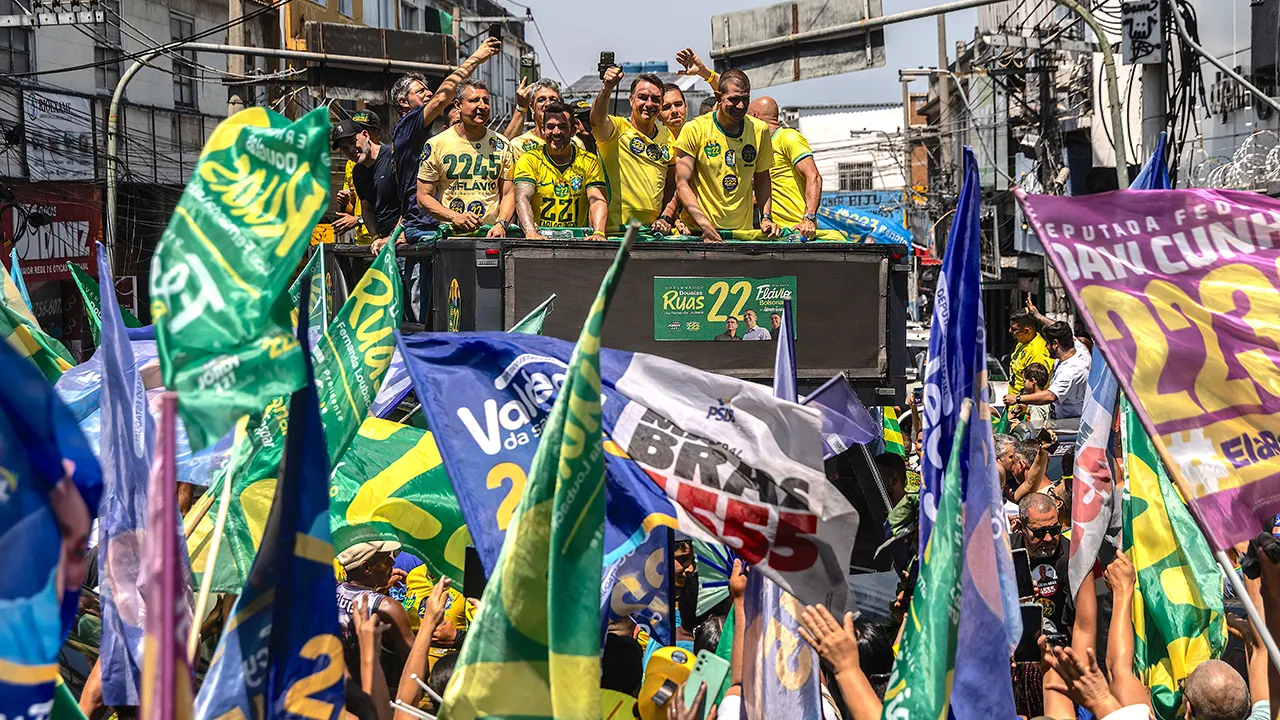
Some elections are just elections. This one feels like a continental hinge. When Brazilians go to the polls on Sunday, they aren’t merely choosing a president; they are deciding whether the largest country in Latin America finally joins the conservative wave that has been rolling across the region. From Colombia to Peru to Chile, voters have pushed back against left-wing rule, and now all eyes are on Brazil, the biggest prize of all. The man in the center of the storm is Luiz Inácio Lula da Silva, the 80-year-old left-wing president known simply as Lula. He is no stranger to drama: a former union leader who rose to become president, then went to prison for corruption in a sprawling payback bribery scandal, then returned to power. His political obituary has been written more than once, yet here he is, still standing, still fighting. His challenger is Flavio Bolsonaro, a Brazilian senator and the son of former president Jair Bolsonaro, carrying a surname that has become a movement in itself. The polls show Lula barely ahead, but barely is not the same as safely. Neither candidate is expected to win outright in the first round, and the race is tight enough that every percentage point feels like a small earthquake. For Brazilians, this is not just a vote for a person; it’s a vote about the country’s soul. For the United States and the rest of the hemisphere, it’s a test of whether the region’s rightward shift is a passing gust or a permanent wind. And for Lula, it is the latest chapter in a political life that has already outlived every prediction. He has been called a miracle and a cautionary tale, often in the same breath. But the one thing nobody has ever called him is boring. This election, like the man at its center, is anything but. It is messy, emotional, and deeply personal, the kind of contest that turns neighbors into strangers and dinner tables into battlegrounds. That is what makes it so compelling, and so hard to predict.
Let’s talk about the numbers, because in Brazil, numbers are a weather forecast, not a verdict. The latest Datafolha poll, the country’s largest polling institute, puts Lula at 42 percent and Flavio Bolsonaro at 38 percent, with a two-point margin of error. That is uncomfortably close. If the race goes to a runoff, the same poll gives Lula a three-point edge. But here is the catch: Brazilian polls have a history of missing the real energy on the ground, especially when a candidate is running against Lula or his Workers’ Party. Roberto Reis, an electoral strategist who works with candidates across multiple tiers, points out that Datafolha has consistently underestimated the strength of anti-Lula candidates for more than a decade. In the 2018 runoff, it missed Jair Bolsonaro’s actual support by seven points. That is not a small miss. That is the kind of miss that changes the way you read every subsequent survey. Reis says that when you look at aggregator data from sources like MRT News or Polling Data, the picture is even murkier: Lula leads 42 to 39 in the first round, but Bolsonaro leads 45 to 44 in a runoff. In other words, the race is a coin flip wearing a suit. The only honest thing to say is that nobody really knows how this ends. Polling in Brazil is not just a science; it’s a battlefield. Every pollster has a house style, every candidate has a base that is either shy or loud, and every election has a surprise hiding in the shadows. The 2018 miss is a reminder that the crowd in the streets often tells a truer story than the spreadsheet in the office. So when you see a poll that says Lula is ahead, take a breath. When you see one that says Bolsonaro is ahead, take another. The only certainty is uncertainty, and the only thing that matters is what happens when the votes are actually counted. In a country this polarized, the numbers can shift overnight, and the candidates know it. That is why both campaigns are spending every waking hour chasing the undecided, the skeptical, and the angry.
Beyond the horse race, this election is about something bigger than left versus right. Brazil is the last major stumbling block in the Western Hemisphere that has not yet shifted to the conservative column. There are other left-wing governments in the hemisphere, from Cuba and Jamaica to Mexico, Nicaragua, and Uruguay, but Brazil is the heavyweight. It is the 11th largest economy in the world according to the IMF and the 10th according to the World Bank. It has more people than any other country in South America, more land, more resources, more ambition. If the conservative wave that has swept Colombia, Peru, and Chile can also wash over Brazil, then the political map of the Americas will look radically different. If it cannot, then the left will still have a giant beachhead. That is why analysts are not treating this as just another election. It is a strategic inflection point. For the United States, Brazil matters in ways that go far beyond soccer and samba. It is a source of critical minerals, a major agricultural supplier, and a key player on everything from trade to security to climate. The next Brazilian president will help determine whether the United States can reduce its dependence on China, whether organized crime in Latin America is treated as a terrorist threat, and whether the hemisphere moves toward greater economic integration or deeper fragmentation. The candidates understand this. Their campaigns have become a kind of shadow foreign policy. Lula’s vision is rooted in the old politics of non-alignment and South-South solidarity, with a pragmatic wink toward Beijing. Bolsonaro’s vision is rooted in a much closer embrace of Washington, modeled on the relationship his father had with Donald Trump. The choice is not just between two men. It is between two maps of the world. And the map that wins will shape the lives of hundreds of millions of people, not just in Brazil but across the entire region. It will also determine whether the United States can finally build the kind of hemispheric alliance that has been talked about for decades but never fully realized.
Bolsonaro has spent much of the campaign wrapping himself in the American flag. He met President Donald Trump at the White House in May, and the two talked about organized crime, tariffs, and Brazil’s rare earth and critical mineral reserves. Those are not abstract topics. Rare earths are the quiet engines of modern technology, and Brazil has enough of them to significantly lower American and European dependence on Russia and China. Bolsonaro also asked Washington to designate Brazil’s two largest criminal organizations, the First Capital Command and Red Command, as terrorist groups. The State Department accepted both designations in May, and they took effect in June. That was a major victory for Bolsonaro’s campaign, and a major irritant for Lula, who saw it as direct meddling in Brazil’s domestic affairs. In Lula’s eyes, the Trump administration was handing Bolsonaro a political gift, a rubber stamp that said the United States trusted the Bolsonaro family more than the current left-wing government to fight organized crime. It is hard to overstate how much this angered Lula and his allies. It turned a foreign policy decision into a campaign ad. Bolsonaro has also proposed a free-trade agreement between Brazil and the United States, with the possibility of expanding it into a broader free-trade arrangement across the Americas. That would be a dramatic shift from Lula’s approach, which has been more cautious, more independent, and often more confrontational toward Washington. A Bolsonaro presidency would likely mean closer U.S.-Brazil security cooperation, greater alignment with Israel, and a more aggressive posture toward China’s influence in Brazil. But whether any of that can actually be delivered is another question. Brazil’s Congress is a maze of competing interests, its bureaucracy is famously powerful, and its economic heavyweights, especially agribusiness and mining, have their own agendas. Campaign promises are one thing. Governing is another. Still, the direction of travel would be unmistakable: a Brazil that wants to be America’s partner, not its adversary. For voters who feel left behind by globalization, that message has real appeal. For voters who fear American dominance, it is a warning.
Lula’s foreign policy is a different animal. China is Brazil’s largest trading partner, and Brazilian agricultural exports to China totaled more than $55 billion in 2025, according to Reuters. Lula has defended maintaining strong relations with Beijing while pursuing what he calls an independent foreign policy. In practice, that independence has often bordered on aggressiveness toward the United States and its closest allies, including Israel. Lula’s relationship with Trump has been complicated, to put it mildly. Washington imposed new 25 percent tariffs on a wide range of Brazilian goods in July, affecting about $7 billion in exports. Lula’s government challenged the measures and sought negotiations, but with very limited success. Washington also imposed a ban on most new permanent visa requests from Brazil, a move that could affect green cards and send a chill through Brazilian families dreaming of a new life in America. For Lula, these are not just trade disputes; they are proof that the United States cannot be trusted to act in Brazil’s interest. For Bolsonaro, they are proof that Lula’s approach has failed. The contrast could not be clearer. A Bolsonaro victory would signal a realignment of Brazil’s foreign policy toward Washington, with all the economic and security cooperation that implies. A Lula victory would mean continuity: strong commercial ties with China, strategic autonomy from Washington, and a continued stance on Israel and Gaza that directly defies Trump’s policies. That could damage U.S.-Brazilian relations even further, especially if Trump remains in the White House. But Lula’s position is not simply ideological. It is also economic. Brazil sells a lot to China, and that money pays for a lot of things. No Brazilian president, no matter how pro-American, can simply turn off the tap. The question is whether Bolsonaro can find a way to balance Brazil’s economic reality with his political ambitions, or whether Lula can manage to keep Brazil’s independence without turning it into isolation. Either way, the next president will have to navigate a world where the United States and China are locked in a global struggle, and Brazil is too big to be ignored. The choices made in Brasília will echo far beyond Brazil’s borders.
With the presidential race effectively heading toward a second round, the stakes for the United States are enormous. This is not just a Brazilian affair. It is a test of whether the “wave of freedom” that has swept Latin America can reach the region’s most powerful nation. It is a test of whether the United States can build a new version of the Americas, one where partners like Brazil help counter Chinese influence and secure critical supply chains. It is also a test of whether the left, which has lost ground across the continent, can hold on to its biggest prize. The outcome will hinge on a few million votes, on the mood of a country that is deeply polarized, on the mistakes and triumphs of two very different campaigns. There will be runoff rhetoric, accusations, and probably a few surprises. But underneath all the noise, the question is simple: What kind of Brazil will emerge? A Brazil that looks to Washington and its neighbors as partners, or a Brazil that keeps its distance and plays its own game? The answer will not be known until the votes are counted, and even then, the full consequences will take years to unfold. But one thing is certain: the world will be watching. Brazil has always been a country of grand gestures, dramatic reversals, and larger-than-life characters. This election has all of that in abundance. Lula, the old lion who refuses to fade away. Bolsonaro, the heir to a political dynasty that has remade Brazil’s right. And between them, a nation of more than 200 million people trying to figure out what it wants to be. Whatever happens Sunday, the runoff will be a referendum on the future of the Americas. And the result, as always in Brazil, will be anything but boring. It will be loud, contested, and full of passion, because that is how Brazil does everything. The only question is which side gets to write the next chapter. For now, the world waits, the candidates sweat, and Brazil holds its breath.