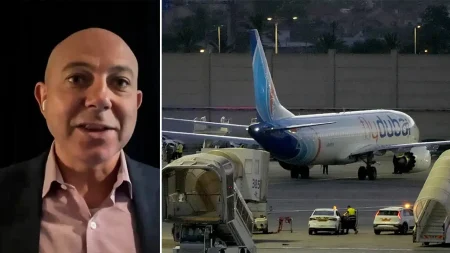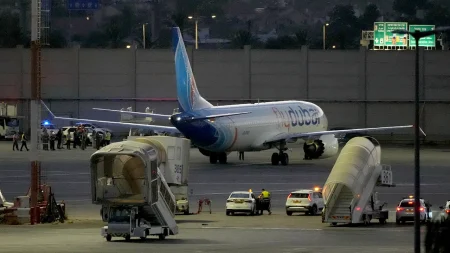






On a clear Wednesday morning, the familiar hum of a Boeing aircraft filled the cabin as FlyDubai Flight FZ1073 made its way from Dubai to Tel Aviv. For the 174 passengers aboard, it was an ordinary journey—perhaps a business trip, a long-awaited family visit, or a dream vacation to Israel. But somewhere high above the Arabian Peninsula, ordinary turned to nightmare in an instant. Inside the cockpit, a violent struggle erupted. The copilot had allegedly attacked the Indian captain, Smit Machchhar, stabbing him in the confined space where two men were meant to work calmly side by side. Blood filled the cockpit as the aircraft continued through the sky, carrying hundreds of lives in its pressurized hull. What happened next would be described by world leaders as a miracle and a lesson in extraordinary courage. Despite his wounds, Captain Machchhar refused to surrender control. He fought back. He managed to keep the plane steady enough to divert from its path and make an emergency landing in Tabuk, Saudi Arabia, touching down safely and sparing everyone aboard from a catastrophe that could have mirrored the darkest days of modern aviation. It was not until after the plane was on the ground and the attacker was subdued that the world would fully understand what this one man had done.
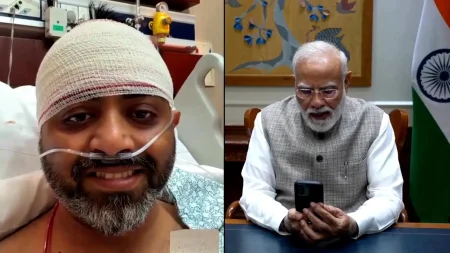
News of the attack and the captain’s bravery spread quickly, reaching the highest offices in India and beyond. Prime Minister Narendra Modi, speaking with visible emotion, said that Captain Machchhar had “shown the world the highest form of courage.” In a statement that resonated across borders, Modi praised the pilot for acting “without fearing for his own life,” describing how he had “fought valiantly and prevented another 9/11-like attack from happening.” The prime minister’s words were not hyperbole. Had the plane continued on its course without an able pilot in command, the outcome could have been unthinkable. The Indian Embassy in Saudi Arabia confirmed that the pilot was in stable condition at a hospital, where he was being treated for severe injuries. The Israel Foreign Ministry also released a statement that captured the harrowing sequence of events: Captain Machchhar, despite being severely injured, managed to unlock the cockpit door, allowing Israeli passengers and the Emirati crew to rush in and intervene. In that single act, he did not just save the plane from crashing; he opened the door to salvation. He turned his own vulnerability into a lifeline for 173 other souls, proving that heroism is not the absence of fear, but the will to act when fear is pressing in from every side.
The political response was swift and pointed. Israeli Ambassador to the United Nations Danny Danon appeared on Fox News’ “The Ingraham Angle” and said there was “no doubt” that the attack was an attempted act of terror. “We have no doubt that it was a terror attack of a radical individual,” he said. “We know that there was an intention to bring that plane down, and we are grateful.” President Donald Trump, speaking after conversations with Israeli Prime Minister Benjamin Netanyahu, characterized the alleged attacker in raw terms, suggesting the copilot may have been “a terrorist or perhaps a whack job.” Netanyahu, for his part, praised the heroic bystanders who rushed to help subdue the attacker, acknowledging that ordinary civilians were forced into extraordinary roles in the cramped confines of an airplane. The State Department also confirmed that at least four Americans were among the passengers, adding a distinctly American connection to the multinational ordeal. But beyond the political statements and diplomatic cable traffic, something more profound was unfolding in the story. Passengers of different nationalities, backgrounds, and faiths had found themselves united in a single desperate struggle to stay alive. In the chaos, there were no borders, no flags, no disagreements—only the shared, primal need to survive and the instinct to protect one another from a man intent on destruction.
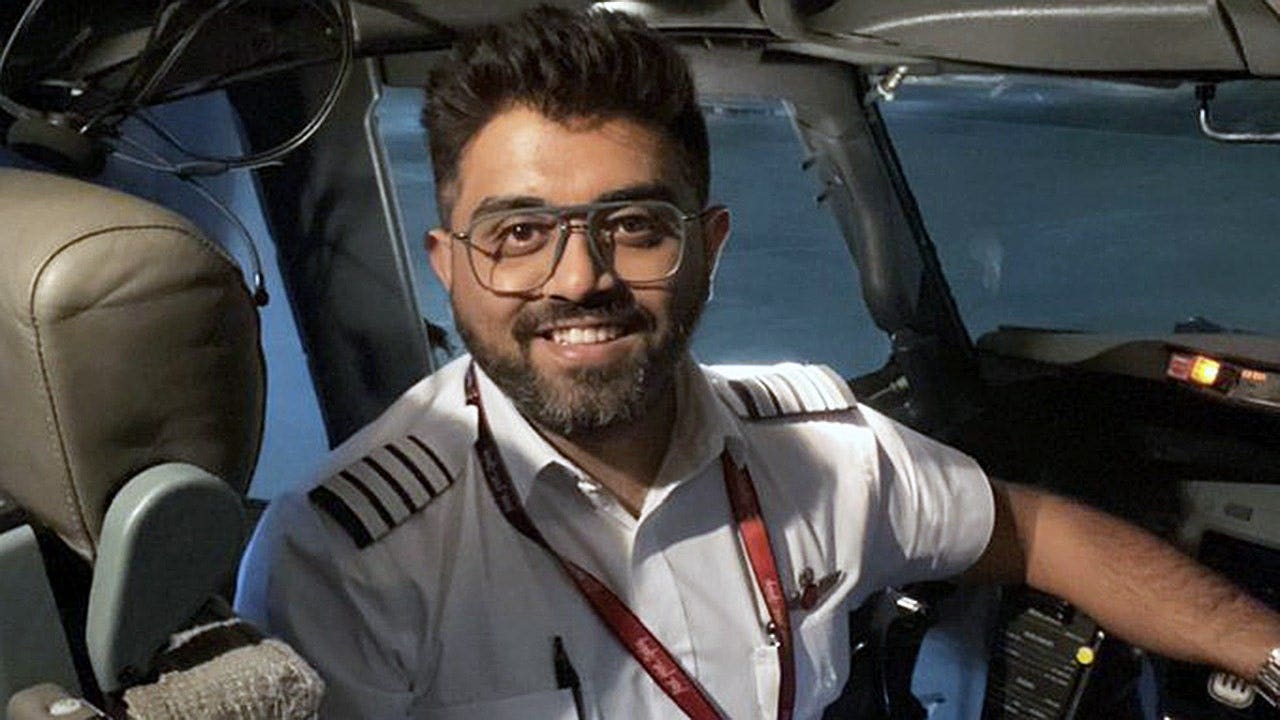
Who is Captain Smit Machchhar? The answer reveals a man who had spent his entire professional life preparing invisible moments of crisis. Born and raised in Mumbai, Machchhar did not stumble into the cockpit by accident. He trained for 18 months at Mainland Air in Dunedin, New Zealand, beginning in 2008, where flight school head Philip Kean remembered him as a dedicated student learning the craft of aviation. For 11 years, he served with SpiceJet, an Indian low-cost carrier, where he rose to the position of senior commander and line training captain. His profile lists more than 9,750 flying hours with SpiceJet alone—a staggering number that represents decades of takeoffs, landings, weather patterns, checklists, and calm decisions made far above the earth. He later joined FlyDubai, where he had worked for about four years at the time of the attack. SpiceJet took to social media to praise the pilot’s “heroic courage” and “selfless actions,” writing, “You are a hero to us all, Captain.” But behind the glowing profiles and official praise is a human story. Machchhar is a married father of two, a man with a family who very nearly lost him in a moment of senseless violence. His children will grow up knowing that their father, a quiet professional who spent his working hours navigating the skies, once stood between a plane full of strangers and catastrophe—and chose to fight.
The account of what happened inside the aircraft has emerged piece by piece, and it is a story of terrifying intimacy. Shota Musayev, a dentist and eyewitness, spoke to The Associated Press about the scene after Captain Machchhar managed to open the cockpit door. The wounded pilot was praying, Musayev said, still in contact with him as passengers and crew moved to subdue the assailant. Musayev, whose medical training made him a natural first responder, immediately began treating the captain. “Poor pilot, he was just praying the whole time and was in contact with me, and I was afraid we would really lose him,” Musayev recalled. In that moment, the cabin became a microcosm of human resilience. A pilot fought for his life while still carrying the responsibility for everyone on board. A dentist turned trauma medic. Israeli passengers and Emirati crew members worked side by side, their collaboration a testament to the bonds that can form in the face of shared danger. The alleged attacker was eventually restrained, but the plane still had to land. Captain Machchhar, with his wounds bleeding and his body trembling from adrenaline, guided the aircraft down to safety in Saudi Arabia. Only then could the evacuation begin. To get the remaining passengers to their intended destination of Tel Aviv, FlyDubai dispatched another aircraft, completing a journey that had very nearly ended in tragedy.
Ultimately, this is a story about choices. The copilot had a choice, and he chose violence. But Captain Smit Machchhar also had a choice—and he chose courage. He chose to keep fighting even after he was stabbed, to trust passengers and crew with his own safety, and to bring the plane down gently, carefully, as if all those years of experience had led to this single, terrible moment. His actions have inspired tributes from prime ministers, ambassadors, presidents, and ordinary people around the world. But perhaps the most powerful words came from the dentist who held him as he prayed: a simple, terrified acknowledgment that they were almost losing him. In the end, they did not lose him. The pilot survived, the passengers survived, and the world was reminded that heroes are not fantasy characters. They are real people with real fears, real families, and real wounds. They are men like Machchhar, who woke up on an ordinary Wednesday morning and found themselves thrust into history. The Indian prime minister said the pilot has “shown the world the highest form of courage,” and in many ways, that courage is not just about fighting an attacker. It is about enduring pain for the sake of others, remaining calm when everything inside you is screaming, and opening the door to rescue even when your own body is failing. As Captain Machchhar recovers in a hospital bed, surrounded by prayers and gratitude, his story will remain a reminder that amid the chaos of the world, there are still those who rise above it. He may have been the captain of that flight, but now, in the hearts of all who hear his story, he is something more: a guardian, a hero, and a human being whose bravery gave 174 people another day to live.