






Paragraph 1
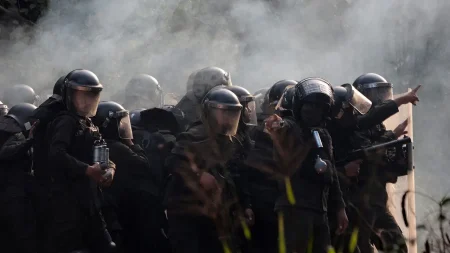
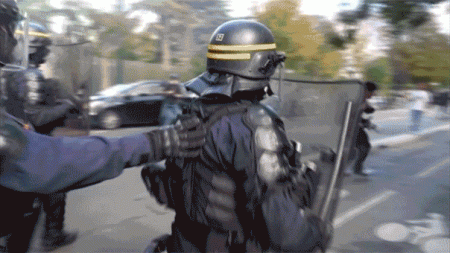
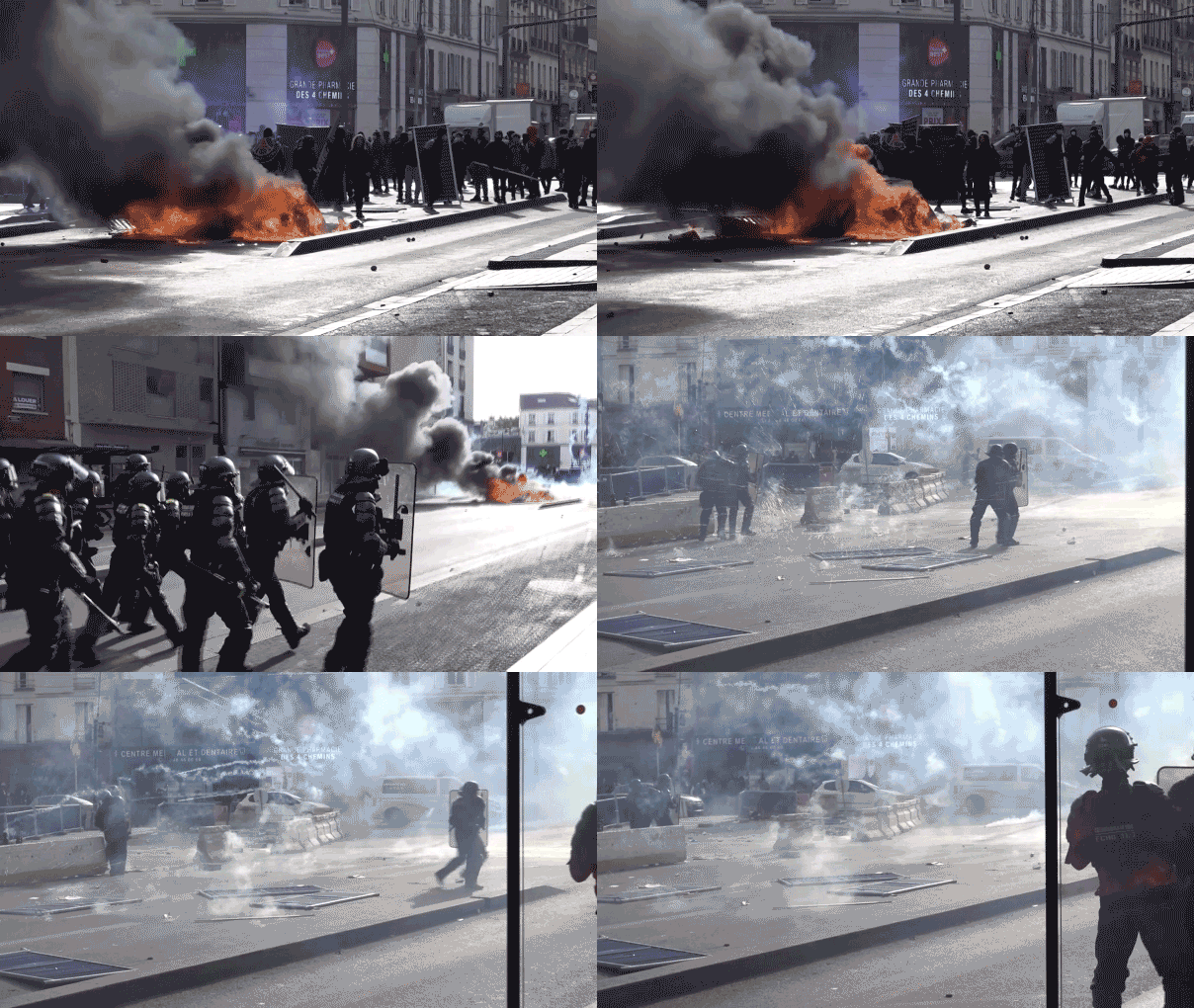
Friday in France was a scene of raw, disorienting chaos. Tear gas swirled through the streets of Strasbourg, turning familiar boulevards into war zones where teenagers crouched behind barriers, their faces half-hidden by scarves and jackets. In Marseille, protesters launched fireworks toward police lines, the brilliant flashes and loud bangs echoing off apartment buildings as residents pulled their curtains shut. In Rennes, trash bins were dragged into the middle of intersections and set ablaze, sending black smoke spiraling above a city already tense from days of unrest. Even Paris, a city no stranger to protest, was shaken by fresh clashes between young demonstrators and riot police. By the end of the day, roughly 400 high schools across the country were shuttered, their gates locked, their hallways empty, and their classrooms transformed into hasty shelters for staff who feared the violence outside. The French government confirmed that approximately 2,000 people had been arrested since the protests began, most of them teenagers—boys and girls still young enough to complain about homework, yet old enough to be handcuffed and taken to police stations. What began as a familiar French tradition, the student walkout over unfair conditions, had twisted into something far more dangerous. Parents spent the day glued to their phones, waiting for messages from their children; teachers stood in front of windows, watching flames and smoke rise from neighborhoods where they had once taught lessons about liberty, equality, and fraternity. The atmosphere was one of bewilderment and fear, a national classroom suddenly transformed into a battleground.
Paragraph 2
The violence on Friday marked a sharp escalation from the unrest that had already made headlines a day earlier. What started as scattered blockades and a few hundred arrests had grown into a coordinated wave of destruction and confrontation. Justice Minister Gérald Darmanin, speaking to RTL radio, said that roughly 2,000 people—many of them students, some as young as fifteen or sixteen—had been detained since the protests first erupted. He added that parents whose children damaged property should be held financially responsible, a statement that struck a chord with exasperated taxpayers but also raised questions about how far discipline should go. The human toll was staggering. Education Minister Édouard Geffray told BFM TV that at least 65 school staff members, including 40 principals, had been injured, along with about 170 students. More than 100 high schools had suffered what he described as “severe damage”—broken windows, torched cars, damaged classrooms, and wrecked administrative offices. Simone Rodan-Benzaquen, a senior envoy to Europe at the Foundation for Defense of Democracies, pointed out that the movement had crossed a moral line. “Dousing a principal in gasoline and attacking firefighters are acts of extreme violence,” she said. These were not the impulsive acts of a schoolyard scuffle; they were intentional, brutal, and deeply alarming to a nation that prides itself on rational debate. The sight of firefighters, who had come to extinguish flames, being pelted with rocks and bottles shocked even hardened observers. Parents of schoolchildren, already anxious about their kids’ safety, now had to wonder whether their own children were safe inside the very institutions meant to shelter them.
Paragraph 3
To understand how a protest about classroom conditions turned so ugly, it is necessary to look at the frustrations that ignited it. Students across France had genuine grievances. They complained about overcrowded classrooms, where too many children competed for too few desks and too little attention. They spoke of teacher shortages, subjects left untaught, and lessons canceled at the last minute because no replacement could be found. Long school days—often from early morning until late afternoon, with a lunch break that stretched painfully—left students exhausted and anxious. Facilities were deteriorating: leaky roofs, broken heating systems, outdated equipment, and cramped corridors that felt more like prison passageways than places of learning. For years, students said, governments had promised to fix these problems, but little had changed. When the government unveiled its draft 2027 budget on Thursday, the disappointment sharpened. Education spending was set to rise by only 1.7 percent to 65.53 billion euros, excluding teacher pensions—a figure that, in real terms, was actually a cut when inflation was taken into account. To many students, this was proof that their concerns were being ignored, that their futures were being sacrificed to balance sheets. Their initial protests were therefore emotional and, in many ways, deeply justified. A student in Lyon told reporters that she had not come to fight or break windows; she simply wanted to go to class. She wanted a teacher who knew her name, a classroom that had enough chairs, and an education system that did not treat its students as burdens. Those words, quiet and sincere, were drowned out by the smoke and sirens, but they remained the true heart of the movement.
Paragraph 4
The unrest, however, soon became far more than a school crisis; it became a political battleground. French intelligence agencies told a government crisis meeting on Thursday that the protest movement had been initiated by politicians from the hard-left France Unbowed party, known by its acronym LFI. Government officials, including Education Minister Geffray, accused LFI of fueling the initial demonstrations before claiming that the movement had been “taken hostage by ultra-left groups.” LFI lawmakers rejected the allegations outright, accusing President Emmanuel Macron’s government of using the crisis to smear its opponents ahead of the 2027 presidential election. Jean-Luc Mélenchon, the fiery leader of LFI, denied any responsibility for the violence, but he did not hide his support for the mobilizations, denouncing the government’s response as repressive. Rodan-Benzaquen noted that LFI had “actively supported the mobilization,” with activists circulating footage of clashes, party accounts amplifying the images, and elected officials presenting themselves as defenders of the students. Marine Le Pen, leader of the far-right National Rally, also accused LFI of playing a direct role, writing on X: “This is no longer about high school student protests. It is about riots organized by professionals and overseen by deputies from La France Insoumise.” She called for a new anti-rioters law that would make participation in a riot a clearly identified offense. With an election on the horizon, the country was already being divided into camps: those who blamed the students, those who blamed the government, and those who blamed the politicians hiding behind the students. The real victims—the kids who just wanted to learn—were caught in the middle, their voices swallowed by the slogans of adults with their own agendas.
Paragraph 5
For all the political blame, the human cost of the crisis was impossible to ignore. The government had deployed specialized riot police and mobile gendarmes in an effort to regain control of streets that had grown anarchic. But the heavy-handed response drew its own criticism. Students and human rights groups accused police of using excessive force against minors, pointing to baton strikes, tear gas canisters fired into crowds, and reports of non-lethal weapons that still caused serious injuries. Amnesty International warned against excessive force, and by Friday, France’s Interior Ministry confirmed that three separate investigations into alleged police violence had been opened. The image of a teenager, bleeding from a head wound, being led away by an officer—or of a young girl coughing and crying after inhaling tear gas—was heartbreaking to many. Education Minister Geffray reminded the nation: “In the streets, the children are in danger.” But whose danger? The danger of being crushed by a mob, or the danger of being beaten by those sent to protect them? Parents found themselves in an impossible position. They wanted their children to receive an education, but they also feared sending them to schools that had become targets. Some chose to keep their kids home; others went to the barricades themselves, trying to pull their children away from the violence. Teachers, too, were caught between their duty and their safety. One principal in a troubled suburb described spending an afternoon barricaded in her office while students screamed in the courtyard and masked figures threw projectiles at the windows. She did not know whether she was protecting herself from her own students or from outsiders who had invaded her school. The line between protest and crime had become disturbingly blurred.
Paragraph 6
The events in France did not stay within its borders. In Liège, Belgium, students began demonstrating on Thursday in solidarity, and high schools there were closed on Friday. The unrest seemed to be spreading, fueled by social media footage that made French teenagers look like soldiers in a noble uprising or pawns in a dangerous game, depending on who was watching. The situation was, as Rodan-Benzaquen put it, “a very dangerous situation for France.” The country was already facing deep political, geopolitical, and economic challenges, and now its classrooms were on fire. The question everyone was asking—parents, teachers, politicians, and citizens—was how to bring peace back to the streets without crushing the legitimate aspirations of youth. The students’ grievances were real, and no amount of arrests could solve them. But the violence, the arson, the assault on teachers, and the deliberate sabotage of public property were not the language of legitimate protest; they were the language of chaos. Some wanted to blame Mélenchon, others blamed Macron, and still others blamed the deep inequalities of a society that had let its schools rot. In the end, the greatest tragedy was that the children, the very reason for the protests, were being lost in the noise. A young girl in Paris, interviewed through tears, said she had only wanted better access to teachers and smaller classes. She had not wanted to see her city burn. She had not wanted to be arrested. She had not wanted to be a symbol in someone else’s political fight. As France prepared for an election, for a budget debate, and for the long process of repair, the hope was that leaders would remember that behind the smoke and the slogans were real children with real futures, and that a nation that cannot protect its schools cannot truly call itself the land of progress.