




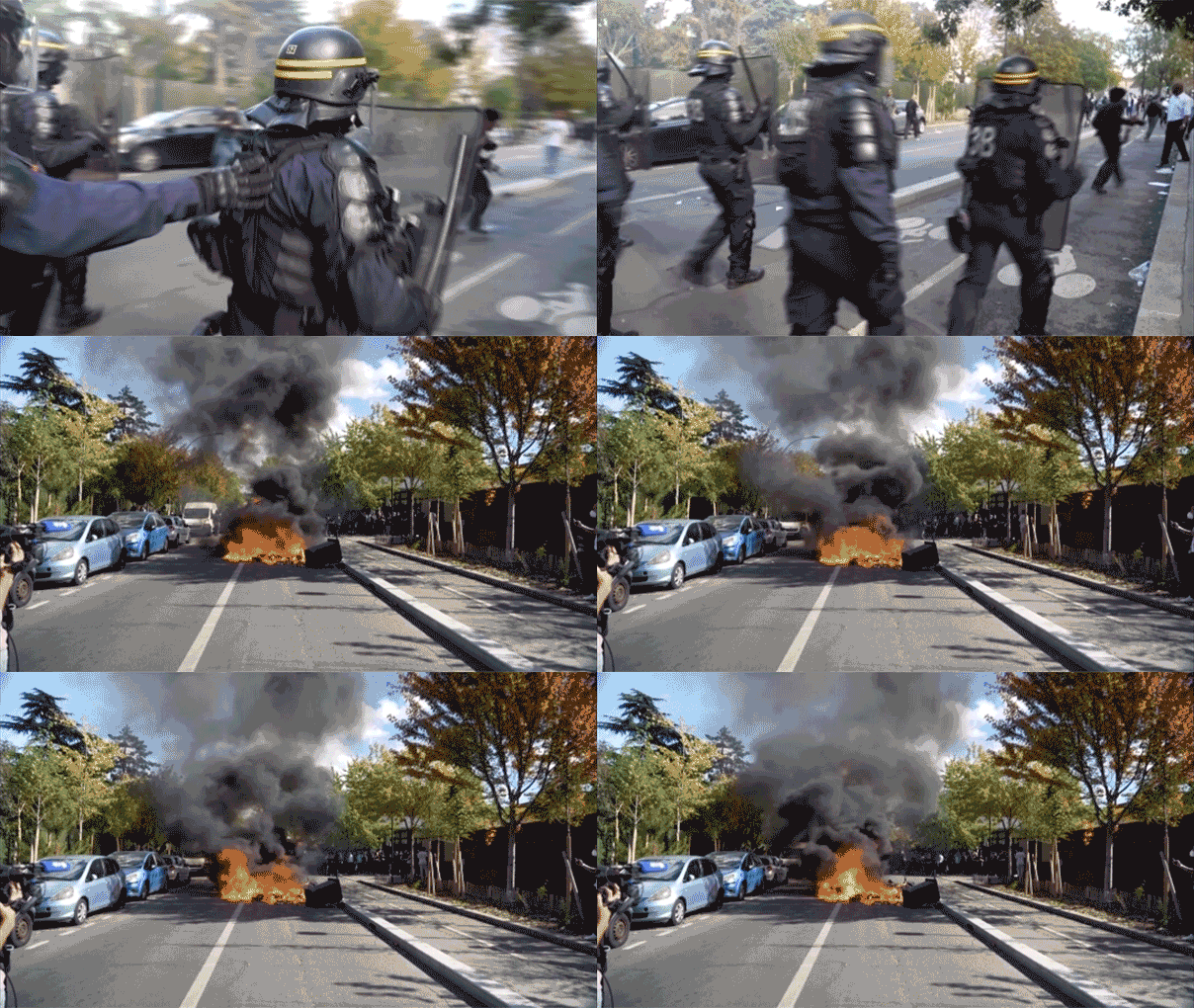
Morning in France used to mean the sound of classroom doors opening, backpacks thudding onto the floor, and teachers calling the roll. These days, across too many towns and cities, it means sirens, shouting, and smoke from overturned trash cans. The country’s schools have become the strange, violent centers of a national crisis, and the people paying the highest price are often the same students who asked for nothing more than a decent education. Over two days, authorities arrested more than 625 people, most of them students, as protests swept through neighborhoods around schools and universities. What began last week as a restless rumble in the Paris region grew into an avalanche, touching more than 350 high schools and roughly 30 university campuses on Thursday alone. The students’ complaints are the kind that have been simmering for years: not enough teachers, too many students squeezed into too few classes, buildings that are crumbling, schedules that stretch their patience, and budgets that keep shrinking just when schools need more support. Anyone who has stood in an overcrowded classroom or watched a favorite teacher leave without a replacement knows how these frustrations brew. The anger is not abstract. It is in the cracked plaster, the broken radiator, the permanent substitute shortage, the exhaustion of teenagers who spend more time on buses than at desks. But the protests quickly left the classroom behind. Reports say 83 police officers and gendarmes were injured on Thursday, and 119 students and school staffers have been hurt since last week. In Marseille, the principal of the Lycée Victor Hugo was doused with gasoline and attacked. In Rouen and Petit-Quevilly, two other principals were assaulted. Police answered with tear gas; students answered with accusations of heavy-handed tactics. With authorities warning about urban violence and attempted arson, the mood has shifted from demonstration to eruption. It is no longer simply a student movement; it is a test of France’s capacity to hold itself together while a generation looks on, frightened and unmoored.
The government is scrambling to respond to a crisis it did not see coming, or at least did not see arriving this fast. Prime Minister Sébastien Lecornu convened a crisis meeting and canceled ministers’ travel plans, pulling his government back to Paris to focus entirely on the fires sweeping through the educational system. The sense of panic is real: no minister wants to be abroad when a school burns. Interior Minister Laurent Nunez tried to frame the violence as the work of outsiders, telling Reuters that there were “individuals acting as agitators” in certain places, people who moved from school to school to incite students and turn their genuine frustration into acts of violence. Education Minister Edouard Geffray, for his part, urged schools to hold classes remotely if protesters were blocking the gates, and he posted a blunt warning on X: “Violence will not keep our students from their fundamental right to an education.” The words sound reasonable, but they miss the reality on the ground. Students watching the smoke rise from their own school gates are not thinking about their right to an education; they are thinking about whether they will be caught in the next wave of tear gas. Teachers, caught between sympathy for the young people and fear for their own safety, are quietly wondering how to keep a classroom running when the hallway outside feels like a riot zone. The government’s response has been a mix of pressure and patience, but the pressure has been visible: police in several cities used tear gas to disperse crowds, and the injured list keeps growing. The vision of a principal soaked in gasoline has rattled the nation, and the phrase “urban violence” is now being thrown around by officials who sound less like educators and more like generals preparing for a siege. What began as a cry for help has become a confrontation with the state, and the state is still unsure how to answer without either rewarding violence or crushing the legitimate grievances underneath it.
The timing of the protests is no coincidence, and everyone in France knows it. Two weeks before the first barricades went up, the government announced a series of unpopular spending cuts in its 2027 budget. To students who were already living with overcrowded classrooms and teacher shortages, the budget news felt like another slap: the institutions that were supposed to prepare them for the future were being squeezed again, and no one seemed willing to pay for the things that made a school feel like a school. Education is often described as an investment, but in France it has come to look more like a target. The protests have therefore become an immediate political flashpoint, especially with a presidential election scheduled for next May. It is impossible to separate the images of teenagers fleeing tear gas from the speeches of presidential hopefuls, who have quickly realized that this is a moment that could define a campaign. Simone Rodan-Benzaquen, senior envoy to Europe at the Foundation for Defense of Democracies, told Fox News Digital that the students’ grievances were genuine at the beginning. “The students’ grievances about missing teachers and deteriorating schools were real at first,” she said. But she warned that the violence has transformed the movement. Dousing a principal in gasoline and attacking firefighters, she said, are acts of extreme violence, not tools of negotiation. The truly dangerous part, she argued, is the effort to turn frustration over schools into a much broader confrontation with the government. That is a tempting strategy for the political class, but it is a terrible one for the students. They asked for help and were offered a battlefield.
The political battle lines are now being drawn in chalk and fire. Far-left presidential hopeful Jean-Luc Mélenchon has loudly denounced the government’s response as repressive, presenting himself as the defender of France’s angry youth. His party, La France Insoumise, or LFI, has moved quickly to champion the protests, but critics see a cynical calculation behind the solidarity. They accuse LFI of using the unrest to score points in the presidential campaign and of inciting violence by amplifying the most explosive footage. Rodan-Benzaquen says the party has “actively supported the mobilization,” with activists circulating videos of clashes, party accounts boosting the images, and elected officials posing as the defenders of the student cause. The visuals are troubling. Video posted to social media shows Bally Bagayoko, the LFI-affiliated mayor of Seine-Saint Denis, joining students with a smile and high-fiving pupils right after a trash can was set on fire in the street. Whether the mayor intended the gesture as harmless encouragement or something darker, it sent a message that the party was comfortable standing beside flames. The president of the Île-de-France region went even further, telling Radio Monte Carlo that LFI was issuing a call to action with the phrase “Trash your high school,” spread through TikTok challenges designed to provoke students into destruction. If that is true, it is a dangerous game. Encouraging teenagers to vandalize their own schools might win votes in the short term, but it leaves the schools worse off than they were before, which was the original complaint. The students are caught in the middle: their real pain is being used as fuel for a political machine that will not be there when the smoke has cleared.
The deeper danger is that the school protests have stopped being about schools, and that is precisely the point. Rodan-Benzaquen noted that Mélenchon sees these mobilizations as a way to consolidate young voters and marginalize the moderate left. At a time of deep political, geopolitical and economic challenges, she said, this is a very dangerous situation for France. Her words may sound like the caution of an outside observer, but they capture what many ordinary French citizens are beginning to feel. The country is already navigating an uncertain economy, global tensions, and a sense that the old political order no longer works. Adding a generation of angry, radicalized students to that mix could reshape the political map in unexpected ways. It could push voters further to the extremes, making compromise even harder and governance even more fragile. For the students themselves, the cost is enormous. A teenager who joins a protest to demand a better school is not necessarily asking to become a soldier in someone else’s war. But once the fires start, it is hard to return to a calm conversation. The legitimate pleas of students who simply want a decent learning environment are being drowned out by the noise of agitators and the blare of political campaigns. Parents are left to wonder whether their children will come home with bruises or arrests on their records. Teachers are left to clean up the damage in buildings that were already broken. And the nation is left with a strange, sad paradox: a movement that began as a demand to be heard has become so loud that almost no one is listening anymore.
President Emmanuel Macron, speaking in Madrid on Wednesday, tried to restore some clarity. “High schools are meant to be open and to share knowledge,” he said. “They are not meant to be blockaded or to have trash cans set on fire.” The statement is simple, and most people would agree with it. But simple statements are not enough when the streets are on fire. Education Minister Geffray’s decision to allow remote learning for schools that are blocked may protect some students, but it also signals that the government cannot guarantee the physical safety of its own school system. There is an unavoidable tragedy in that. A school is supposed to be the place where a society passes its knowledge and values to the next generation. When a school becomes a fortress, when a principal is attacked with gasoline, when students and police face each other across burning trash cans, everyone loses. The protesters wanted attention, and they got it. But the attention has turned to the violence, not the crumbling buildings or the missing teachers. If France is to find a way forward, it will have to separate the genuine grievances from the chaos and the political maneuvering. It will have to repair the schools, staff the classrooms, and shorten the schedules that leave students exhausted. It will also have to confront the opportunists who see a burning high school not as a tragedy but as a photo opportunity. The young people at the heart of this storm deserve better than tear gas and TikTok dares. They deserve to be heard, but they also deserve to be protected from the forces that would use them. Whether France can meet that challenge will determine not only the future of its school year, but the future of its Republic.