





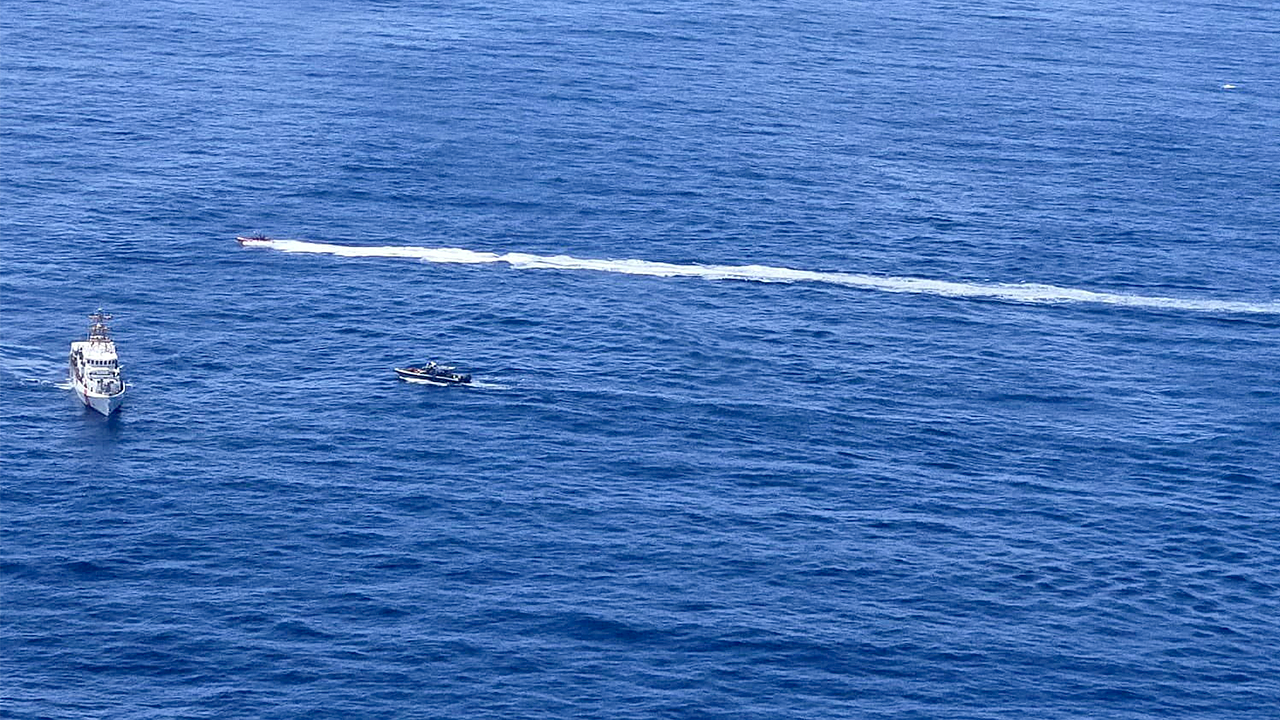
There is a certain kind of silence that follows a disaster at sea, but the waters off Mona Island on Monday were not silent. They were filled with the sounds of desperate voices, splashing hands, and the low hum of a boat engine approaching like a miracle. For more than twelve hours, people had been clinging to life in the open Caribbean, their bodies exhausted, their hope nearly gone. They had set out on a makeshift vessel, crowded with an estimated sixty souls, all of them fleeing something terrible back home. But their journey had turned into a nightmare before the sun even rose. A fight had broken out aboard the fragile craft late Sunday night, and in the chaos, someone wielded a machete, leaving several people severely injured. The violence caused the boat to capsize, throwing everyone into deep water. There were no life vests, no rescue beacons, no way to call for help—just the dark, indifferent sea and the will to survive. By the time a passing boat spotted the survivors around noon on Monday, some had been treading water for more than half a day. That passerby alerted authorities and immediately pulled four people from the water, becoming the first face of hope they had seen since the disaster began. The U.S. Coast Guard arrived soon after, and over the course of Monday, they rescued at least forty people. Tragically, two did not make it, their bodies recovered from the unforgiving water. The search continued into the evening, with Coast Guard crews scanning the horizon for anyone else who might still be out there, because the sea does not always give back what it takes.
The story of how this vessel met its end is as troubling as the rescue itself. According to survivors who were brought ashore, the boat capsized after an argument escalated into a violent confrontation. In the confined, desperate space of a smuggling boat packed with far more people than it was ever designed to carry, tensions can boil over quickly. A machete appeared, and screams turned into panic, and panic turned into a tragedy that sent dozens of people into the water without a single life jacket. It is almost impossible to imagine the terror of that moment—the sudden tilt of the boat, the crush of bodies, the shock of cold saltwater, and the realization that there was nothing between you and drowning except your own exhausted arms. Some of the injured likely went into the water bleeding. Others may have gone under within minutes. Those who survived did so because they found something to hold onto, or because they were strong swimmers, or because sheer luck kept them afloat until daylight. They spent the night in complete darkness, with no idea if anyone would ever find them. When the sun finally rose over Mona Island—a tiny, uninhabited speck of land west of Puerto Rico—they could see the rocky shore in the distance, but it was miles away, unreachable. The Coast Guard said it was not immediately known where the people aboard the boat were from, but the route is a familiar one. For years, migrants have traveled from the island of Hispaniola, shared by Haiti and the Dominican Republic, through the treacherous Mona Passage, hoping to reach Puerto Rico, a U.S. territory where the promise of safety and opportunity feels closer than it ever has on their home soil. It is a passage that has become a watery graveyard for far too many.
To understand why people would take such a risk, one has to understand what they are leaving behind. The migrants who board these overloaded vessels are not casual adventurers or thrill-seekers; they are mothers, fathers, sons, and daughters who have looked at their lives and decided that death at sea is somehow preferable to the death they see coming at home. Haiti, in particular, has been collapsing under the weight of political chaos, economic despair, and a level of gang violence that has made everyday existence unbearable. The United Nations has reported that gang violence has displaced a record 1.5 million people across Haiti, and between January and June alone, more than three thousand people were killed. Armed men control an estimated seventy percent of Port-au-Prince, the capital, along with large swaths of the country’s central region and beyond. In this landscape, ordinary citizens live under the constant threat of kidnapping, rape, extortion, and murder. Schools have closed. Hospitals have closed. People are afraid to walk to the market or gather for church. For many, the choice is not whether to stay safe at home or take a dangerous journey—it is whether to stay and be killed slowly by hunger or violence, or to take a chance on the open water, where at least there is a possibility, however small, of reaching a place where the human body and spirit are treated with dignity. That is why they pack themselves into flimsy wooden boats and rickety fishing vessels, sometimes with engines that break down miles from shore, sometimes with no working navigation equipment, sometimes with so many people aboard that the sides sit dangerously low in the water. They know the risks, because they have heard the stories of those who did not make it. But the stories of those who stayed behind are just as terrifying.
The tragedy near Mona Island is only the latest chapter in a long and heartbreaking history of maritime disasters in this region. In June 2022, eleven Haitian women and girls were buried in Puerto Rico after their grossly overloaded boat capsized in open waters northwest of the U.S. territory. They had been seeking the same thing that today’s survivors were seeking: a new life, a safe haven, a chance to breathe freely. Their bodies washed ashore or were pulled from the sea, and the community that buried them could only grieve for the futures that were stolen. Just last week, police in the Turks and Caicos Islands detained a makeshift vessel carrying sixty Haitian migrants, none of whom had surrendered their right to hope just because the law might treat them as criminals. And in June, two hundred and forty Haitian migrants were detained near the same islands in a single operation, a staggering number that shows how desperate the exodus has become. The Coast Guard and other agencies have intercepted countless vessels over the years, sometimes firing warning shots, sometimes boarding boats carrying Chinese nationals, Uzbek nationals, Dominicans, Haitians, and people from many other countries, all of them converging on the same patch of blue water in search of something better. The operations are routine in a way that almost banalizes the human catastrophe—another interdiction, another group of people in handcuffs, another overcrowded boat being towed ashore. But behind every statistic is a human story: a woman who saved her children’s lives by pushing them onto floating debris, a man who watched his brother disappear beneath the waves, a teenager who learned to swim in a river before setting out to cross an ocean. The sea does not care how old you are or how much you have suffered. It takes without apology.
And yet, amid the sorrow, there is something profoundly human about the response that unfolded on Monday. The person who spotted the survivors did not look away or decide that the problem was too complicated to get involved in. They stopped. They helped. They pulled four strangers from the water, not knowing their names, not knowing where they were from, not caring about paperwork or border policies or politics. They simply saw people in trouble and acted. The U.S. Coast Guard crews who arrived on the scene then took over, working for hours in grueling conditions to bring as many people to safety as possible. The survivors themselves, who had spent more than twelve hours in the water, must have been suffering from hypothermia, exhaustion, dehydration, and trauma. Some had been injured in the machete attack before the boat even capsized. Their physical wounds will heal, but the memory of that night will stay with them forever—the sound of the boat breaking apart, the screams of those who did not come back up, the desperate prayers whispered into the darkness. They will also carry with them the complicated guilt of survival, wondering why they lived when others did not. The Coast Guard said rescue efforts were still ongoing as of Monday evening, which means that somewhere out in the choppy waters off Mona Island, there may still be someone clinging to a piece of debris, or swimming toward an island they can see but cannot reach. Every hour that passes makes the chances of finding them alive slimmer, but the search continues, because that is what it means to be rescued by a civilization that still values life above all else.
As the sun sets on this latest tragedy, the larger picture remains painfully clear. The migrant crisis in the Caribbean is not a problem that can be solved with more patrols or bigger fences or harsher penalties for those who are caught. It is a crisis born of desperation, and as long as children in Haiti are being recruited by armed gangs, as long as families are being driven from their homes by men with rifles, as long as mothers cannot feed their babies and fathers cannot find work, people will continue to take to the sea in boats that are not fit for the crossing. They will continue to arrive on beaches and shores, or they will continue to drown, and the world will be forced to bear witness to their suffering. The two people who died on Monday were not just numbers in a report. They were somebody’s beloved—a friend who told jokes, a cousin who always knew the right thing to say, a lover who promised to send for their family once they reached the other side. Their names may never be known to the wider public, and their bodies may end up in unmarked graves or be returned to grieving relatives who will never fully understand what happened in those final moments on the boat. But their sacrifice, and the suffering of the forty people who survived, should not be in vain. It should remind us that migration is not a political abstraction or a talking point to be debated on television. It is the oldest human story there is: the story of people looking for a place where they can live, and love, and die in peace. Until the conditions that force people to flee are addressed—until there is real safety, real opportunity, real hope in the countries they leave behind—the boats will keep coming, the waters will keep claiming lives, and the rescuers will keep pulling the living from the sea. And we will keep telling their stories, because that is the least we can do to honor those who were never given the chance to tell their own.