





At the United Nations General Assembly in New York, the contrast between two wartime leaders could not have been more pronounced. Ukrainian President Volodymyr Zelenskyy stood before the world with a chilling warning: Russia, frustrated by its inability to conquer Ukraine, may turn its aggression outward, striking other European nations with drones, missiles, or even ground operations. His message was urgent, almost desperate, a plea for the free world to understand that the war in Ukraine is not a contained tragedy but the opening act of a broader campaign against European security. But just a few steps away, Finnish President Alexander Stubb radiated a different kind of energy—calm, measured, almost serene. In an interview on the sidelines of the General Assembly, Stubb did not dismiss Zelenskyy’s fears outright, but he gently pushed back against the idea that Russia is about to test Finland, a nation that shares the longest border with Russia of any European Union member. Instead, Stubb offered a message of preparedness and resilience, and perhaps surprisingly, he credited President Donald Trump with changing the trajectory of the conflict. “I think we’re certainly in a better place than we were before President Trump started,” Stubb told Fox News Digital. “He’s doubled down in the past year and a half to try to find a solution for peace with negotiators such as Steve Witkoff, Jared Kushner and many others.” Stubb described his own role, alongside Norway’s prime minister, as largely “back office” work—relaying information among Kyiv, Washington, and European capitals, trying to keep the channels open and the conversation alive. He acknowledged that Trump was working hard, and he hoped a solution would come. It was a striking vote of confidence from a European leader whose country joined NATO only after Russia’s full-scale invasion of Ukraine, and it underscored the complicated, often contradictory feelings that many allies now hold toward the American president.
Zelenskyy, for his part, did not soften his rhetoric. Speaking to Fox News Digital after his own meeting with Trump, the Ukrainian leader painted a grim picture of what might come next. He argued that Putin, unable to achieve his military objectives in Ukraine, could seek to create instability elsewhere in Europe—not necessarily through a full-scale invasion, but through a steady drumbeat of provocations designed to weaken Western resolve. He pointed to drone incursions, cyberattacks, and disruptions that have already affected several European countries, warning that Moscow is testing European societies, probing for weaknesses, and trying to intimidate ordinary citizens into pressuring their governments to abandon Ukraine. When asked what European countries should do in response, Zelenskyy’s answer was simple and direct: “Respond. Always respond. It’s not about the war. If you don’t respond, Russians, they will go further.” It is the logic of a man who has spent years watching Russia push and push, always retreating when met with force, always advancing when met with hesitation. But Stubb, who as Finland’s commander-in-chief sees the same intelligence reports and receives the same briefings, offered a different interpretation. “I just don’t see a factual basis for it,” he said when asked about the possibility of a direct Russian attack on Finland. That does not mean Stubb is naive about Russian intentions. He drew a clear distinction between the “kinetic” war Russia is fighting in Ukraine and the broader “hybrid” campaign Moscow is waging across Europe—cyberattacks, sabotage, damage to undersea cables in the Baltic Sea, and a relentless effort to sow fear and division. “We have to see this as a campaign,” he said. “Russia tries to intimidate Europe, scare us and get into our heads.” His prescription, characteristically Finnish, was to stay “cool, calm and collected, take a sauna and a nice bath and deal with it.” It was a phrase that captured something essential about the Finnish character: a refusal to panic, a stubborn belief that preparation is the antidote to fear.
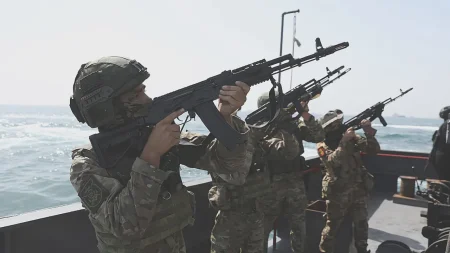
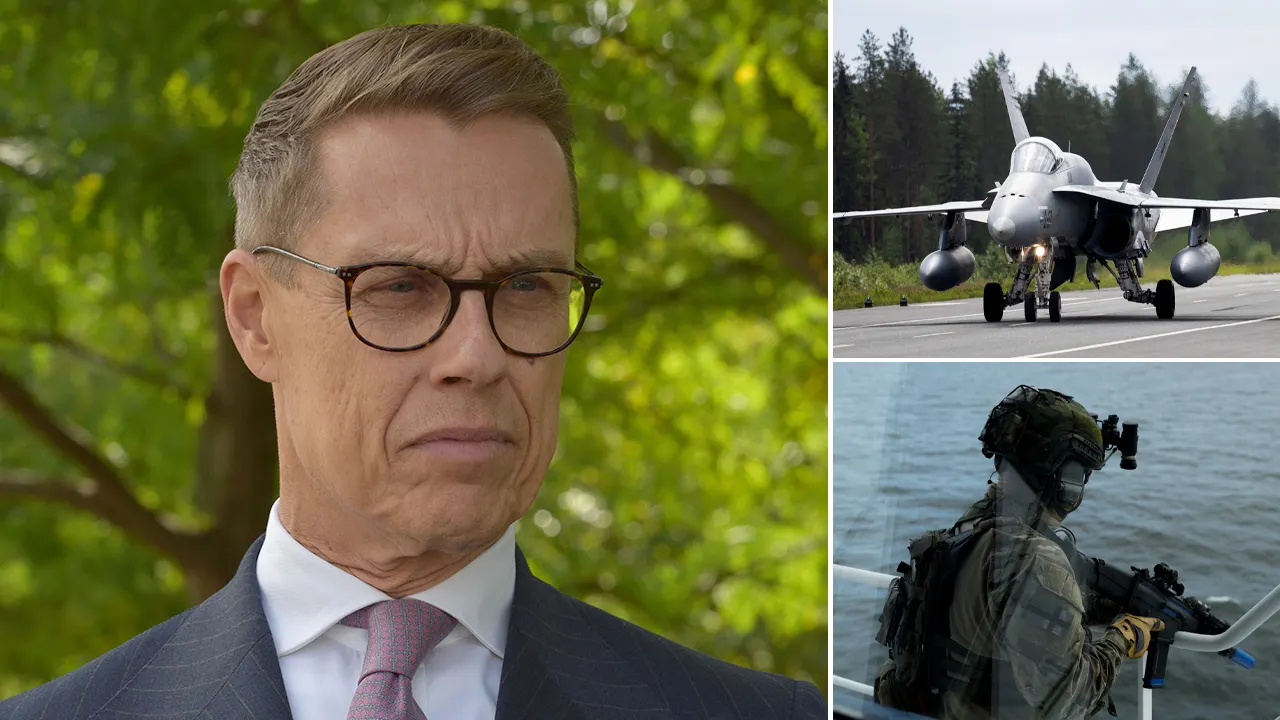
Stubb’s calm is not complacency; it is the confidence of a nation that has spent decades preparing for the worst. Finland is a small country of just 5.6 million people, but it has built one of the most formidable defense postures in Europe. Military service is mandatory, and Stubb himself served, as did his son. Women serve voluntarily in growing numbers. Finland has a wartime strength of 280,000 troops, with additional reservists ready to be called up if needed. It has one of the largest artillery forces in Europe, shared with Poland, and a vast network of civilian shelters capable of housing 4.4 million people—more than three-quarters of the population. And just days before Stubb traveled to New York, Finland took another major step: the first two of 64 new F-35A fighter jets arrived at the Lapland Air Wing in Rovaniemi, replacing the aging F/A-18 Hornet fleet. Stubb rattled off these details with the ease of a man who has recited them many times, not to boast, but to explain why Finland is not afraid. “We don’t have them because we’re worried about Sweden,” he joked, before adding, “We have them because we see a security threat coming from Russia.” That threat, he said, is real, but it is also manageable. Finland’s level of preparedness, combined with its membership in NATO—which it joined on April 4, 2023, after abandoning decades of military non-alignment—creates a deterrent that makes a direct Russian attack unlikely. “We feel that we’re very prepared, and that gives us a strong enough deterrent that we don’t believe that Russia is going to test a country like Finland,” Stubb said. “And of course the icing on the cake is that we are now security providers in the Alliance NATO.” It is a remarkable transformation for a country that once tried to stay out of great power conflicts, and Stubb wears it with a kind of quiet pride.
That same steady confidence shaped Stubb’s diplomacy during a frenetic week at the United Nations. In his address to the General Assembly, he advocated for continued support for Ukraine, calling the “Coalition of the Willing” that backs Kyiv “particularly close to my heart.” He spoke of working toward a “just and lasting peace in Ukraine in accordance with the U.N. Charter,” a phrase that sounds like diplomatic boilerplate but carries real weight when spoken by a leader whose country actually borders Russia. Stubb also made news with a surprising request: he urged SpaceX owner Elon Musk to extend Starlink coverage so Ukrainian forces could use the satellite network in areas containing Russian ballistic missile launchers, including inside Russia. The idea was simple—if Ukraine could see the launchers and target them, it could stop the missiles before they hit Ukrainian cities. It was a practical, almost technical suggestion, but it spoke to Stubb’s broader approach: find the tools, use the leverage, do whatever it takes to end the war on terms that do not reward aggression. Yet even as Stubb focused on Ukraine, he was acutely aware that the world is facing something far more complex than a single conflict. The wars in Gaza, Yemen, Sudan, and the escalating tensions with Iran are all intertwined, and Stubb argued that they can no longer be viewed in isolation. He pointed to a troubling dynamic: Russia providing intelligence to Iran that Tehran has used against U.S. military bases in the Gulf, while Iranian weapons have been supplied to Russia for use against Ukraine. “We’re going in this merry-go-round where every bit of the conflict is linked to another,” he said. “The sooner we can end both, the better.”
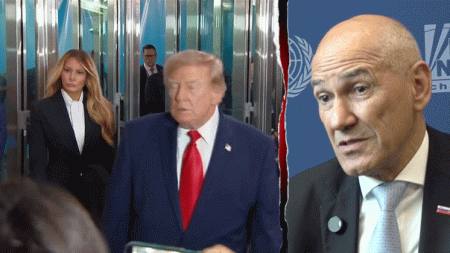
Stubb’s comments on Iran were unequivocal. Asked about Trump’s call at the U.N. for countries to support efforts to prevent Iran from obtaining a nuclear weapon, Stubb said simply, “I agree, Iran should not obtain nuclear weapons.” He added that Tehran should not use proxies or be able to produce missiles, a stance that aligns closely with the Trump administration’s maximum pressure campaign. Trump, in his own address to the General Assembly, called for Iran’s economic isolation and reiterated that Tehran should not obtain a nuclear weapon, while warning of further U.S. military action if a peace agreement is not reached. For Stubb, the convergence of these crises is not just a matter of foreign policy; it is a test of the entire international system. The United Nations, designed to prevent exactly this kind of cascading instability, is struggling to keep pace. Diplomacy is being stretched thin, and the old rules no longer seem to apply. Stubb acknowledged this with a kind of resigned realism. “It’s not a zero-sum game,” he said. “We have to deal with a multiplicity of conflicts right now, unfortunately.” But he did not sound defeated. Instead, he sounded like a man who has learned, through years of living next to a difficult neighbor, that the only way to survive is to stay calm, stay prepared, and keep working.
In the end, the contrast between Zelenskyy and Stubb is not really about who is right and who is wrong. Both men are telling the truth as they see it. Zelenskyy sees a Russia that will never stop unless it is forced to stop, and he fears that the West is losing its nerve. Stubb sees a Russia that is dangerous but also rational, a country that will not attack a well-defended NATO member when it is already struggling in Ukraine. Both perspectives have merit, and both have their risks. But Stubb’s message is perhaps the more useful one for a world that is exhausted by war and anxious about the future. He is not asking anyone to be naive. He is asking them to be prepared. He is asking them to build the shelters, train the soldiers, buy the fighter jets, and maintain the alliances—not because war is inevitable, but because peace is more likely when the cost of aggression is too high. And he is asking them to keep talking, keep negotiating, keep trying to find a way out, even when the path seems impossible. For Trump, Stubb said, that means “working around the clock.” For Finland, it means taking a sauna, staying calm, and being ready for whatever comes next. It is a simple philosophy, but in a world of escalating threats and fraying alliances, it may be the most sensible one on offer. The war in Ukraine is not over, and the broader security crisis is not going away. But if Stubb’s attitude is any indication, the free world still has the capacity to meet the moment—not with panic, but with resolve.