





Paragraph 1
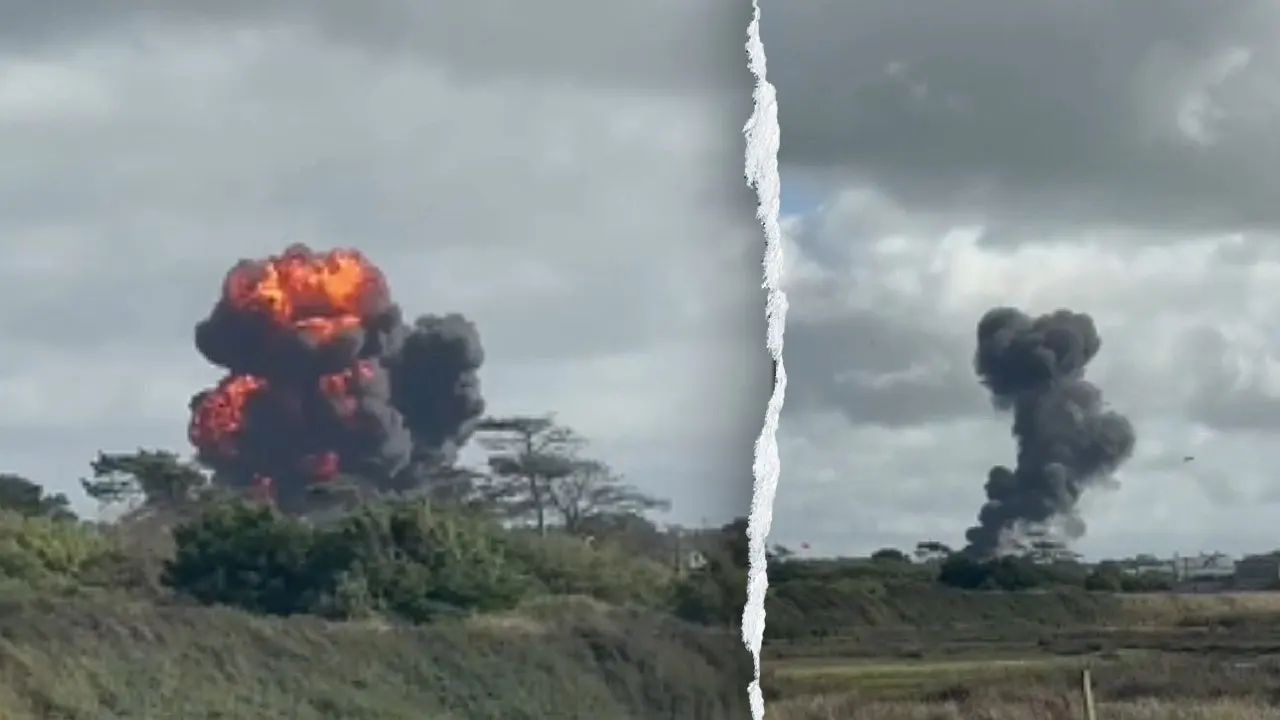
There are moments when the sky, which for most of us is a distant and peaceful backdrop, becomes the setting for a life-or-death struggle. On Wednesday, over the rolling green landscape near Anglesey in Wales, that struggle played out in full view of anyone looking upward. A Royal Air Force training jet, a Hawk T2, had just departed RAF Valley, the base tucked into the northwestern edge of the country, when something went terribly wrong. In a matter of seconds, the sleek aircraft became a fireball that tore through the countryside, and two pilots were catapulted into the air, their ejection seats firing in a desperate, precisely engineered escape. One local resident, Danni Jones, captured the scene on video, and the footage shows the two aviators floating beneath their parachutes as smoke and flames roil beneath them. For anyone watching, the sight must have been horrifying and beautiful at the same time—the fragile blue-and-white canopies contrasting with the dark plume rising from the crash site. It was a reminder that military flight, no matter how routine it may seem from the outside, is a high-wire act performed thousands of feet above the ground. The RAF later confirmed the pilots were safe, saying they were “doing well, in extremely good spirits, and expected to make a full recovery.” That statement, short and carefully worded, carried an enormous weight. Two people had walked—or floated—away from what could have been a tragedy, and a community that had watched the drama unfold could finally exhale.
Paragraph 2
The details of the incident, at least in the early hours after it happened, were still emerging. What is known is that the Hawk T2, a high-performance two-seat training aircraft, crashed near Anglesey after taking off from RAF Valley, a base that has long been a cornerstone of British military flight training. The Royal Air Force announced that a formal investigation was underway and, as a precautionary measure, temporarily paused all flying operations for both Hawk T1 and Hawk T2 aircraft. That pause was not a sign of panic but of discipline; when something goes wrong in aviation, the first instinct is to protect lives and ensure every other aircraft, every other crew, is safe while experts begin assembling the puzzle of what happened. For the pilots involved, the ordeal was over in the starkest sense—they were alive and breathing, being attended to by medical staff and surrounded by relief. But for the witnesses on the ground, the image of the burning wreckage and the falling airmen would not be easily forgotten. Danni Jones’s video, obtained by Storyful, offers a raw and unfiltered glimpse into the chaos of that afternoon. It shows the pilots drifting toward the earth with an eerie calm, as if the violence of the ejection had given way to the quiet silence of the parachute descent. In those moments, the only sound might have been the wind and the distant crackle of fire. The fact that both pilots survived is a testament to the training, the equipment, and perhaps a measure of luck that every aviator hopes to carry in their pocket.
Paragraph 3
Understanding what was lost in that fiery crash—and what was saved—means understanding the Hawk T2 itself. The RAF describes it as a high-performance, two-seat training jet equipped with advanced avionics and synthetic radar systems designed to simulate the experience of flying front-line combat aircraft like the Typhoon. It is not a toy; it is a classroom with wings, and its purpose is to prepare pilots for the most complex tactical environments imaginable. RAF Valley, where the jet was based, is home to No. 4 Flying Training School, which is responsible for training the United Kingdom’s next generation of fighter pilots. There, aircrew are also trained for mountain and maritime operations, honing skills that require sharp judgment, steady hands, and the ability to make split-second decisions while hurtling through the air at incredible speed. For the instructors and students who fly the Hawk, every sortie is a blend of technical learning and personal endurance. The ejection seats, now proven to have done their job, are a last-resort piece of engineering that can mean the difference between a fatal accident and a survivable one. On Wednesday, that difference was real. Two pilots are alive because the machine, for all its destructive potential, also contained the means of escape. And while the wrecked aircraft will be investigated, studied, and likely reconstructed in painstaking detail, the human story is simpler: two people climbed into a cockpit expecting a normal training mission, and they came back to earth in a way they will never forget.
Paragraph 4
The incident near Anglesey is not isolated in the broader world of military aviation. In recent weeks, the public has been reminded of the risks that come with high-performance aircraft. A video showed a bloodied Marine Corps pilot, calm and collected after ejecting from a jet during a crash in Washington, and another incident saw a pilot eject as an F-35 crashed at MCAS Miramar, sparking fire. These moments, captured on camera and shared across the world, pull back the curtain on a reality that pilots live with every day. Ejection is not a graceful exit; it is a violent, bone-jarring act of survival. The seat slams into the pilot’s body with tremendous force, the wind tears at exposed skin, and the sudden deceleration can leave bruises that take weeks to fade. Yet it works. It buys time, chance, and ultimately life. For the aircrew who eject, the aftermath is a blur of medical checks, debriefings, and the slow process of processing what just happened. The RAF’s mention that the two pilots were in “extremely good spirits” is telling. It suggests not only physical survival but emotional resilience, a testament to the mental strength that military training instills. Of course, the gravity of the event will settle in. There will be memories that flash at odd moments, the sound of the bang, the pull of the parachute, the sight of the ground rushing up. But for now, they are alive, and that is everything.
Paragraph 5
There is also a human story beyond the pilots themselves. The residents of Anglesey, a place known for its rugged beauty and close-knit communities, found their ordinary day interrupted by an extraordinary event. Emergency responders raced to the scene, unsure of what they would find. The RAF base, where the families of pilots and the wider support staff live and work, felt the shockwave of uncertainty that ripples out from any crash. It is easy to think of military aviation as a matter of machines and numbers, but behind every sortie is a person who has people waiting for them at home. The call that follows a crash is one of the most terrifying moments a family can experience. When the news came that both pilots were safe and in good spirits, the relief was likely felt in homes, in the control tower, and across the base. The investigation that now begins will be thorough and methodical. Every component of the Hawk T2, every decision made during the flight, every detail of the weather and the aircraft’s maintenance history will be examined. The goal is not to assign blame but to learn, to make the next flight safer, and to ensure that the lessons of this incident are carried into every future training mission. It is a process that can take months, but it is one of the reasons aviation safety continues to improve, even in the face of tragedy.
Paragraph 6
Looking forward, the pause in Hawk operations will allow time for reflection and adjustment, but it will not be permanent. The mission of RAF Valley and No. 4 Flying Training School is too important to remain grounded for long. The United Kingdom needs its next generation of fighter pilots to be ready, and the skills taught in the Hawk T2 are essential to that readiness. The two pilots who ejected will recover, physically and emotionally, with the support of their comrades and medical teams. Perhaps they will fly again, climbing back into the cockpit with a new awareness of the risks and a renewed appreciation for the engineering that saved them. And eventually, the skies over Anglesey will once again be filled with the roar of training jets. But there will always be people who remember the day when the sky caught fire, when parachutes opened over green fields, when a town held its breath and then let it out again. In the end, this story is not just about a crashed aircraft. It is about survival, the fragility of life, and the extraordinary courage that ordinary people show when every second counts. It is a reminder that the threats pilots face are real, but so is the resilience they carry with them into the air. The investigation will find answers, but the human heart of the story is already clear: two pilots came home, and that is a victory worth honoring.