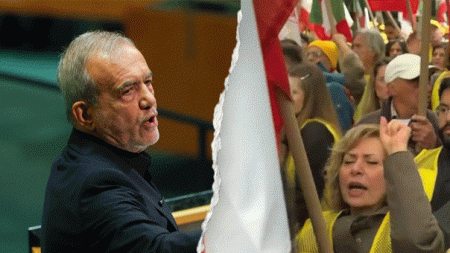






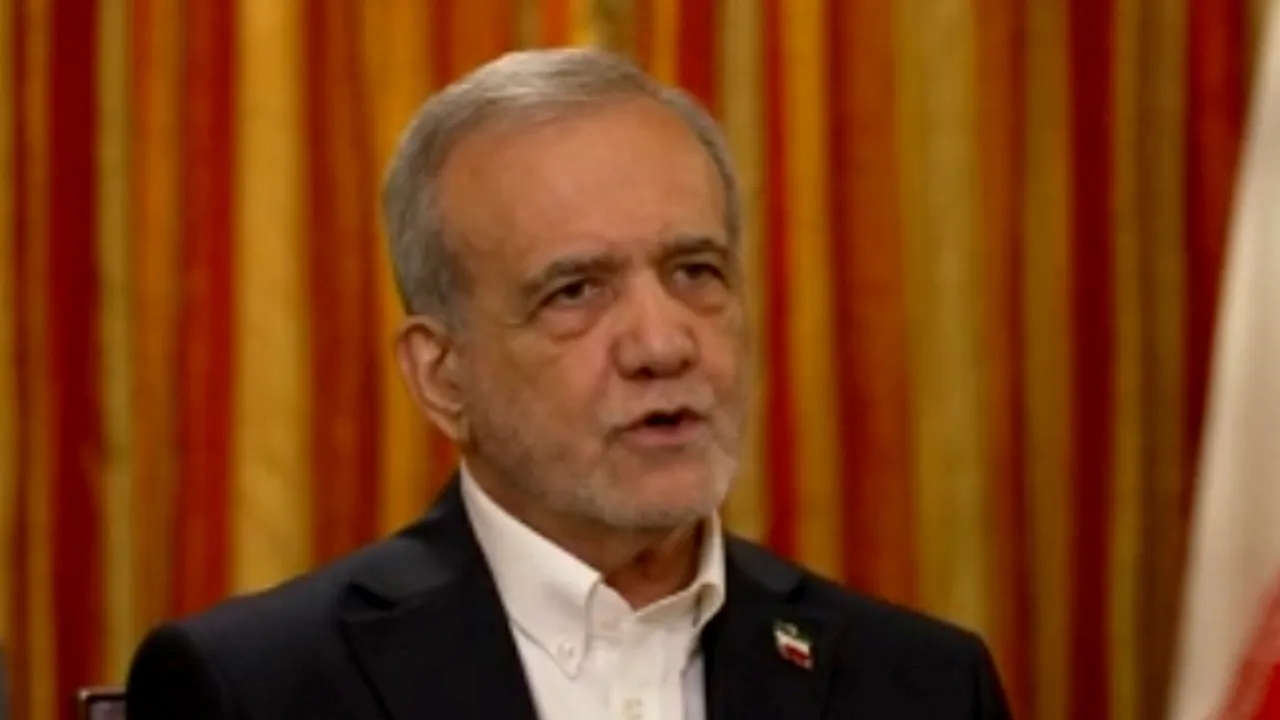
In a rare and strikingly direct interview with Fox News’ “Special Report,” Iranian President Masoud Pezeshkian was asked a question that has haunted the Islamic Republic for decades: Does Iran want a nuclear bomb? His answer came without hesitation, almost before the question had fully left Bret Baier’s lips. “Not at all. Not at all,” he said, before turning to the religious dimension that he insisted lies at the heart of Iran’s position. He invoked the authority of the country’s supreme leadership, pointing to religious decrees, or fatwas, that declare weapons of mass destruction to be unholy and illegal. For Pezeshkian, this was not merely a diplomatic talking point; it was a matter of faith, a way of saying that the very idea of building a nuclear weapon contradicts the moral foundation of the Iranian state. Yet his words landed in the middle of an international storm. For years, Iran has enriched uranium to levels far beyond what is normally needed for civilian nuclear power, and international inspectors have been locked in a difficult, sometimes fruitless dance with Tehran over access and transparency. The United States, under President Donald Trump, concluded that the program posed an unacceptable threat, and in February, Washington launched Operation Epic Fury, a military campaign aimed at degrading Iran’s nuclear infrastructure. Pezeshkian’s denial, however sincere or strategic, was not going to erase that context. But he insisted that the world has misunderstood Iran’s intentions, and he seemed determined to use the interview to set the record straight as he sees it.
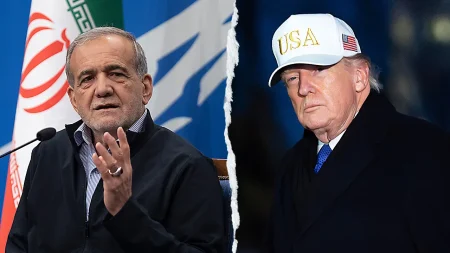
Yet Pezeshkian did not stop at denial. He went further, suggesting that Iran is willing to take concrete steps to ease international fears. He said Tehran would be open to lowering its enrichment levels and to allowing outside verification of its nuclear activities. “So, that weapon’s mass destruction,” he said, as if trying to make the point simple and obvious. “We said we’re willing to dilute them. It’s not a big deal. We are willing to submit ourselves to verification.” Those words were striking because they appeared to move beyond Iran’s usual posture of guarded ambiguity. Pezeshkian pointed to a memorandum of understanding that he had signed with President Trump in June, an agreement that was meant to halt hostilities and create a framework for a broader U.S.-Iran deal. According to the Iranian president, that agreement already laid out a 60-day process toward a final understanding, and Tehran was ready to continue along that path. “We have no problems. We did reach an agreement with your president,” he said, speaking of Trump with a curious mix of formality and familiarity. He insisted that the framework was agreed upon, that the Strait of Hormuz remained open, and that Iran had done nothing to violate the spirit of the arrangement. The problem, as he described it, was that Washington chose a different course. Instead of pursuing dialogue, he said, the United States began bombing first and blocking every diplomatic pathway. There was a note of frustration in his voice, a sense of betrayal that an agreement signed in good faith had been abandoned. For Pezeshkian, the story is not one of Iranian intransigence but of American inconsistency.
The interview soon deepened into something more emotional. Pezeshkian spoke of assassinations and martyrs, of scientists and military commanders and government officials who had been killed in what he described as targeted attacks. He did not name specific incidents, but the references were unmistakable. Iran has long accused Israel and the United States of carrying out covert operations against its nuclear scientists and military leaders, and those accusations have become a central part of the regime’s narrative of victimhood. “They attacked us,” he said. “They assassinated and martyred our esteemed supreme leader, our scientists, our military commanders and government.” He presented Iran as a nation that has been repeatedly struck while trying to defend itself, a country that has lost too many of its brightest minds and most dedicated servants to the violence of its adversaries. His tone was not one of aggression but of grief, and he used that grief to explain why Iran cannot simply surrender to pressure. “This is not the way to conduct yourself on the world stage,” he said, addressing Washington directly. He insisted that the United States can have free access to see whatever Iran has, but not on the basis of blockades, sanctions, and threats. For Pezeshkian, verification is possible, but only if it is paired with respect. He seemed to be asking for a kind of dignity that he believes America has denied Iran for too long. And he made it clear that Iran will not be bombed into submission. “We are ready,” he said, a short sentence carrying an enormous amount of weight.
Pezeshkian also addressed the broader war in the Middle East, placing the blame squarely on the United States. He rejected the idea that Iran seeks to kill Americans, pointing to what he called demonstrable actions as proof. “America has sought to kill Iranians,” he said, reversing the narrative that Washington has long presented. He framed Iran’s military activities as purely defensive, arguing that any nation has the right to protect itself when attacked. That logic extended to the ongoing strikes and sanctions imposed by the United States, including the military operation known as Operation Outcast and the increasingly aggressive secondary sanctions aimed at crippling Iran’s economy. Pezeshkian did not deny that Iran is struggling economically. “Yes, we do have economic issues, certainly,” he admitted. But he quickly pivoted to defiance, insisting that Iran will endure whatever hardships come its way. “We will keep resisting. We will find ways, and the life of our country will continue. We will remain,” he said. There was a quiet stubbornness in his words, a determination to outlast the pressure. He even dismissed the idea that American elections matter to Iran’s decision-making. Whether the current government wants to reach an agreement or not, he said, makes little difference to Tehran. If Washington is willing to negotiate within international legal frameworks, Iran is ready. If not, Iran will simply wait. The message was clear: Iran may be under pressure, but it is not broken, and it will not be moved by the rhythm of American politics.
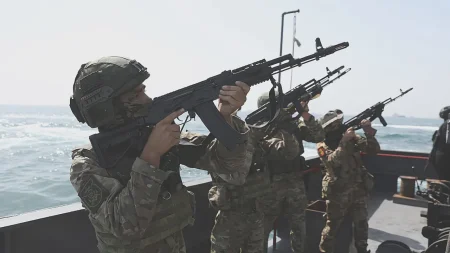
When the conversation turned to Israel, Pezeshkian’s tone became sharper. He insisted that Iran never sought war and does not want war now. “We will stand resolutely to defend ourselves,” he said, but he placed the responsibility for the conflict at Israel’s feet. “With the instigations conducted by Israel, they have imposed this war on us,” he claimed, describing the Middle East as a region set ablaze by Israeli provocation. And he was blunt about who he believes holds the key to ending the conflict: Washington. “It’s America that must choose whether it wants to end this or not,” he said. In his telling, Iran is not the aggressor but the reluctant warrior, forced to defend itself against a coalition of enemies led by Israel and supported by the United States. He also faced a difficult question about a deadly attack on a U.S. base in Jordan, an attack that killed three American service members and was reportedly carried out using Chinese satellite imagery provided to Iranian forces. Pezeshkian denied any direct knowledge of the imagery, saying, “I’m specifically unaware of these purported images that you talk about.” He then shrugged off the broader question with a touch of bureaucratic detachment, saying that what militaries do with one another is their own business, within their own guidelines. It was not a full denial of Iran’s involvement, but it was also not an admission. Instead, it was a way of sidestepping a sensitive issue without offering any new information, a reminder that even in a candid interview, the Iranian president is careful with his words.
Taken together, Pezeshkian’s remarks painted a portrait of a leader who wants to be seen as reasonable, religious, and resilient, but also as someone who has little trust left in American promises. He offered concessions in theory—dilution, verification, inspection—but always with conditions attached. The United States, he insisted, must stop bombing, stop sanctioning, and stop blocking diplomacy. He denied nuclear ambitions while simultaneously leaving the door open for a negotiated solution. He blamed Israel for the war and America for its continuation, yet he refused to say what Iran would do if the pressure continued. The result was a mix of pragmatism and defiance, a message designed for both international audiences and domestic consumption. For the Trump administration, the interview offered little reason to soften its approach. Pezeshkian’s denials are unlikely to satisfy American intelligence officials who have watched Iran enrich uranium to unprecedented levels, and his offers of verification will probably be met with skepticism unless they are backed by concrete, verifiable actions on the ground. But for those looking for a diplomatic off-ramp, there was at least a thread to hold onto. Pezeshkian did not close the door. He said Iran is willing to move forward, to submit to verification, and to reach an agreement. The question is whether Washington and Tehran can find a way to walk through that door together, or whether the cycle of strikes, sanctions, and retaliation will simply continue. The interview ended much as it began: a standoff, wrapped in words, with no easy resolution in sight.