






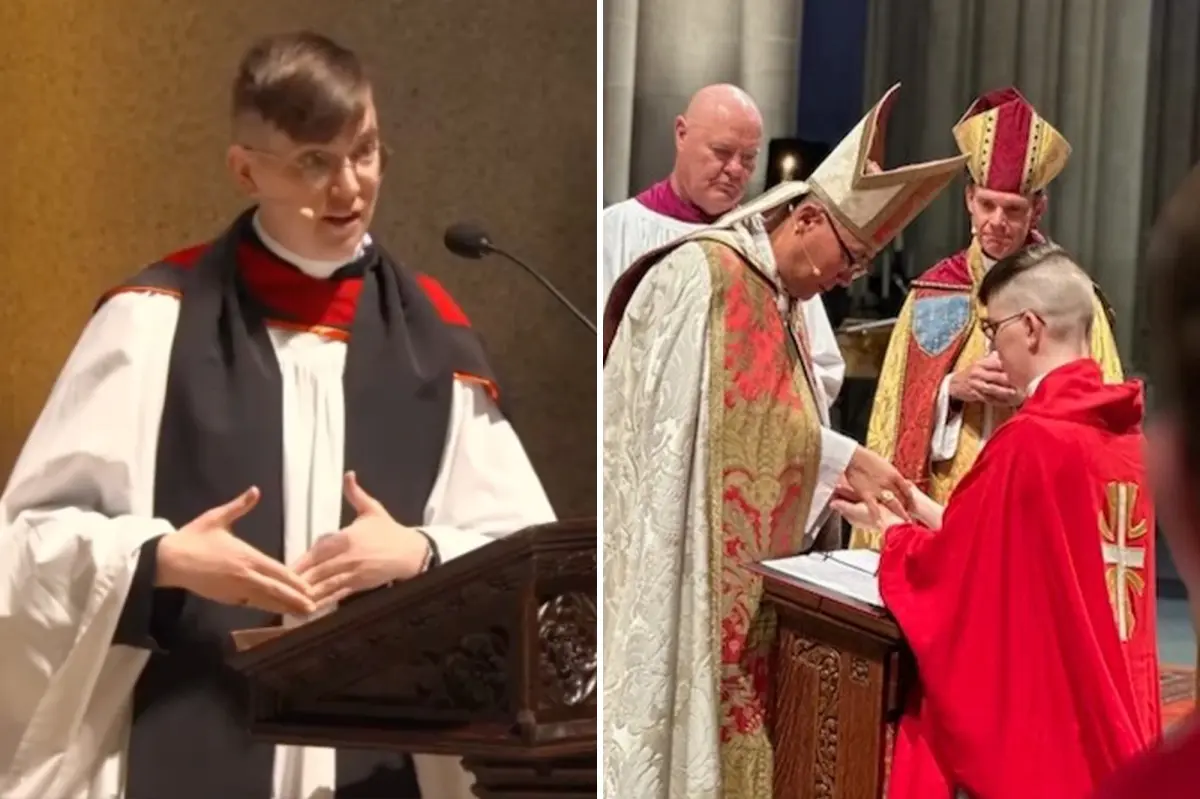
In the hushed, candle-lit sanctum of Christ & St. Stephen’s Episcopal Church on Manhattan’s Upper West Side, a theological earthquake was quietly unfolding. The Rev. Flourish Klink, a priest who navigates the world with pronouns like they/elle/hen, stood before the congregation not to deliver a homily of comfort, but a provocation that would echo far beyond the wooden pews. The sermon, recently surfaced online, began with a startling declaration that God is nonbinary. But Klink, a married parent with a deep, almost poetic conviction, did not stop there. They pushed the envelope with a claim that left traditionalists breathless: God is also transgender. To Klink, this wasn’t a stunt or a mockery of scripture, but a deeply felt re-reading of the Incarnation itself. They painted a picture of Mary looking into the manger and, through the lens of human biology and societal expectation, declaring “a baby boy.” Yet, Klink argued, if God exists beyond the binary of human sex, then that initial assignment was inherently a misgendering of the divine. The priest wove a narrative where the very flesh of Christ becomes a canvas for the struggle between external labels and internal truth—a struggle familiar to anyone who has ever felt their outer existence didn’t match their inner soul. For Klink, the incarnation wasn’t a simple entry into a male body, but a profound act of divine empathy, where God willingly submitted to the confines of human gender categories only to transcend them through resurrection. The air in the church was thick with tension; some parishioners leaned forward in rapt attention, while others sat rigid, grappling with a message that redefined the very cornerstone of Christian identity.
Klink’s theology is rooted in a deeply personal well. As a transgender and nonbinary individual, they see their own journey mirrored in the story of Jesus. They explained to the congregants that at birth, society looks at a body and assigns a gender based purely on physical appearance. It is a diagnosis made from the outside looking in, often arriving before the person can speak for themselves. Later, in the quiet corridors of self-awareness, that diagnosis is found wanting. Klink used this as a working definition of a trans person, and applied it directly to the divine. If God, in the person of Jesus, was fully human, then God experienced the same external imposition of identity. Mary’s joyful announcement of a son becomes, in Klink’s framing, the first misgendering in history. Furthermore, Klink drew upon the Gospel accounts of the resurrection, where Mary Magdalene and the disciples failed to recognize the risen Christ. The Bible itself notes that something was different about him, yet remains frustratingly silent on the specifics. Klink admitted, with a disarming honesty, “I don’t know for sure, I wasn’t there.” But they proceeded to offer their boldest hypothesis: that the resurrected Jesus finally shed the earthly constraints of male identity and appeared as his “true self,” which exists beyond the categories of male and female. This wasn’t just a transfiguration, Klink insisted; it was a transition. By avoiding the traditional path of marriage and instead engaging with women in radical, unconventional ways, Jesus had already rejected the “traditionally masculine” roles of his first-century context. To Klink, the entire life of Christ is a testament to breaking the boxes humanity builds, culminating in a resurrection that liberates even the divine body from the binary.
Unsurprisingly, the sermon detonated across the internet, sparking a firestorm of outrage that flooded social media platforms. Clips of Klink’s remarks were shared with captions of pure disgust, and the comment sections became a battlefield of theological warfare. “How can so many Christians just stand by and let this happen?” one furious user demanded. “Where is the pushback?” The critics were quick to dismantle Klink’s biblical exegesis, pointing to the Gospel of Luke, where the angel Gabriel explicitly tells Mary, “You will conceive and give birth to a son, and you are to call him Jesus.” They argued that the gender of Christ was not a human assumption but a divine declaration delivered by an archangel, rendering Klink’s “assigned at birth” theory null and void. Others were far less charitable, invoking hellfire and damnation. “There is a special place in hell for these pernicious blasphemers,” a third commenter spat. For these traditionalists, Klink’s words were not merely an intellectual disagreement but a sacrilegious attack on the very foundations of the Christian faith—the deity of Christ, the authority of scripture, and the revealed nature of God. They saw a priest using their pulpit to dismantle the orthodox understanding of the Trinity, replacing it with a subjective, modernized projection of contemporary gender politics. The fury was raw, visceral, and deeply personal, as many felt that their most sacred beliefs were being mocked and repurposed into a radical social agenda. The controversy highlighted the widening chasm in Western Christianity, where the pews are increasingly divided between those who view scripture as timeless, unalterable truth and those who see it as a living, breathing text that must evolve with human understanding.
This incident is not an isolated anomaly but a symptom of a profound cultural and theological reckoning taking place within mainline Protestant denominations. Over the past decade, the Episcopal Church and similar bodies have been deeply embroiled in debates over sexuality, marriage, and gender identity. For progressive theologians like Klink, the goal is to create a church that is fully inclusive, where marginalized groups see their own experiences reflected in the divine narrative. They argue that if God is love, then God must transcend the rigid categories that humanity uses to exclude one another. This involves a radical re-imagining of scripture, treating it less as a historical rulebook and more as a poetic testimony of God’s unfolding relationship with humanity. To them, finding a trans Jesus is an act of liberation, affirming that trans people are created in the image of a God who understands their unique struggle. However, for conservative and orthodox Christians, this approach represents a capitulation to secular culture, a dangerous slide into heresy where the transcendent God is remade in the image of human ideology. They see the authority of the church being undermined from within, as priests reinterpret foundational doctrines to fit the spirit of the age. The battle lines are drawn not just over the identity of Christ, but over the very source of spiritual authority: is it the unchanging word of scripture, or the evolving consciousness of the community? Klink’s sermon forced this uncomfortable question into the spotlight, revealing that the “culture war” is not just fought in political arenas, but in the very sanctuaries where people gather to seek the holy.
The echoes of Klink’s proclamation reached far beyond New York, landing directly in the high-stakes arena of Texas politics. James Talarico, a Democratic candidate for the U.S. Senate locked in a fiercely contested race against Republican Ken Paxton, found himself confronting a nearly identical ghost from his own past. Years earlier, in 2021, Talarico had stood on the floor of the Texas State House and uttered words that were now being circulated alongside Klink’s sermon: “God is both masculine and feminine and everything in between. God is nonbinary.” With the political stakes now astronomically high, Talarico has been forced into a defensive retreat. He admitted that he was “being provocative” with the statement, but immediately pivoted to a more orthodox defense, arguing that his point was simply that human categories are insufficient to define the infinite creator. He invoked the authority of the late Pope Benedict and others to argue that acknowledging God’s transcendence of human gender is not theological radicalism, but a foundational aspect of classical Christian mysticism. This stark contrast between the priest and the politician highlights the varying consequences of theological exploration. Klink, safely ensconced in the pulpit of a liberal urban parish, can speak with unapologetic audacity, embracing the controversy as a badge of prophetic honor. Talarico, however, must navigate the treacherous waters of electoral politics, where a single provocative quote can doom a campaign. His backtracking reflects the pragmatism of a candidate who needs to appeal to a broad constituency, including deeply religious voters who might find such language alienating. The juxtaposition reveals how the same theological claims can be a source of inspiration for one person and a potential political death sentence for another, depending entirely on the platform from which they are spoken.
Ultimately, the controversy surrounding Klink’s sermon is a stark mirror reflecting the fractured spiritual landscape of the 21st century. It is a story of two groups of deeply sincere people, both claiming to love the same God, yet standing on opposite sides of an unbridgeable chasm. For Klink and their supporters, the reimagining of Jesus as transgender is a necessary act of empathy, a way to show a marginalized community that their Creator understands their pain of being mislabeled and unseen. It is an attempt to humanize the divine, to make the ancient story of a Galilean carpenter relevant to the complex identity politics of modern Manhattan. For their detractors, it is a tragic corruption of the gospel, a moment where the church loses its prophetic voice by capitulating to the whims of culture, trading the unchanging rock of faith for the shifting sands of societal trends. The human element is what makes this so poignant. There is the priest, who risks their reputation and standing to share a deeply personal vision of God. There are the parishioners, some moved to tears by a theology that finally includes them, others feeling betrayed by a leader who has upended their cherished beliefs. And there is the broader audience, watching from behind screens, reacting with love, hate, fear, and hope. What remains clear is that the questions Klink raised will not disappear. They strike at the heart of what it means to be human: our search for identity, our need for belonging, and our desperate desire to find a reflection of ourselves in the sacred. Whether one views Klink as a visionary prophet or a heretical provocateur, they have succeeded in forcing a conversation that will not be easily silenced. In the end, it is a testament to the enduring power of faith—a force so potent that we are willing to fight, argue, and even divide over what, exactly, it means to know the divine. And as the candles are extinguished in that Upper West Side sanctuary, the debate over who Jesus truly was, and who God truly is, rages on in the hearts and minds of believers everywhere.