
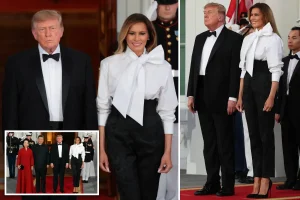





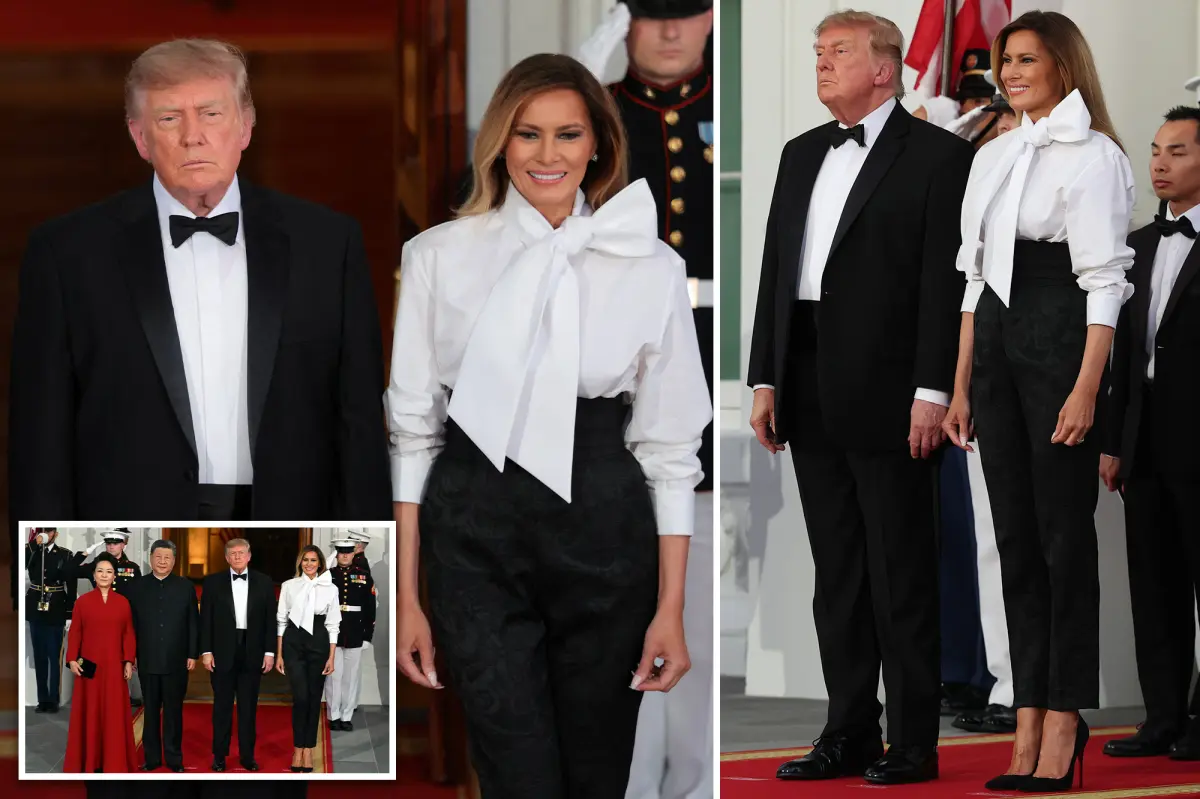
The White House glowed like a jewel against the cool Washington night as the gates opened for one of the most anticipated evenings in diplomatic life: the official state dinner honoring Chinese President Xi Jinping and his wife, Peng Liyuan. But before the first course was served, before the toasts were raised, the room was already buzzing with the kind of electric excitement that only arrives when fashion and history collide. First lady Melania Trump stepped into the grand reception hall wearing an outfit that was deceptively simple and yet impossible to ignore: a crisp white bow blouse by Saint Laurent, sleek black tuxedo-inspired trousers, a black silk cummerbund, and sky-high Christian Louboutin heels. The trousers, designed by Dolce & Gabbana, featured a subtle peony-motif brocade that seemed to catch the light with every movement. The internet immediately erupted with admiration, sharing photographs and parsing every detail of her look. Some saw a modern, confident first lady; others saw a woman who had mastered the art of dressing for the moment. But the true power of her ensemble went much deeper than aesthetics. It was a carefully calibrated message, one that honored her guests, her country, and the quietly complex role she plays as the first lady of the United States.
Fashion has always been a language of its own in Washington, and Melania Trump is fluent in it. The peony, after all, is known in Chinese culture as the “King of Flowers,” a symbol of wealth, nobility, prosperity, and romantic beauty. To the Chinese, the peony embodies feminine charm and perfection, a flower of such deep cultural significance that it has been celebrated in art, poetry, and imperial courts for more than a thousand years. By choosing a pair of trousers woven with that delicate emblem, Melania offered a tribute not just to Chinese aesthetics, but to the very values that define the nation’s understanding of grace and strength. It was a subtle, thoughtful gesture, and it spoke volumes. She was not making a statement about who wears the pants in the White House, as some jokingly suggested; she was weaving the guest of honor’s cultural heritage into the fabric of her own appearance. That kind of soft diplomacy is often overlooked, but it is never accidental. The first lady had been exploring a menswear-inspired style in recent months, borrowing from tailoring, suiting, and military details to create looks that were both commanding and refined. That morning, she had worn a black Alexander McQueen military-style suit for the official welcoming ceremony for the Chinese first couple, a picture of precision and formality. And the year before, she had posed for her official White House portrait in a Dolce & Gabbana tuxedo suit, signaling that she was not interested in conventional first-lady softness alone. But for the state dinner, she softened the sharp edges of that aesthetic with the romantic bow and the floral pattern, creating a look that bridged two worlds: the disciplined elegance of Western tailoring and the poetic grace of Eastern symbolism.
Melania Trump was not the only woman at the center of the evening’s quiet diplomacy. Peng Liyuan, herself a celebrated figure in China, arrived in a deep red gown that shimmered with quiet opulence, carrying a black clutch with a gold clasp. Red is an auspicious color in Chinese tradition, a hue of joy, luck, and celebration, and her choice seemed perfectly suited for the occasion. More striking than the gown, however, was the warmth between the two first ladies. Earlier in the day, they had visited the Smithsonian National Museum of Asian Art, where they wandered through galleries filled with treasures from centuries of Chinese and Asian craftsmanship. At one point, they paused with a group of students from the Hope Chinese School, who were dressed in white with sparkling blue vests, singing a medley of English and Chinese songs. Peng, who had been a famous singer in China before marrying Xi Jinping, could not resist the music. She nodded her head, smiled broadly, and softly sang along, her eyes bright with memory and joy. Melania, usually more reserved in public, seemed genuinely moved, and the two women shared a whisper and a smile as the children’s voices filled the room. They also visited the famous Peacock Room, James McNeill Whistler’s breathtaking masterpiece of cobalt blue walls, gilded leather, and delicate ceramic pots. In that room, surrounded by art that had traveled across oceans and centuries, the two women seemed to find a moment of genuine connection, a small proof that diplomacy does not always need to happen at the negotiating table.
Down to the smallest detail, the state dinner itself was Melania Trump’s creation. She personally oversaw every element of the evening, from the brilliant red tablecloths that echoed the celebratory color of her guest’s gown, to the lush centerpieces of dahlias and ranunculus that seemed to bloom like fireworks across the tables. The flowers, with their layered petals and vibrant tones, were a poetic echo of the peony motif on her own trousers, a subtle touch that tied the whole evening together in visual harmony. The menu, heavy with seafood, was designed to impress with elegance and delicacy, showcasing American ingredients while respecting the palates of the distinguished guests. The head table itself read like a map of global power and technology: Apple CEO Tim Cook, Nvidia CEO Jensen Huang and his wife Lori, and AMD CEO Dr. Lisa Su with her husband Daniel Lin. Their presence was a reminder that this was not merely a social occasion, but a meeting of worlds where politics, business, and culture collide. The Chinese president sat among the most influential leaders of American innovation, a tableau of interconnected economies and ambitions. For Melania, the evening was a test of grace under pressure, and she moved through it with a quiet precision that seemed almost effortless. Every seating arrangement, every bloom, every glimmering glass had been considered with care, and the result was a dinner that felt both opulent and intimate, grand yet welcoming.
As the evening reached its crescendo, President Trump rose to lead the dinner in a toast, raising his glass in honor of the Chinese president and the long relationship between the two nations. There was applause, the soft clink of crystal, and the murmur of conversation. But it was the moment that followed that captured the true heart of the evening. Melania Trump turned toward President Xi, lifted her glass, and gently clinked it against his. It was a simple gesture, a wordless exchange of goodwill and acknowledgment, but in that small sound there was the echo of months of preparation, hours of protocol, and the quiet hope that a single dinner could bring two vast nations closer together. She smiled, and for a fleeting moment, she seemed genuinely pleased with the night she had created. The state dinner had been historic from the moment the invitations were sent, but in that instant, it became personal. Melania had not simply hosted a meal; she had curated an experience, one designed to make the Chinese first couple feel honored, seen, and respected. The white bow she wore was the literal punctuation on the evening, the finishing touch on a production that she had quietly engineered from behind the scenes. It was her way of saying that, despite all the complexities of politics and power, beauty and courtesy could still open doors.
When the night finally wound down and the last guests drifted out into the cool Washington air, the state dinner became more than a footnote in the history books. It became a lesson in the power of soft diplomacy. Diplomats often speak of treaties, trade deals, and strategic alliances, but the truest connections are often built in smaller moments: a shared laugh in a museum, a song sung by children, a compliment woven into the fabric of a dress. Melania Trump understood that intuitively. Her white bow blouse and peony-patterned trousers were not just fashion choices; they were a quiet statement of respect, a bridge between cultures, and a reminder that sometimes the most powerful messages are the ones delivered without words. In the days that followed, images of the evening would circulate around the world, and people would talk about the first lady’s outfit, the red tablecloths, the famous guests. But beneath the glittering surface, the real significance of the night lay in the connections it created. Melania had put a bow on a historic state dinner, but more importantly, she had helped build a moment of shared humanity between two of the most powerful nations on earth. In an era of division and uncertainty, that was no small achievement. It was the kind of grace that does not make headlines forever, but quietly changes the way people see each other, one glass, one smile, one flower at a time.