






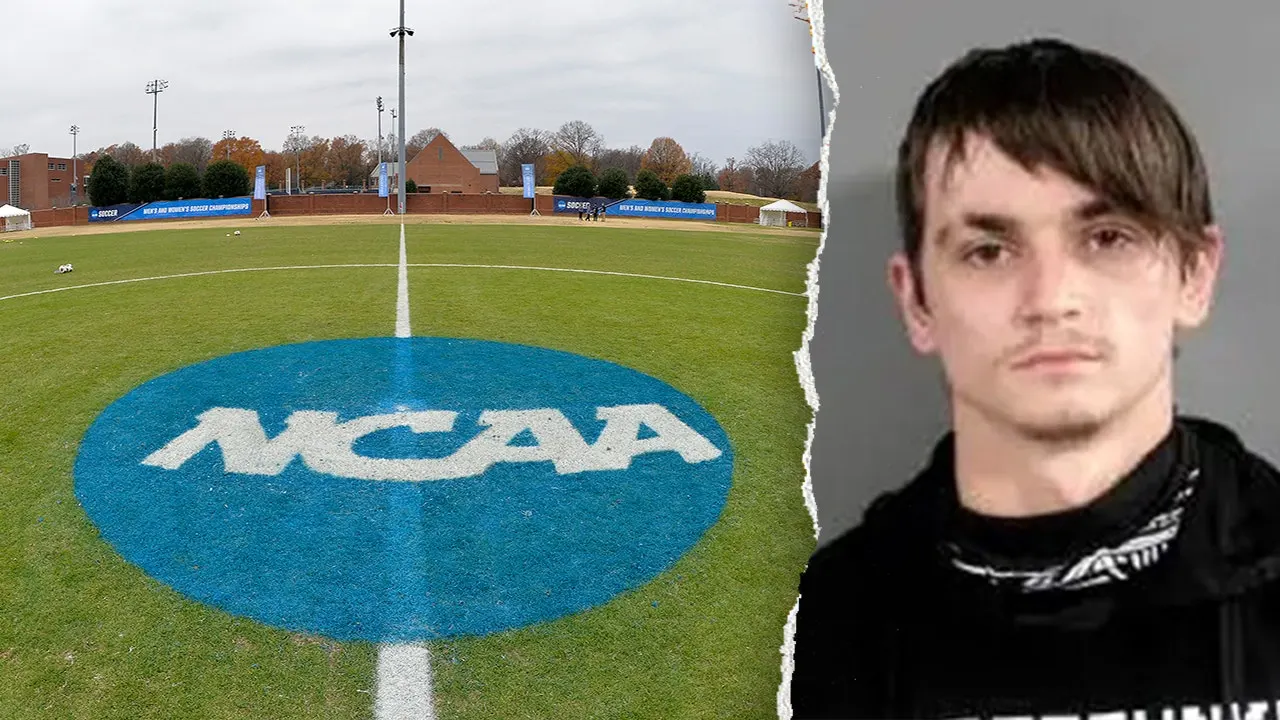
On a quiet Tuesday evening at Wilmington College, the familiar rhythms of a university campus—practices winding down, students heading back to dorms, the soft hum of the athletic center after hours—were shattered by a discovery that no one could have prepared for. Members of the women’s soccer team were inside their locker room, doing what athletes do after a long session: changing out of their gear, unwinding, speaking in the easy shorthand of teammates. But as the minutes passed, something felt wrong. A player looked up, perhaps noticing a disturbance in the ceiling above, and what she found sent a chill through the entire building. Hidden in the ceiling space, concealed in the shadows between the locker room and the roof, was a man with a camera. According to local reports, that man was Jayson Barker, a 39-year-old from Jeffersonville, Ohio, who had been working at the school as a contract custodial employee. In a matter of moments, a routine evening transformed into a deeply invasive scene, one that would leave the team shaken, trigger an immediate police response, and raise unsettling questions about trust, safety, and the hidden spaces we rarely think to examine.
The incident unfolded just before 9:40 p.m. when Wilmington Police Department officers were dispatched to the Scheve Athletic Center following reports that someone was photographing players as they changed. By the time law enforcement arrived, the situation was already under some degree of control: Barker had been detained by Wilmington College Campus Safety personnel, the first responders on the scene who had managed to hold him until officers took over. Investigators soon pieced together what had happened. Barker, who had legitimate access to the building as part of his custodial job, had allegedly used that access for a sickening purpose. He had hidden himself in the ceiling above the women’s locker room, positioning himself in a place no player would ever think to look, and had begun taking photos of the team members below. It is a violation that cuts to the core of privacy—a space meant to be safe, four walls and a locked door where people expect to be unseen, became a stage for predation. The precise details of how he entered that ceiling space, how long he was there, and what he captured are now part of an active criminal investigation, but the emotional damage is already evident in the faces and voices of the young women who were simply trying to end their day in peace.
For the victims, the discovery of a hidden photographer in their locker room is not just a crime; it is a profound betrayal of the body’s most basic boundaries. The women’s soccer team at Wilmington College had likely viewed their locker room as a sanctuary, a place where they could be vulnerable without fear, a space shared among teammates and trusted coaches. That illusion was destroyed in an instant. The team member who spotted Barker in the ceiling acted with remarkable courage, immediately alerting others and setting in motion the events that led to his arrest. Yet for the players who were photographed, the aftermath can be a long and painful road. Survivors of voyeurism often describe feeling violated in ways that are hard to articulate—an ongoing sense of being watched, a lingering anxiety about spaces that were once comfortable, and a deep anger at the person who exploited their trust. The fact that Barker was a custodial employee makes the betrayal even more chilling. He was not a stranger lurking outside a window; he was someone who moved through the campus with the invisible permission of a work badge, someone whose presence would not have raised eyebrows, someone who used the very systems meant to keep facilities running as a cover for criminal behavior.
Wilmington College responded swiftly, though the weight of the moment demanded more than procedural action. In a statement provided to local news outlets, the institution emphasized that “the college’s paramount concern is the safety and well-being of its students,” and officials moved immediately to provide counseling and other support services for the affected players. That language may sound like standard institutional boilerplate, but in practice, it represents a critical lifeline for young people grappling with a deeply personal violation. A college campus is supposed to be a place of growth and exploration, and when that sense of security is breached, the psychological consequences can ripple far beyond the initial incident. The athletic department, the counseling center, and campus administrators all had to pivot to address not only the logistical questions of law enforcement and facilities, but also the human needs of frightened students and their families. The college also said it was taking measures to ensure that no student’s safety or well-being is compromised, a promise that will require a thorough review of building security, access controls, and the oversight of contracted personnel. For the players, knowing that administrators are taking the threat seriously is important, but healing will take time—and many survivors find that the greatest challenge is not the initial shock, but the slow, unwelcome process of rebuilding a sense of normalcy in the same spaces where they were harmed.
On the legal side, the case against Barker is moving forward with a gravity that reflects the severity of the allegations. He faces 11 counts of voyeurism, a charge that in Ohio carries significant penalties, particularly when the victims are in a locker room or changing area and the offender has no legitimate reason to be there. Voyeurism laws exist precisely because lawmakers recognize that the invasive act of secret photography is not a minor offense—it is a direct assault on personal dignity, and it leaves lasting scars that cannot be measured in a courtroom. The Clinton County Jail is now Barker’s residence, held on a $22,000 cash surety bond, a figure that signals the seriousness with which the court views the allegations. His next court appearance is scheduled for October 5, where his legal team will have the opportunity to respond to the charges, and where the prosecution will begin to lay out the evidence gathered by investigators. The community, meanwhile, is left to wrestle with uncomfortable questions: How could this happen under the noses of students and staff? What should have been done differently? And perhaps most hauntingly, what does this say about the unseen vulnerabilities in every school, workplace, and public facility across the country? The answers are not simple, but the arrest itself is a reminder that vigilance matters—that one brave person who looks up, who notices something out of place, can be the difference between a predator continuing and a predator being caught.
This incident, disturbing as it is, is not isolated. Across the United States, cases of hidden cameras in locker rooms, bathrooms, and dressing rooms continue to surface, often perpetrated by people in positions of trust—custodians, coaches, employees, even fellow students. Each case leaves behind a trail of trauma, and each one forces communities to confront a truth they would rather avoid: the spaces we believe are private are only as safe as the people around us choose to make them. But there is also a thread of resilience in this story. The women’s soccer team did not stay silent. The campus safety personnel acted quickly. The police treated the report with the urgency it deserved. And the college has begun the slow work of supporting its students and tightening its security. For the players, the road ahead may include therapy, difficult conversations, and maybe even a lingering instinct to check the ceiling before changing—a permanent, unwanted souvenir of this experience. But they are not alone, and their willingness to speak up has already protected others. In the broader sense, this story is a call to all of us—to stay aware of the hidden corners, to take reports seriously, and to stand with survivors who have the courage to come forward. The trial will determine Barker’s fate, but the strength of these young women, and the response of the college community, will determine what this moment ultimately means.