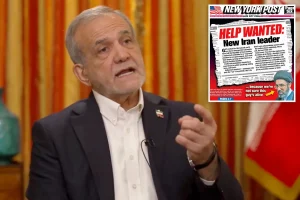






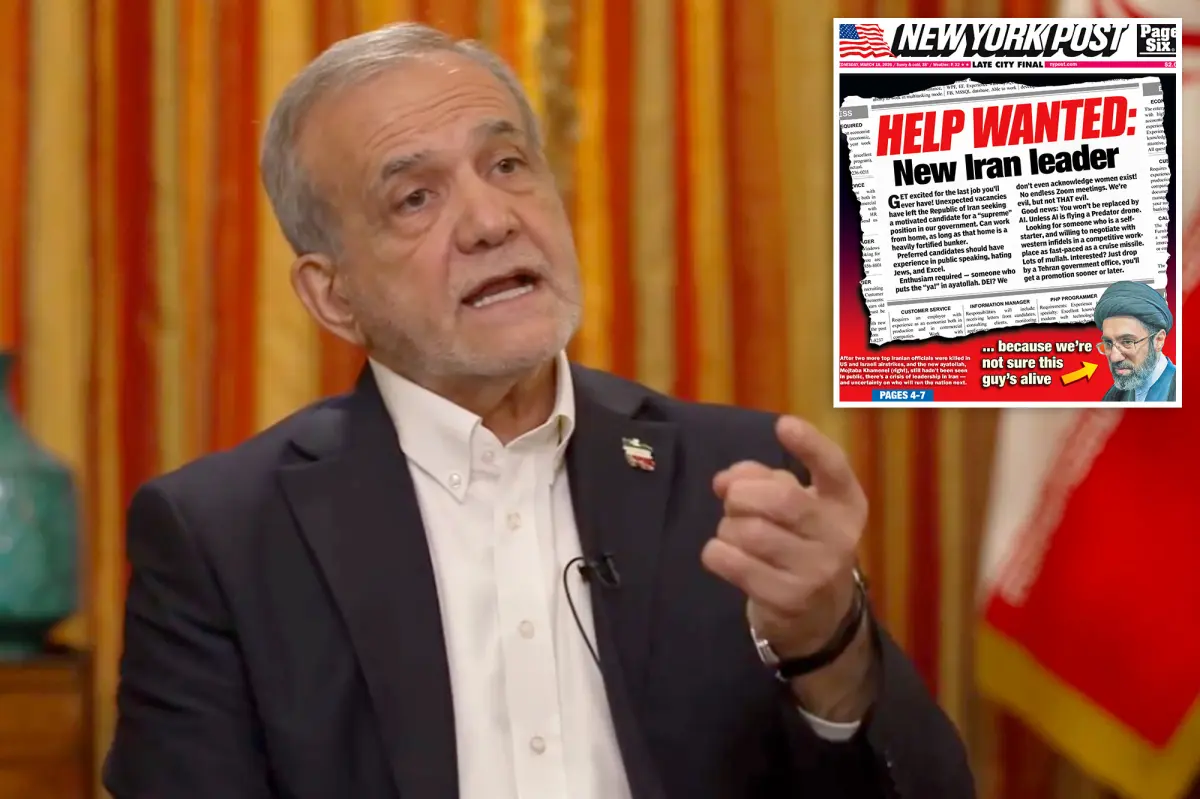
In the echo chamber of modern geopolitics, where information is weaponized and reality is often filtered through the fog of war, few statements manage to be both profoundly reassuring and hauntingly unsettling as the one issued by Iranian President Masoud Pezeshkian recently. Amidst the rubble and the smoke of a conflict that has devastated his nation, a singular question hangs over Tehran like a persistent shroud: does the invisible Supreme Leader, Mojtaba Khamenei, actually exist in a tangible, functional capacity? Pezeshkian, acting as both a political figurehead and a conduit for a hidden authority, stepped into the international spotlight to answer that question. In an exclusive interview with Fox News’s Bret Baier, he did not just affirm the leader’s existence; he painted a vivid picture of a face-to-face, intimate encounter that lasted a staggering seven hours. The meeting, he claimed, occurred about a month to a month-and-a-half ago—a specific enough timeframe to ground the narrative in a sense of recent truth, yet vague enough to remain utterly unverifiable. This single claim forms the bedrock of a narrative designed to reassure a nation and a world that the man at the top is not merely a ghost, but a fully engaged, all-powerful hand steering the ship of state through the most perilous waters it has ever faced.
The details Pezeshkian offered were sparse, yet the missing details are where the human story truly lies. What does one discuss with a supreme leader who has been reduced to a spectral figure in the national consciousness? Seven hours is an eternity in the realm of political negotiations; it is the length of a full workday, a transatlantic flight, or a deep, exhaustive therapy session. For Pezeshkian, that block of time must have carried an immense psychological weight. It suggests a meeting not of ceremony or public relations, but of sheer, unadulterated strategy and survival. One can almost imagine the dimly lit room, perhaps somewhere deep within a secure bunker or a fortified compound, where the two men sat across from each other, the silence punctuated by urgent consultations, maps of conflict zones, and the heavy burden of a country under siege. Pezeshkian’s lack of precise dates—shrugging it off with an “I don’t remember. About a month”—adds a disarming touch of human fallibility to his otherwise politically polished appearance. It is a small, almost trivial detail, but it humanizes him. It suggests a man burdened by countless sleepless nights, where the exact demarcation of weeks blurs into a continuous stream of crises. In that moment, he is not just a president; he is a weary administrator giving a status report to a sovereign, albeit one who remains hidden from the very people he rules. The fact that he chose to discuss this meeting openly with an American outlet suggests a calculated desperation—a need to project stability outward to the very nation that is bombing his country, while simultaneously trying to calm the frantic whispers at home. It is a tightrope walk over an abyss of distrust, where every word is a potential misstep.
To understand the gravity of this claim, one must revisit the tragic crucible in which it was forged. The date February 28th stands as a scar on the Iranian psyche, marking the moment the American war machine descended with brutal, unforgiving force. It was in that initial wave of airstrikes that Masoud’s father—the revered Ayatollah—was killed, a devastating blow that fractured the spiritual leadership of the nation in a single, deafening blast. Mojtaba Khamenei, now 56, was caught in that same maelstrom of fire and shrapnel. The whispers that have circulated since then speak of horrific injuries, burns, and internal trauma that would have felled a lesser man. The public has been shown nothing: no video, no photograph, no soundbite. Since his ascension to the supreme leadership in the chaotic aftermath, he has existed only as a concept, a voice relayed through intermediaries, a signature on state documents. In the human mind, the absence of visual proof breeds a fertile ground for doubt. Is he in a hospital bed, unable to move or speak clearly? Is he leading from a shadowy wheelchair, his mind sharp but his body broken? Pezeshkian’s suggestion of his “complete” health flies in the face of every natural instinct of a public that has seen their leaders fall. The trauma of that day is not just political; it is visceral, deeply personal for millions who mourned the old leader and now fear for the new one. For a nation grieving a father and praying for a son, the seven-hour meeting is a fragile lifeline—a glimpse—that he is not just alive, but miraculously, undauntedly vital. It is a story of survival against all odds, a narrative that humanizes the invisible ruler by casting him as a resilient survivor who clawed his way back from the brink of death to guide his people, even if only from the shadows.
The core of Baier’s pressing questions revolved around a fundamental paradox: can a spiritual and political sovereign govern effectively from the void? Pezeshkian’s response was resolute—”Very much so, completely.” He insisted that his administration is actively receiving “directions” from Khamenei. This is the most crucial element of the claim, because it shifts the narrative from mere existence to active, functional leadership. Yet, for the human mind, this raises more questions than it answers. How do these directions arrive? Are they written by an aide? Dictated over a secure line? Do they come with the same ironclad authority that once emanated from the public Friday prayers that galvanized millions? The human aspect of this dependency is a delicate dance of trust and anxiety. For Pezeshkian, staking his entire presidential legitimacy on the invisible will of a man he claims is healthy is a terrifying gamble. If Khamenei were to die tomorrow, or if it were revealed that he is incapacitated, Pezeshkian would not just lose a leader; he would lose the anchor of his own political legitimacy. This is a deeply human vulnerability—the need for a father figure, a guiding compass, is deeply rooted, and the Iranian state is currently projecting that need onto a silhouette. Pezeshkian’s insistence almost sounds like a desperate plea, a mantra repeated to convince himself as much as the world. He carries the government on his shoulders, but the steering wheel is held by a phantom, and every turn of that wheel requires a leap of faith. He is asking his people to trust him just as he claims to trust the hidden leader, creating a chain of belief that is both awe-inspiring and utterly fragile. The weight of that responsibility is palpable in his words, a burden that would crush a lesser man.
To deflect the skepticism, Pezeshkian wove a narrative of external aggression. He attributed Khamenei’s inexplicable reclusiveness to the “lack of security that was created by the action of foreigners… the action of aggressors.” This is a profoundly human defense mechanism—blaming the chaos of the outside world for a retreat inward. It is not an unreasonable fear; after all, the enemy successfully killed his father in a targeted strike. If the intelligence networks that hunted the father are still actively hunting the son, then absolute secrecy becomes not a sign of weakness, but a necessary tactic of survival. One can humanize this by imagining the paranoia that must grip such a man. Every window is a potential sniper’s nest, every crowd a potential bomb. To appear on video is to give the enemy a geographic and biometric signature. By framing this as a security imperative, Pezeshkian is asking the world to understand a ruler’s ultimate vulnerability: the fragility of his own breath. It transforms Khamenei from a godlike figure into a hunted animal, a man whose most basic instinct—self-preservation—now dictates the entire architecture of the state. It is a tragic, almost Shakespearean plight: to lead a nation of millions, you must become a recluse, isolated from the very adulation and interaction that historically defined your role. The “directions” he sends are the only proof he exists, a thin, invisible thread connecting the hidden king to his visible subjects. This humanizes the supreme leader by making him relatable in his fear; he is not invincible, but rather a man who is terrified of being the next target, and his retreat is a testament to the brutal reality of modern warfare where even the highest authority cannot escape the bombs.
In the final analysis, Pezeshkian’s assertion is a masterclass in political survival, yet it is also a deeply human tragedy unfolding in real time. The world watches a nation navigate a war while its supreme commander remains a myth. For the average Iranian, the question is not just about political legitimacy, but about their own psychological anchor. They are asked to take up arms, endure sanctions, and sacrifice their lives for a leader they cannot see, touch, or hear, save for the secondhand assurances of a president who himself looks weary under the strain. The seven hours Pezeshkian spent with Khamenei represent a reservoir of faith that the rest of the country cannot access. It is a memory that he hoards, doling out only fragments to a desperate public. Whether his claim is a bold-faced lie to maintain national morale or a genuine testament to a miraculously resolute leader, the outcome is the same: a nation’s stability teeters on the credibility of a single man’s word. It speaks to the eternal human dichotomy between faith and empiricism. We demand proof, yet we often accept belief. Pezeshkian is asking the international community to make a massive leap of faith, to believe in an invisible hand guiding an ancient civilization. In doing so, he reveals the profound loneliness of modern power. The curtain of war has fallen, the actors have been scattered, and the leading man is performing his most critical role from a closet, relying on whispers and shadows to direct an epic that is still being written in blood. Whether this story ends in triumph or tragedy, the human spirit’s desperate need to project strength and stability amidst chaos ensures that the phantom leader will remain a potent, if invisible, force in the coming months. This is not just a geopolitical update; it is a story of a traumatized nation, a frightened ruler, and a president who carries the weight of a thousand secrets, hoping that his brave face will hold the fraying fabric of his society together just a little while longer.