




Every September, the United Nations General Assembly turns New York into a swirling vortex of diplomatic declarations, side meetings, and carefully calibrated press conferences. But for Saudi Arabia’s foreign minister, Prince Faisal bin Farhan Al Saud, this year’s gathering carried a much sharper urgency. Just hours before he sat down with reporters, Saudi air defenses had intercepted six ballistic missiles fired by Yemen’s Iran-backed Houthi rebels toward the cities of Taif and Yanbu. It was the kind of incident that rarely makes headlines beyond the region anymore, yet it is exactly the kind of event that should. The prince used his moment on the global stage to push back against the idea that this is Saudi Arabia’s fight alone. “The fact that the Houthis are threatening the Bab el-Mandeb, threatening international shipping, is a risk to international security stability,” he said. “That means that the responsibility to dealing with this threat is not just on Saudi Arabia, it is also on the whole international community.” It was a carefully worded but unmistakably blunt message: the missiles striking Saudi soil are aimed at the arteries of global trade, and the rest of the world cannot keep looking away. For years, the Houthis have been dismissed as a localized militia with limited reach. But they have evolved into a more dangerous force, armed with ballistic missiles, drones, and the backing of a regional power with its own ambitions. By standing at the United Nations and calling for collective action, Prince Faisal was making a calculation that many nations make in times of crisis: when your own defenses are holding but the threat is expanding, you need the world to understand that your problem is also their problem.
The attack that prompted those remarks was stark enough on its own. The Saudi-led coalition announced early Thursday that it had intercepted the six ballistic missiles, apparently aimed at both Taif and Yanbu. It was not immediately clear whether the missiles caused any casualties or damage, but the gravity of the moment was inescapable. Saudi authorities issued emergency warnings across several areas, including the holy city of Mecca and the bustling port city of Jeddah, directing residents to take shelter until the immediate danger had passed. Those warnings were later lifted, but the psychological residue of such events lingers. For the people of western Saudi Arabia, the sound of air defenses and the rush of alerts have become part of life in a region where the Houthis have repeatedly tried to strike deep into the kingdom. Yanbu is particularly significant. It is not just another city along the Red Sea coast; it is a major export hub for Saudi oil, a vital piece of the country’s economic infrastructure. The Houthis know this. They know that hitting Yanbu is not merely a symbolic gesture but a way to threaten Saudi Arabia’s commercial lifeline and, by extension, global energy markets. The attack also came at a moment of heightened tension in the wider region, with the war between Israel and Iran disrupting shipping through the Strait of Hormuz and making every chokepoint from the Persian Gulf to the Red Sea a potential flashpoint. In that context, the Houthis have discovered that they do not need to win battles in Yemen to wield enormous influence. They can simply fire a missile, seize a ship, or menace a strait, and the entire world has to take notice. The urgent warnings in Jeddah and Mecca, two cities that represent the spiritual and economic heart of the kingdom, were a reminder that no distance from Yemen’s front lines is truly safe in this conflict.
Speaking on the sidelines of the General Assembly, Prince Faisal did not hide Saudi Arabia’s position. He made clear that the kingdom was defending itself and would continue to respond to attacks. “So we are, of course, defending ourselves. And we are responding as necessary to the attacks by the Houthis,” he said. But he was equally clear that Saudi Arabia should not have to carry the burden alone. “But we are also, of course, coordinating with all of our international allies, because this is not just about Saudi Arabia.” He thanked the countries that have already stepped forward to work with Riyadh and confirmed that discussions with Washington were ongoing. “And we are obviously continuing to work with our partners in the U.S., to address the issue of this conflict as well,” he added. His tone was diplomatic, but his underlying point was impossible to miss. The Houthis are not just a Yemeni problem or a Saudi problem. They are a direct threat to the Bab el-Mandeb Strait, a narrow waterway that links the Red Sea to the Gulf of Aden and serves as one of the most heavily used maritime corridors in the world. Every day, oil tankers and container ships move through those waters carrying billions of dollars in cargo to Europe, Asia, and beyond. If the Houthis are allowed to turn that passage into a free-fire zone, the consequences will not stop at the Arabian Peninsula. Shipping costs will rise, insurance premiums will spike, energy prices will climb, and the global economy will feel the pain. That reality does not fit neatly into the usual narrative of a proxy war between Iran and Saudi Arabia, but it is the truth. Prince Faisal’s appeal was an invitation for the international community to recognize that the threat is no longer contained, if it ever was. He was asking for partnership, not pity, and certainly not permission to respond. Saudi Arabia has shown time and again that it can project power when it needs to. What it wants now is a world that understands the stakes.
The question of what the United States is willing to do loomed over his remarks, even if the prince did not dwell on it publicly. Reports have surfaced in recent days that President Donald Trump considered launching direct American military strikes against the Houthis but ultimately decided against them, at least for now. According to a report from Axios on September 21, Saudi officials had again requested American military assistance as Houthi forces advanced across Yemen. The administration, for its part, has continued to provide intelligence and targeting support to Saudi Arabia, but it has held back from directly entering the fight. That distinction matters. It is one thing to help Saudi Arabia improve its ability to intercept incoming missiles, and quite another to put American pilots and warships in a sustained confrontation with a well-armed militia that has proven resilient despite years of sanctions and air strikes. The Houthis, after all, are not a conventional army. They are an entrenched force with a multibillion-dollar proxy network that has survived American pressure, Saudi bombardment, and internal Yemeni power struggles. Some former Pentagon officials have warned that the Houthis have effectively entered an American “kill box” after seizing what was once described as a cork in the Red Sea, meaning the military options are becoming more consequential but also more urgent. The Trump administration appears to be weighing the risks of escalation against the risks of doing nothing. The calculus is not easy. Direct American strikes could degrade Houthi capabilities, but they could also draw the United States deeper into a regional war at a time when Washington is already stretched across multiple crises. Saudi Arabia, meanwhile, finds itself in a peculiar position. It has one of the most advanced air defense systems in the region, but it is facing an adversary that keeps attacking in a manner designed to exhaust and distract. The prince’s public reassurance that the kingdom was defending itself may have been intended as much for skeptical American audiences as for the Houthis. It was a way of saying that Saudi Arabia is not asking the United States to do its fighting for it, but that the fight itself belongs to everyone.
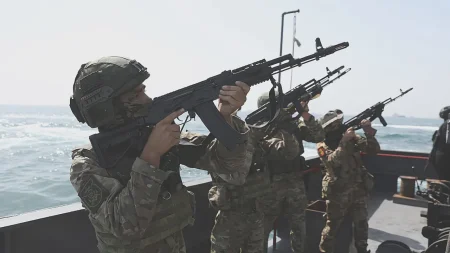
At the heart of the crisis is the Bab el-Mandeb Strait, a strip of water that carries enormous weight in international trade and maritime security. The Houthis have expanded their control along Yemen’s western coastline in recent weeks, edging ever closer to the strategic waterway. This is not just a territorial gain on a map. It is a game-changing development for the security of the Red Sea and the global economy. The strait is already one of the world’s most critical chokepoints. Ships moving between the Mediterranean, through the Suez Canal, and on to Asia must pass through the Bab el-Mandeb. If that route is disrupted, vessels have no easy alternative. They could be forced to sail all the way around Africa, adding weeks to voyages and enormous costs to everything from oil to manufactured goods. For Saudi Arabia, the strait is also a vital outlet for its energy exports. The kingdom has spent heavily on infrastructure and security to ensure that its oil can reach global markets, but no amount of desalination plants or ports can fix a hostile force stationed within striking distance of the waterway. The Houthis have demonstrated that they do not need a navy to threaten shipping. They have used drones, missiles, and booby-trapped boats to harass ships in the region. By seizing territory along the coast, they have given themselves a platform to escalate those attacks. The danger is not merely hypothetical. There have already been moments in recent years when tankers were targeted and crew members were held, and the world saw how quickly the price of oil and the cost of shipping can react to such crises. Prince Faisal’s warning was, in many ways, a description of the present tense. The Houthis are not waiting for permission to become a global threat. They are already acting like one. The question is whether the international community will treat them as a shared problem or let the burden fall on the countries closest to the fire.
There is something deeply human about the moment Prince Faisal found himself in at the United Nations. He was not giving a lofty speech about values and ideals. He was describing the reality of a region that has learned to live with the sound of sirens. The emergency warnings in Jeddah and Mecca, the missiles over Taif, the anxious wait to learn whether the interceptors worked, the relief that follows when the danger passes, all of this is the daily texture of life for millions of people in Saudi Arabia. Yet the prince kept trying to widen the lens. He reminded everyone that the threat from the Houthis extends far beyond his country’s borders, that the responsibility to confront it belongs to the whole international community. His words were, perhaps, an attempt to break through the fatigue that has settled over so many conflicts in the Middle East. This is not a new war, after all. Yemen has been collapsing for years, and Saudi Arabia has been enmeshed in that conflict for most of that time. The world has become accustomed to headlines about Houthi missiles and Red Sea shipping, and familiarity has bred a kind of indifference. But Prince Faisal was insisting that indifference is a luxury no one can afford. For every missile intercepted, there is a reminder of how close the region is to a wider conflagration. For every attack on a tanker, there is a reminder of how fragile the global supply chain truly is. His message to the world was simple: do not wait for the crisis to reach your shores, because it already has. It is in the price of goods, the cost of oil, the deployment of warships, and the urgency of diplomacy. The international community can pretend that Yemen is a faraway problem, but the Red Sea connects the East and West. The Houthis have made themselves a gatekeeper of that connection. Prince Faisal’s appeal may not have moved every delegate in New York, but it was the kind of warning that history has a way of proving right. The world can either act together now or wait until the next intercepted missile becomes a strike that was not intercepted. The Saudi foreign minister has made his choice, and he wants the rest of the world to make theirs.