





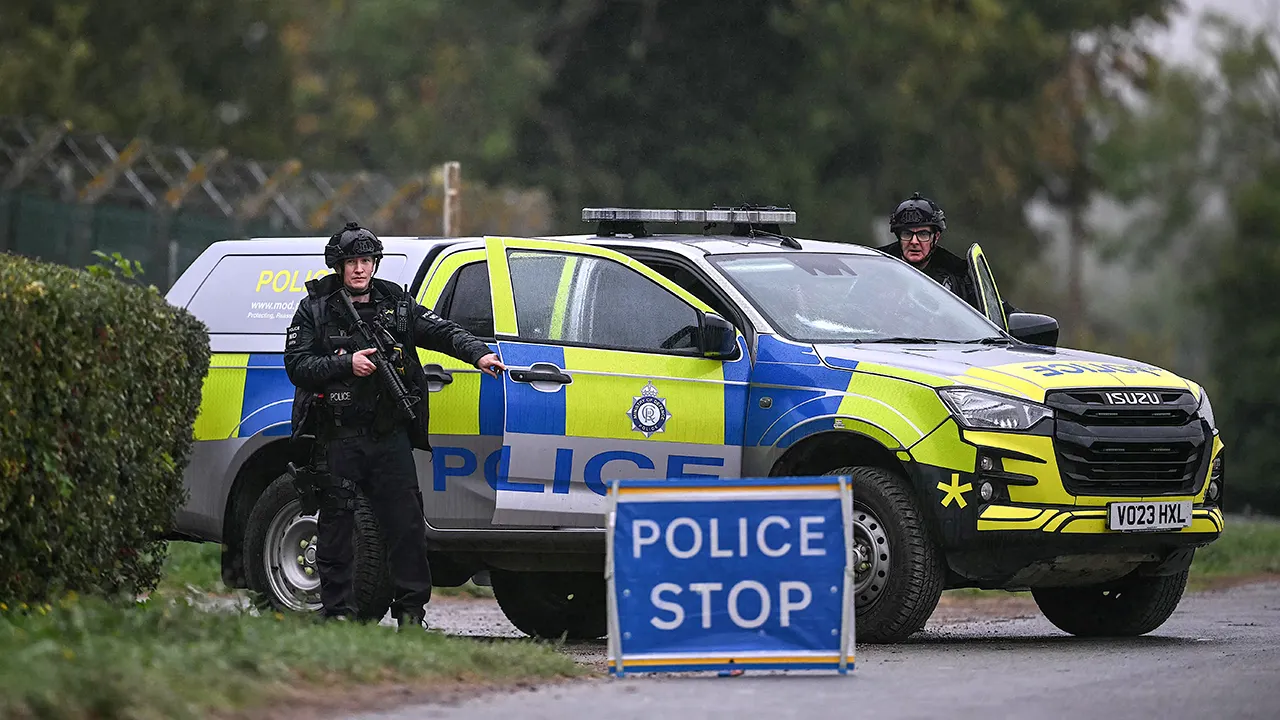
Imagine a quiet stretch of English countryside near the Cotswolds, where rolling fields and sleepy villages give little hint of the high-stakes military activity just down the road. That calm was shattered recently when armed police swooped in on a convoy of vans parked barely 350 yards from RAF Fairford, a Royal Air Force base that American forces use for operations against targets in Iran. Inside those vans, according to reports, were explosive materials and five British nationals, all arrested on suspicion of preparing terrorist acts. The scene was dramatic enough on its own, but the timing made it even more unsettling. It came just days after Britain’s Foreign Secretary, Ed Miliband, had shaken hands with Iran’s top diplomat at the United Nations, a gesture meant to signal diplomacy but which critics saw as appeasement. Now, with the arrests, the question hanging over London is whether the British government has been too soft on Tehran, and whether it fully understands the threat lurking in its own backyard.
The political fallout has been intense, and it has exposed a deep divide in how Britain approaches Iran. On one side, there is the Labour government, led by Prime Minister Keir Starmer, which seems eager to keep channels of communication open with the Islamic Republic. On the other, there are security experts and conservative commentators who argue that such outreach only emboldens a regime that has long targeted British soil. Nile Gardiner, director of the Margaret Thatcher Center for Freedom at the Heritage Foundation, did not mince words when he spoke to Fox News Digital from London. He called the arrests a likely Iranian-orchestrated attack, and he was baffled that the five suspects had been released on bail. “It strikes me as entirely insane,” he said, pointing out that the suspects appear to be Muslim Islamists. Gardiner went further, accusing the British government of being on a “full appeasement drive toward Tehran.” He cited Miliband’s meeting with Iran’s foreign minister at the U.N. General Assembly as evidence that the U.K. does not want to be drawn into a U.S.-led confrontation with Iran, and he described the current administration as a “socialist appeasement-minded British administration that is incredibly weak on defense and national security.” It is a harsh assessment, but it reflects a growing frustration among those who believe Britain has lost its nerve when it comes to confronting hostile state actors.
The investigation itself is still unfolding, and authorities have been careful not to draw definitive conclusions. A source familiar with the probe told Reuters that an Iranian-linked motive was considered the most likely explanation, but they also left room for other possibilities, including Russian sabotage or an Islamist plot. President Donald Trump, however, seemed far more certain. Speaking on Sunday, he said the suspects were “looking to do big damage” and claimed that authorities had been watching them for a long time before moving in. The U.K.’s Counterterrorism Policing Office confirmed that the five men were detained on suspicion of offenses under the Explosives Act and preparation of a terrorist act under Section 5 of the Terrorism Act. Deputy Assistant Commissioner Vicki Evans, the senior national coordinator for counterterrorism policing, described the operation as “hugely complex and large-scale,” involving local and national police, the Ministry of Defence, and other agencies. She acknowledged the intense speculation about the motivation behind the plot, but she stopped short of confirming any specific link to Iran. That cautious approach makes sense, given the diplomatic minefield, but it also leaves the public in a strange limbo, waiting for answers while the suspects walk free on bail.
To understand why Iran is such a prime suspect, you have to look at the broader pattern of behavior. The Islamic Revolutionary Guard Corps, or IRGC, has been designated as a terrorist organization by both the United States and the United Kingdom, and it has a long history of launching plots on British soil. Jason Brodsky, policy director at United Against Nuclear Iran, a group that tracks Iranian espionage and terrorist activities in the U.K., pointed to a recent case in Cyprus, where authorities arrested a man accused of spying for Iran at RAF Akrotiri. He also noted that Iranian officials and media have specifically mentioned RAF Fairford, calling it “an important matter for our self-defense” amid ongoing military operations. The context here is crucial. In late February, the United States and Israel launched a joint military campaign aimed at knocking out Iran’s nuclear weapons and missile systems. That campaign, known as Operation Epic Fury, naturally made any Western military base involved in such strikes a potential target for retaliation. The IRGC had already put the British government on notice in July, warning that military installations used to attack Iran would be considered legitimate targets. Brodsky explained that Iran has a long history of using criminal gangs as proxies to mask its involvement in terror plots, so it would be entirely consistent for Tehran to orchestrate something like this while maintaining a veneer of deniability. He suspects British authorities are probing those exact angles as part of the investigation.
Of course, Iran has denied any involvement, and it did so with characteristic indignation. The Iranian Embassy in London issued a statement categorically rejecting what it called “unfounded and malicious speculations” from British individuals and media outlets. The embassy argued that these fabricated stories, especially in the aftermath of what it described as “criminal acts of aggression” by the United States and Israel against the Iranian people, only serve to fuel Iranophobia propaganda in the U.K. It even reserved the right to take legal action to protect the country’s interests against misleading media narratives. That kind of response is predictable, but it does not erase the concerns raised by security experts. Barak Seener, a senior fellow at the London-based Henry Jackson Society, offered a particularly pointed critique of the British government’s priorities. He noted that while Miliband told Iranian Foreign Minister Abbas Araghchi at the U.N. that Britain would not tolerate intimidation or hostile activity on its soil, he was also sure to take a friendly photo with him while deliberately avoiding any meeting with Israeli representatives. Seener also highlighted a telling moment at the Labour Party conference, where Miliband spent only about 15 seconds discussing Iran but nearly four minutes on Israel. For Seener, that imbalance sends a dangerous signal, creating an environment where a suspected terror plot at RAF Fairford could actually take place. It is a damning observation, and it speaks to a broader anxiety about whether Britain’s diplomatic gestures are being interpreted as weakness by adversaries who respect only strength.
The British government, for its part, has tried to walk a careful line. A spokesperson said the police had issued a statement and that there was no further comment at this early stage. When pressed about Miliband’s meeting with the Iranian foreign minister, the government provided a readout that painted the conversation in firm but diplomatic terms. According to that readout, Miliband told Araghchi that Iran should choose de-escalation and diplomacy instead of prolonging the war. He stressed the importance of restoring freedom of navigation and fully reopening the Strait of Hormuz, warning that continued disruption threatens global security and economic stability. He also reiterated the U.K.’s unwavering resolve to combat threats from Iranian-linked groups on British soil, including attacks on the British Jewish community, and he made clear that Britain will not tolerate intimidation, threats, or hostile activity. Additionally, he raised the ongoing detention of Craig and Lindsay Foreman, a British couple held in Iran, repeating the call for their immediate release and emphasizing that their welfare remains a priority. All of that sounds reasonable on paper, but critics argue that actions speak louder than words. A friendly handshake, a carefully staged photo, and a diplomatic readout cannot easily be reconciled with the image of armed police discovering explosives near a military base. The situation remains fluid, and the investigation is far from over. But one thing is already clear: the threat from Iran, whether real or perceived, has become an inescapable part of Britain’s national security landscape, and the choices made in the coming weeks will determine whether the country is seen as a resolute defender of its own soil or as a nation that talks tough while quietly hoping the problem will go away.