






Across one of the coldest, most remote and strategically exposed corners of the United States, American and allied forces are quietly practicing for a fight no one wants to see. In western Alaska, along the Bering Sea and high above the Arctic tundra, troops have been moving rocket launchers over frozen ground, scrambling F-35 and F-16 fighters toward mock attacks, and sailing U.S. and Canadian warships through some of the most unforgiving waters on Earth. This is Tundra Merlin, an enduring military campaign designed to prove a simple but vital idea: even in Alaska’s vast wilderness and brutal Arctic conditions, the United States and its allies can pull together enough combat power to defend the northern doorstep of the homeland. For the men and women taking part, there is nothing ordinary about it. The cold seeps through gear, equipment must be coaxed to life in sub-zero temperatures, and the distances are so staggering that a single mistake can leave a unit isolated. Lt. Gen. Robert Davis, commander of Alaskan Command, says Alaska’s security picture has shifted dramatically. “I think what’s changed is primarily two things,” he told Fox News Digital. “One is that the melting sea ice has made the Arctic more accessible. And we’re seeing increased activity both commercially and militarily in the Arctic, particularly during the summer months.” The second, he said, is that China and Russia are pushing their own military ambitions into the region. That changing reality has turned a remote training ground into a proving ground for the Pentagon’s newest Arctic strategy, and Tundra Merlin is the way Alaskan Command is making sure troops are ready.
Alaska is not just an abstract outpost; it is a place where the world’s superpowers nearly touch. At the Bering Strait, the Russian and American mainlands are only about 55 miles apart, and two islands—Big Diomede in Russia and Little Diomede in Alaska—sit just 2.5 miles from each other. Strategists call Alaska the crossroads of the Arctic and the Pacific, and its value goes far beyond its striking geography. The state hosts major air bases, early-warning radar sites, missile-defense installations and tens of thousands of service members. U.S. Northern Command says Alaskan Command alone has more than 22,000 active-duty personnel across all services, plus about 4,700 Guard and Reserve members. From this high-latitude perch, American forces can reach almost anywhere in the Northern Hemisphere within about ten hours of flight time, according to Davis. That gives Alaska a dual role: defending the homeland and projecting power far beyond it. The Pentagon’s 2024 Arctic Strategy made clear that the era of benign neglect is over. It warned that growing Russia-China cooperation could “alter the Arctic’s stability and threat picture,” and called for more presence, more exercises and better preparedness in a region that is becoming easier to reach as sea ice melts. For the soldiers, sailors, airmen and Marines who call Alaska home, this is not geopolitical theory. It is the backdrop to every drill, every flight and every patrol. They know that the same distances that make Alaska a wild, largely untouched place are also what make it a potential avenue of attack—or a launchpad for a response.
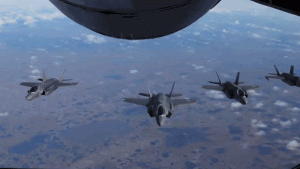
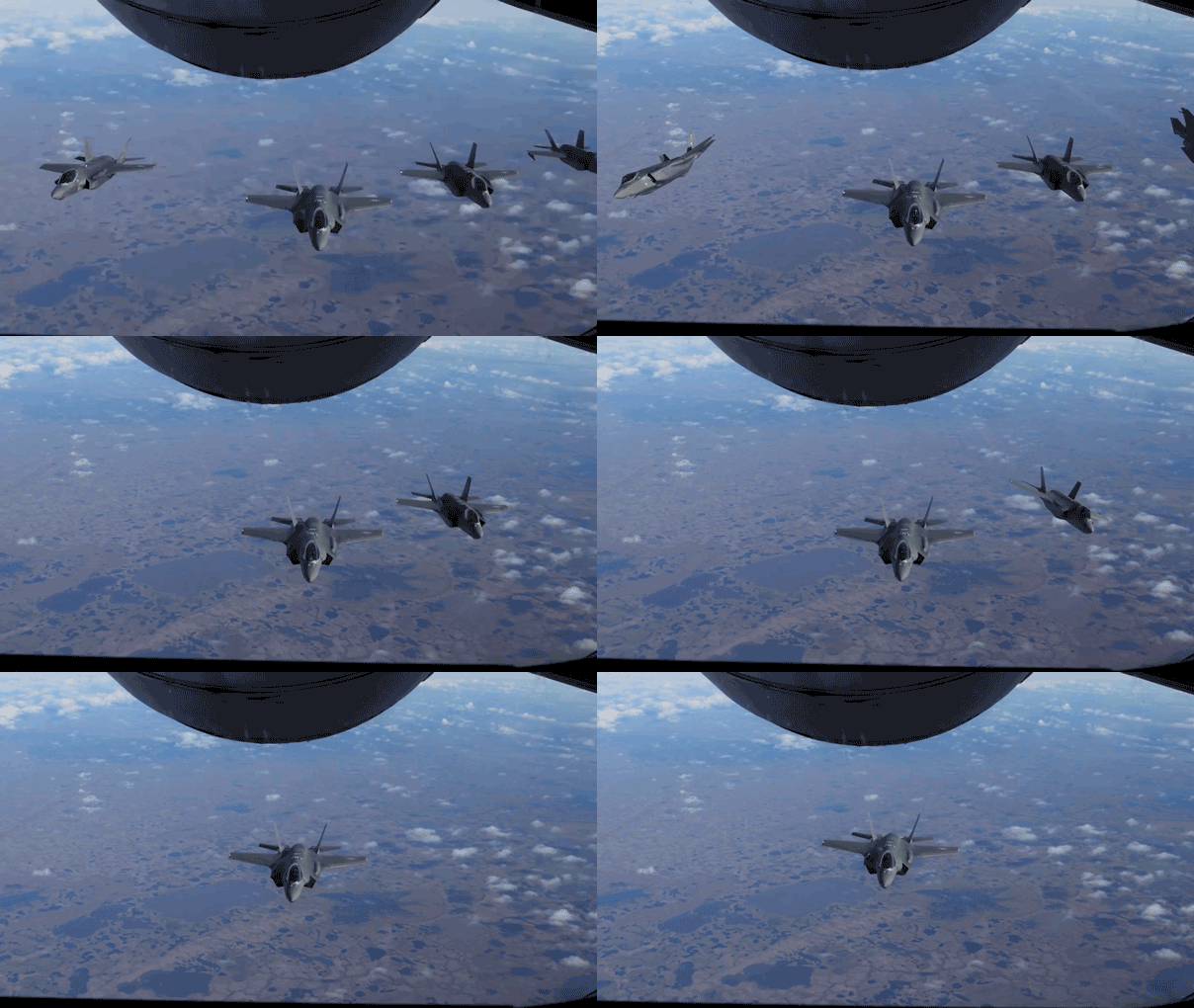
Tundra Merlin, Davis explained, is best understood as a playbook—a collection of military options that commanders can pull out to deter an adversary or answer aggression. “Our hope is that we don’t have any adversarial activity because we’ve effectively deterred it,” he said. “But if we do see it and we have kind of a play in the playbook ready to go for a response.” One of the most striking plays unfolded recently on Alaska’s western edge. U.S. and Canadian forces rushed a U.S. Army HIMARS mobile rocket system and an AN/TPQ-53 radar into western Alaska aboard a Royal Canadian Air Force C-17, then connected those ground forces with American F-35 fighters, F-16s and a KC-135 tanker operating overhead. In a tightly choreographed scenario, the F-35s and HIMARS synchronized to strike a simulated ground target about 135 miles away, while F-16s intercepted F-35s acting as simulated incoming enemy aircraft. For outsiders, it might have looked like a complicated game of tag in the sky. For the participants, it was a test of their ability to move pieces across enormous distances and fuse them into a single, lethal team. Davis stressed that the exercise wasn’t just about whether each weapon system worked. The real question was whether troops could get into a remote corner of Alaska, set up operations, and link together before an adversary could act. The quick transport by Canadian C-17 and the seamless coordination with fighter jets above demonstrated that they could. It also sent a quiet message: American and allied power can concentrate here faster than most adversaries might expect.
In September, Tundra Merlin pushed the same concept out to sea, where the Bering Sea lives up to its reputation as one of the harshest environments on the planet. From Sept. 18-22, U.S. and Canadian forces carried out a joint maritime strike exercise roughly 100 nautical miles north of Dutch Harbor. The scenario integrated U.S. Coast Guard cutters and Royal Canadian Navy ships and submarines with Canadian maritime patrol aircraft and Alaska-based U.S. Air Force F-35s and E-3 AWACS surveillance planes. Together, they practiced multiple simulated attacks on surface targets, testing whether information gathered by ships and aircraft could be passed quickly enough to identify, track and engage a potential threat. In an era when data can be harder to share than bullets, that is no small task. Davis said the most impressive part was watching units that do not normally work together click into a single formation. “To see the joint nature on the U.S. side integrated together with the inter-agency of the U.S. Coast Guard and with our allies, with Canada as an example, was just an amazing thing to see,” he said. For the sailors on the heaving decks, the pilots trying to pick out a ship in the gray Arctic gloom, and the radar operators watching blips merge into a common picture, it was a reminder that modern war is a team sport. The exercise proved that the Arctic environment can still host complex combat operations, and that the U.S.-Canadian partnership—honed over decades through NORAD—can be used in the maritime domain too.
What makes all of this difficult is Alaska itself. The extreme cold affects machines and humans alike. A battery that works at Fort Hood may fail on the Alaskan tundra; a bolt that turns easily in Texas can freeze solid. Davis said equipment has to be “conditioned” and “properly outfitted to operate in sub-zero temperatures for a long period of time.” Troops need special clothing, extra training and careful procedures to avoid cold-weather injuries, and commanders must account for the fact that a simple delay in moving a vehicle or refueling an aircraft can be amplified by weather and darkness. The Pentagon’s Arctic Strategy points to the same obstacles: enormous distances, limited infrastructure and the difficulty of sustaining forces in a region where roads are scarce and supply lines stretch across thousands of miles. In practical terms, that means being able to fight in the Arctic is not just about possessing weapons. It is about being able to survive in an environment that is relentlessly hostile. The military does not have the luxury of looking at Alaska through a map. It has to operate there, day and night, in storms that can arrive without warning and in temperatures that can turn a minor mistake into a grave emergency. Tundra Merlin’s training is designed to turn those challenges into muscle memory, so that when the real thing comes, the cold and the distance won’t be enough to stop the mission.
The urgency behind those exercises is rooted in a changing Arctic reality. In July 2024, NORAD detected and intercepted two Russian Tu-95 bombers and two Chinese H-6 bombers flying together in the Alaskan Air Defense Identification Zone. It was the first time U.S. and Canadian interceptor aircraft had met Russian and Chinese bombers operating together in that zone. The bombers stayed in international airspace and posed no immediate threat, but the event underscored exactly what Pentagon planners have been warning about: Russia and China are increasingly willing to operate together near North America. Davis said Alaska is currently “postured very well for any of the anticipated threats that we think would come our way in the very near term.” But he acknowledged that if intelligence showed a significant escalation, Alaskan Command would likely ask for more forces and capabilities. Tundra Merlin’s ultimate purpose, then, is to make sure that by the time commanders know they need more, the homeland already has a credible force in place. It is a strategy of deterrence through visible capability, and of response through rehearsed, rapid assembly. For the Americans and Canadians who train in one of the most difficult places on Earth, the work is not abstract. It is the quiet, steady preparation that keeps the northern edge of the continent safe—and shows any potential adversary that they are not alone in the Arctic. The exercises might not make headlines every day, but for the troops in the bitter cold, they are the clearest possible reminder that the world’s coldest frontier is also one of its most consequential.