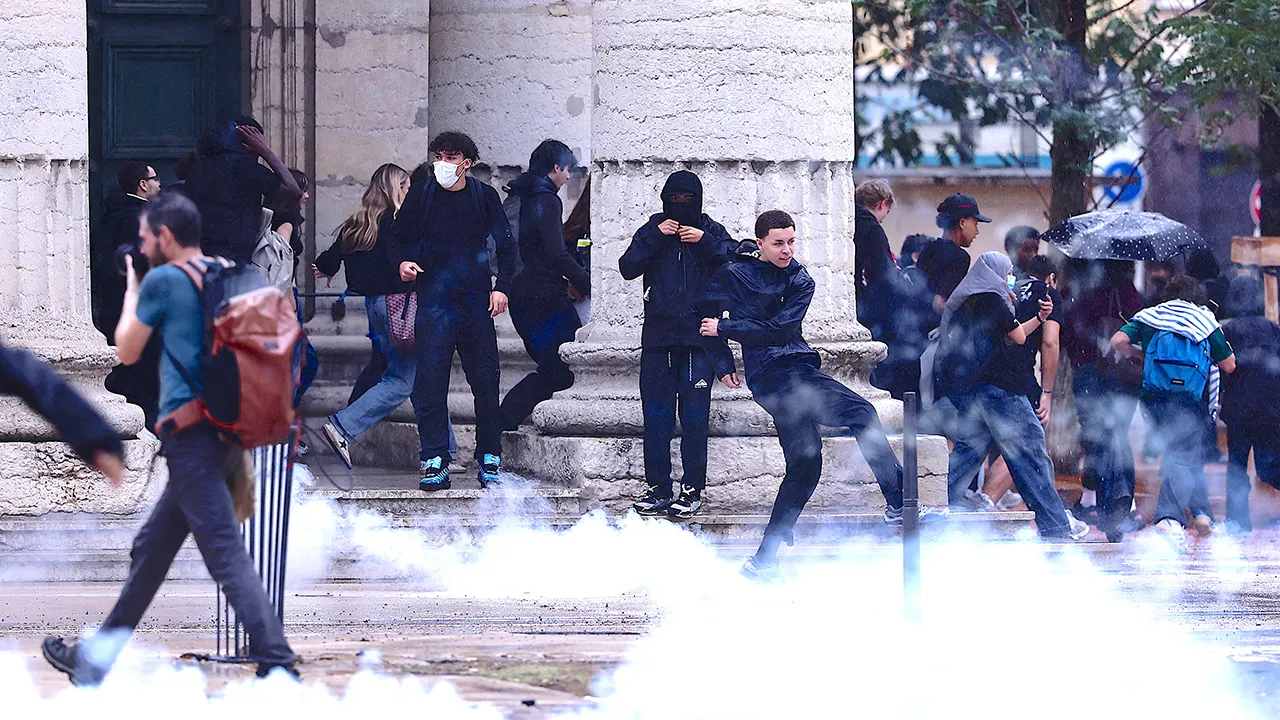
In the gray, industrial light of a chilly French Tuesday afternoon, amidst the cacophony of angry shouts and the acrid, stinging smell of tear gas, a moment of pure, devastating tragedy unfolded in the northern town of Lens. A 15-year-old boy, his face barely past childhood, his mind fueled by the righteous frustration of a student whose school was falling apart around him, spotted a cylindrical object lying on the rain-slicked asphalt. It looked like a piece of abandoned refuse, a harmless metal tubing discarded in the frantic mayhem of the day’s escalating unrest. But it was a police dispersal grenade—a tool of crowd control designed to repel and disorient aggressive crowds—and when the teenager reached down to pick it up, perhaps out of morbid curiosity, perhaps to hurl it back at the line of riot officers, or perhaps simply out of a dazed, terrified confusion in the smoke and chaos, it detonated violently in his grasp. The explosion ripped through the air, searing flesh and shattering bone, and in that fraction of a second, his life was irrevocably altered. He lost his hand and a significant portion of his lower arm, a grotesque, life-altering amputation that instantly turned a protest about overcrowded classrooms and missing teachers into a raw, visceral, and blood-soaked emblem of the violence now engulfing the French education system. The initial shockwaves of this incident were felt not just in the narrow streets of Lens, but rippled across the entire nation through flashing news alerts and frantic social media posts, serving as a stark, brutal punctuation mark to a wave of student demonstrations that had been simmering for weeks and were now boiling over into a national crisis. The sight of a child’s body being carried away, broken by the machinery of the state, forced a deeply uncomfortable question onto the mainstream: how did a simple plea for better schools spiral into such a horrific, irreversible physical tragedy?
To truly understand how a teenage boy ended up maimed and bleeding on the pavement, one must look past the surface-level chaos of shattered glass and burning trash bins and delve into the deeply decaying infrastructure of the French lycées. For months, if not years, students across the economic spectrum have been voicing a litany of grievances that paint a stark picture of a system stretched to its absolute breaking point. Classrooms designed to comfortably accommodate 25 students are routinely crammed with 40 or more, leaving little room for individual learning, no space for desks, and absolutely no chance for meaningful personal attention from instructors. The teacher shortage has reached catastrophic levels, with entire subjects—particularly mathematics, the sciences, and language arts—having no qualified instructor for weeks or even months on end. In many schools, students arrive for class only to find a blank chalkboard and a note saying the substitute hasn’t been hired yet, leaving them to self-study from outdated textbooks or simply wander the hallways, their education put on permanent hold. The physical state of many urban and suburban schools is a scar on the Republic’s promise of Liberté, Égalité, Fraternité: leaking ceilings that cause entire classrooms to be shut down, broken windows patched with cardboard, crumbling plaster that falls into students’ hair, and an overall atmosphere of profound dilapidation that sends an unequivocal message: the state does not care about your future. The protests began as a desperate, dignified plea in the impoverished suburbs of Paris—areas like Seine-Saint-Denis, where inequality and social marginalization are most stark—but they rapidly metastasized into a nationwide upheaval, spreading from the capital to Lens, Lyon, Marseille, Toulouse, and beyond. This grassroots anger is further amplified by a volatile political context: a major presidential election looms on the horizon, and students, many of whom feel profoundly abandoned and overlooked by the outgoing Emmanuel Macron administration, view this moment as a final, crucial opportunity to make their voices heard before the entire political landscape is reshuffled.
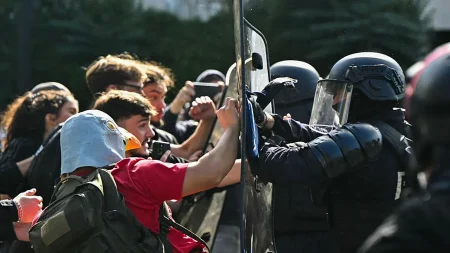
As the third week of student protests commenced, the initial, weary consensus of non-violent demonstration began to fray dangerously at the edges, directly leading to the explosive, catastrophic scene in Lens. According to François-Xavier Lauch, the prefect for the Pas-de-Calais region, the gathering in that town was never a peaceful sit-in or a quiet march; it was a full-fledged siege. Around 200 to 250 protesters, their faces flushed with anger, adrenaline, and the frustration of being ignored for so long, had taken to hurling a relentless barrage of stones, bottles, metal barriers, and other projectiles at the assembled ranks of gendarmes and riot police. The police, clad head-to-toe in heavy protective riot gear, faces hidden behind dark visors, responded with standard, mechanized crowd-dispersal tactics. This included firing volleys of tear gas canisters that filled the air with blinding, choking smoke, and critically, the launching of stun grenades—technically classified as non-lethal, yet undeniably dangerous munitions designed to create a deafening, earsplitting bang and a blinding flash of light to disorient, scare, and scatter dense crowds. However, in the brutal, fluid chaos of the melee, the crucial visual distinction between a projectile deliberately fired by the police and a harmless piece of metal resting on the ground blurred fatally for the 15-year-old boy. The situation across the country has escalated far beyond ordinary street scuffles; senior government officials are now reporting that the protests have devolved into outright, indiscriminate violence, with numerous schools being ransacked from the inside by frustrated pupils, their own classrooms becoming the unexpected battlegrounds where their immense rage and the state’s uncompromising authority violently collide.
Amid the shattered glass, the blaring sirens, and the pitter-patter of running feet, the voices of the students themselves cut through the noise like a knife, carrying a complex mixture of exhaustion, palpable fear, and an unwavering, almost suicidal stubbornness. On the streets of the capital, outside the Charles de Foucauld high school in Paris, an 18-year-old student named Sami Karen articulated the movement’s defiant core with heartbreaking clarity. “We’re going to keep blocking until the government hears us,” he declared to a Reuters reporter, his voice hoarse and strained from hours of shouting at police lines and fellow demonstrators. “As long as they don’t listen to us, we won’t stop this fight.” This is not the calculated, clinical rhetoric of a hardened revolutionary plotting a coup; rather, it is the desperate, heartfelt plea of a young man standing on the precipice of adulthood who has watched his educational opportunities slip away like sand through his fingers. Their defiance is rooted in a fundamental, deeply felt sense of injustice—the firm belief that the French Republic is actively failing a generation by allowing its schools to rot, its teachers to flee, and its students to be treated as an afterthought. They see the massive police presence on their doorstep not as neutral protectors of public order, but as aggressive enforcers of a corrupt, neglectful system that refuses to listen. The shocking, horrifying image of a 15-year-old boy losing his hand is tragic, rubbing raw the national conscience, yet for many students on the front lines, it is also a potent rallying cry. They argue, with bitter logic, that the state’s heavy-handed, militarized response only proves their point: that they are being treated as criminals, terrorists, and subhumans simply for demanding the basic, non-negotiable right to a functional education in a safe building. This pushes them further into a corner, where direct confrontation seems like the only remaining language the government will understand.
The sheer, staggering scale of the state’s crackdown is massive, painting a grim and uncomfortable picture of a central government reeling from the unexpected unrest. The French Justice Ministry has revealed that over 5,000 individuals have been taken into custody since the protests first ignited, and in a deeply troubling, sobering statistic, an extraordinary 87% of those arrested are minors—mere children in the eyes of the law. This means that thousands of teenagers, many of whom are only 14, 15, or 16 years old, have been thrown into police vans, processed through overcrowded holding cells, and subjected to intense interrogations. Currently, over 1,800 people are facing formal prosecution, with a staggering 1,483 of those individuals being minors. The specific charges levied against them remain undisclosed—they could range from obstructing traffic to aggravated assault on police officers—but the sheer, overwhelming volume suggests that the French judicial system is currently drowning, completely overwhelmed by the influx of cases generated from the school protests. Meanwhile, the government’s verbal response has been cautiously defensive, attempting to project an image of control. Education Minister Edouard Geffray acknowledged, in a carefully worded statement, that the wave of protests had been declining in intensity over the past few days, hinting that the absolute worst may have passed. As a gesture of good faith, he announced the launch of a new digital platform—a designated website where students can formally log their complaints and vent their dissatisfaction in a controlled, regulated environment. However, for the thousands of students currently sleeping outside their schools, blocking gates, and facing down riot shields, this platform appears as a weak, bureaucratic band-aid completely inadequate for a severe arterial wound. A digital complaint portal feels like a cynical, insulting gesture when the streets are still sticky with the blood of a peer who permanently lost a limb in a confrontation the government refuses to acknowledge as its own responsibility.
The tragic, bloody event in Lens, combined with the mass arrests of children, underscores a profound and dangerous rupture in the French social contract—a tacit, centuries-old agreement between the citizenry and the state. Historically, France has a proud, volatile, and enormously influential tradition of student protests, dating back to the monumental, paradigm-shifting events of May 1968, where youth revolts, barricades, and philosophical debates fundamentally reshaped the nation’s politics, social mores, and culture. However, this new wave feels distinctly different; it is less about abstract political ideologies, Maoist theory, or existentialist philosophy, and far more about the concrete, harsh, unfiltered realities of crumbling infrastructure, overflowing classes, and a shrinking, demoralized faculty. This movement is not a revolution for a new world; it is a desperate protest against the decay of the existing one. It serves as a warning shot fired directly across the bow of the French state, a clear, unambiguous indicator that decades of austerity, deregulation, and systematic neglect of public services have severe, tangible consequences for the nation’s most vulnerable citizens. As the highly contentious presidential election looms in the near future, this crisis will undoubtedly be weaponized by various cynical political factions—the far-right seeking to exploit fears of lawlessness and youth delinquency to push a law-and-order agenda, and the far-left attempting to channel the students’ boiling rage into a broader, unified anti-establishment movement against corporate elites. But for the thousands of minors currently shivering in police stations waiting for their parents to bail them out, and for the 15-year-old boy lying in a sterile hospital bed grappling with the loss of his hand, the abstract machinations of politics feel utterly irrelevant. The primary casualty of this entire affair is not just infrastructure or public order, but faith—the profound, eroded faith of a generation in its democratic institutions and its elected leaders. The French government may successfully launch its digital platform for complaints, and the protests may eventually fizzle out as the academic year grinds to a weary halt, but the scars left by this confrontation—both physical and deep psychological—will endure far longer than any short-lived political administration. They will serve as a haunting, permanent reminder of what happens when a nation fails to invest in its future, chooses to militarize its police instead of funding its teachers, and listens to its youth only when they throw stones, leaving them with nothing left to lose but the very body parts they need to build a future.