





Let’s be honest: the “bog standard” bed and breakfast has its place, but there’s something irresistible about a holiday where the accommodation itself is the story. These days, travellers can sleep inside an Airstream caravan, a Poké Ball-shaped hotel room, a Victorian water tower, or a snug cave carved into a hillside. Europe is especially good at this sort of thing, and according to a new ranking by the travel company Holafly, no country does it better than France. The study looked at Airbnb listings all over the world and sorted them into eight wonderfully eccentric categories: caves, castles, treehouses, houseboats, windmills, lighthouses, earth homes, and domes. After adding up the numbers by destination, France came out on top with a jaw-dropping 2,947 unusual stays. That’s more than any other country on Earth, and a fitting crown for the world’s most-visited nation. It makes sense in a way: France has always known how to do things with flair, and that extends to where you rest your head. But the real beauty of this ranking is that it goes far beyond simple bragging rights. It paints a picture of a country where ancient stone, wandering waterways, and rural wind create a patchwork of unforgettable overnight experiences. Whether you’re looking for a royal fantasy, a floating hideaway, or a piece of rustic history, France has a place for you—and, more importantly, a story for you to take home. The appeal is simple: in an age of identical hotel chains and predictable check-in desks, the unusual stay is a way of feeling truly alive while travelling.
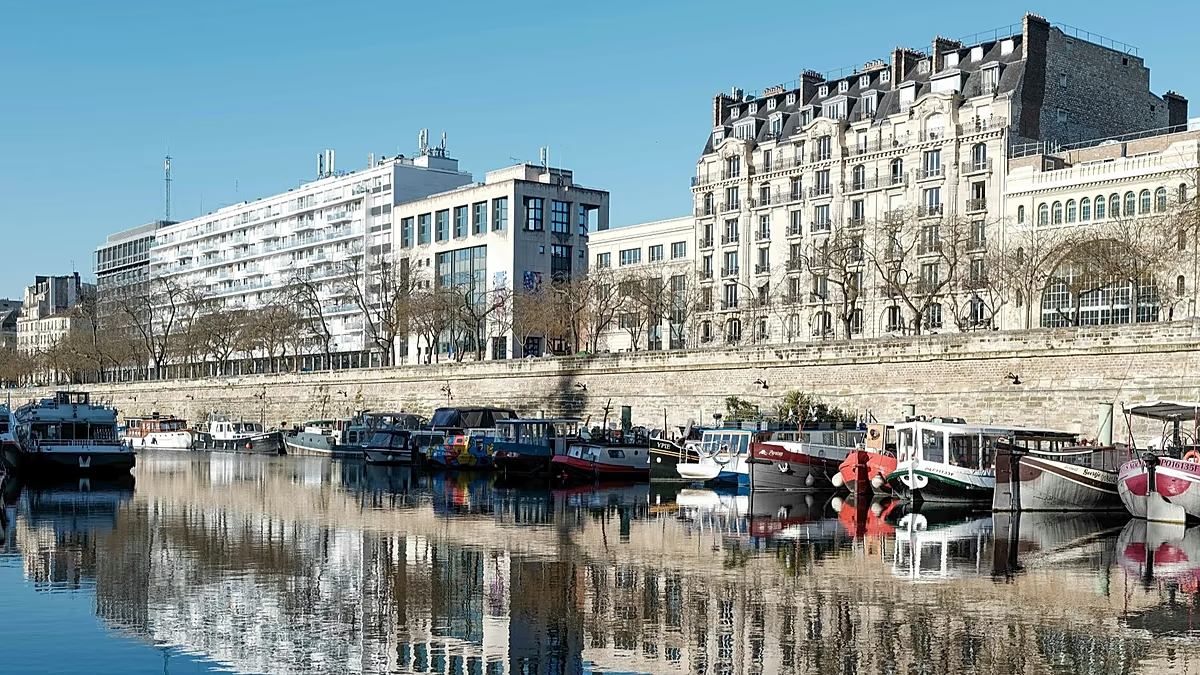
France’s victory isn’t a fluke or the result of one famous region—it’s a full-blown cultural phenomenon. The country offers more than 1,000 bookable castles, which alone would make it a medieval dream destination. Imagine waking up in a turreted château in the Loire Valley, with tall windows opening onto manicured gardens and the smell of fresh bread drifting from a nearby village bakery. Some of these castles are grand and formal, with banquet halls and long galleries; others are cosy country manors with old fireplaces, creaking staircases, and a cat asleep on the stone terrace. Add to that more than 400 houseboats, and France becomes an aquatic wanderer’s paradise. On the canals of Burgundy, the Camargue, or the waterways around Paris, you can rent a barge or a converted péniche, moor outside a village market, and wake up to nothing but the sound of water lapping against the hull. Then there are the windmills—more than 30 of them bookable across the French countryside. Many have been lovingly restored, with old wooden beams and grinding stones still visible, but with cosy bedrooms tucked beneath the sails. It’s the perfect blend of rustic and romantic. The rankings also show that France attracts plenty of treehouses, domes, caves, and other unusual categories, though its castles and houseboats are the true showstoppers. There’s something wonderfully French about the way these old structures have been given a second life—not as museums, but as places where ordinary travellers can live like local lords, bargemen, or millers for a night. You don’t have to be a millionaire to sleep behind medieval stone walls; you just have to know where to look.
Claiming third place in the overall ranking is Italy, with 1,050 unconventional stays, and it’s easy to see why. Italy doesn’t just have history—it wears it. In Tuscany, you can book a stay in a fairy-tale castle surrounded by cypress trees and vineyards, where the biggest decision of the day is whether to sip the local Chianti on the terrace or by the pool. Puglia offers something even more distinctive: the trulli, those strange, cone-roofed stone huts that look like they’ve wandered out of a hobbit’s village. Made from local limestone and whitewashed to a dazzling shine, these little structures were originally farmhouses and storehouses, but many have now been converted into intimate holiday homes. To sleep in a trullo is to be wrapped in centuries of rural Italian life, with thick walls that keep the summer heat at bay and the winter chill out. Then there’s Matera, a city that looks almost impossibly ancient because it is. Its famous Sassi districts are a labyrinth of cave dwellings carved into the rocky hillsides, and in recent years many of these caves have been transformed into stylish hotels. You can have a sleek, minimalist bedroom with a rainfall shower and strong Wi-Fi—while the walls around you have been standing since the Middle Ages. It is a magical contradiction, and one that travellers have truly fallen for. Italy’s mix of natural caves, engineered stone houses, historic castles, and even the occasional windmill makes it a standout in the ranking, but more than that, it shows how different kinds of “unusual” can coexist in one country. From the southern villages of Puglia and Basilicata to the northern hills of Tuscany and Umbria, every corner of Italy seems to have some quirky overnight option waiting to be discovered.
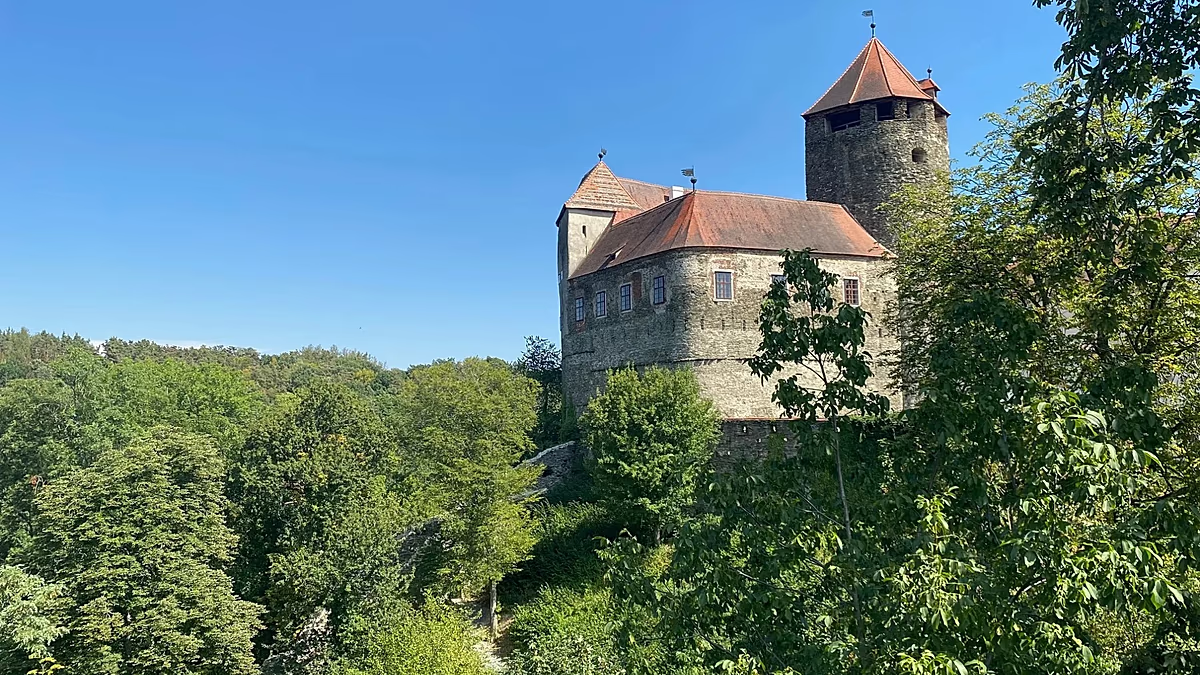
Further north, the United Kingdom lands sixth in the overall ranking with 696 unusual stays—and it might be the most fun to browse. The UK has nearly 250 castles, which is no surprise for a country that practically invented the romantic ruin. You can stay in a restored Victorian castle in Scotland, a moated manor in England, or a Welsh fortress that once guarded a mountain pass. The stone walls may be chilly in places, but there’s often a four-poster bed, a crackling log fire, and a breakfast tray to make it all feel luxurious. But the UK’s real quirk factor lies in its abundance of domes—almost 150 of them. These include everything from futuristic eco-pods with wrap-around windows to bubble-like glamping structures in the middle of meadows, perfect for stargazers who want to feel like they’re sleeping outside without actually camping. For those who prefer being on water, there are more than 100 houseboats in the British mix. Picture a brightly painted narrowboat moored along a canal in London or the Cotswolds, with a cast-iron stove, a snug bedroom, and ducks bobbing by your window in the morning. Then there are the 23 lighthouses and 12 windmills. Staying in a lighthouse is one of the most romantic ideas imaginable: you climb a spiral staircase, eat dinner in a circular room with panoramic windows, and fall asleep to the sound of waves crashing somewhere below. Windmill stays, meanwhile, are scattered across the countryside, offering the same rustic charm as their mainland European cousins but with a very British sense of cosiness. And if you step just outside the ranking categories, the UK also offers Victorian water towers turned into eccentric holiday rentals—proof that British hospitality has never been short of imagination.
Greece, which places ninth overall with 599 unusual stays, has a very clear specialty: caves. With 279 cave accommodations listed, it is the undisputed champion of sleeping underground—but in the most beautiful way possible. On the island of Santorini, cave houses built into the caldera cliffs have become some of the most sought-after stays in the world. Their walls are carved straight into the volcanic rock, painted white, and often punctured by a deep blue dome that gives you a direct view of the Aegean Sea. Inside, it’s all smooth curves and cool air, a welcome break from the Greek sun. You might sleep in a bed tucked into an alcove, with only the sound of the sea far below and the soft evening wind above. Elsewhere, cave stays can be found in Crete, where old shepherd shelters have become minimalist hideaways, or in tiny island settlements where the homes seem to grow out of the earth itself. Greece is also second in the world for windmill stays, with 27. In the Cyclades, most famously on Mykonos, Rhodes, and even quieter islands like Folegandros and Sifnos, windmills have been converted into guesthouses with thick walls, small windows, and terraces that catch the famous Aegean breeze. The sails may no longer turn, but the views still do—white villages tumbling down to blue bays, sunsets that turn the sky pink, and mornings that feel suspended in time. Staying in a Greek windmill or cave isn’t just accommodation; it’s a way of stepping into the landscape. You become part of the island’s geological and cultural fabric, if only for a few nights.
Of course, Europe isn’t the only place where unusual stays are thriving. The Holafly ranking is a truly global affair. The United States takes second place with 2,533 listings, thanks to a mix of forest treehouses, desert earth homes, and coastal lighthouses. Brazil and Colombia round out the top five with 873 and 762 respectively, proving that Latin America is full of ingenious eco-lodges, jungle huts, and mountain hideaways. Mexico follows with 675, India with 604, and Chile rounds out the top ten with 548—the latter being a wonderland of geodesic domes, Patagonian cabins, and adobe earth homes. What all these places have in common is the desire for something more than a standard hotel. Travellers are no longer satisfied with a generic room and a continental breakfast. They want texture, story, and a little bit of magic. An Airbnb stay in a French castle or a Greek cave may not be as convenient as a hotel, but it’s far more memorable. It gives you a photograph you won’t have to explain, a conversation starter at dinner, and a feeling of having truly been somewhere. The success of these unusual stays also reflects a deeper shift in travel: people are looking for connection. Staying in a converted windmill or a lighthouse means living inside local history, supporting people who care about preservation, and treating the place you visit as something more than a backdrop. The Holafly ranking, with France on top, is a reminder that the world is full of strange, beautiful, and wonderful places to sleep. Whether you choose a royal castle, a floating houseboat, a cone-roofed trullo, or a cave carved from ancient rock, you are guaranteed one thing: you’ll never look at a standard bed and breakfast the same way again.