




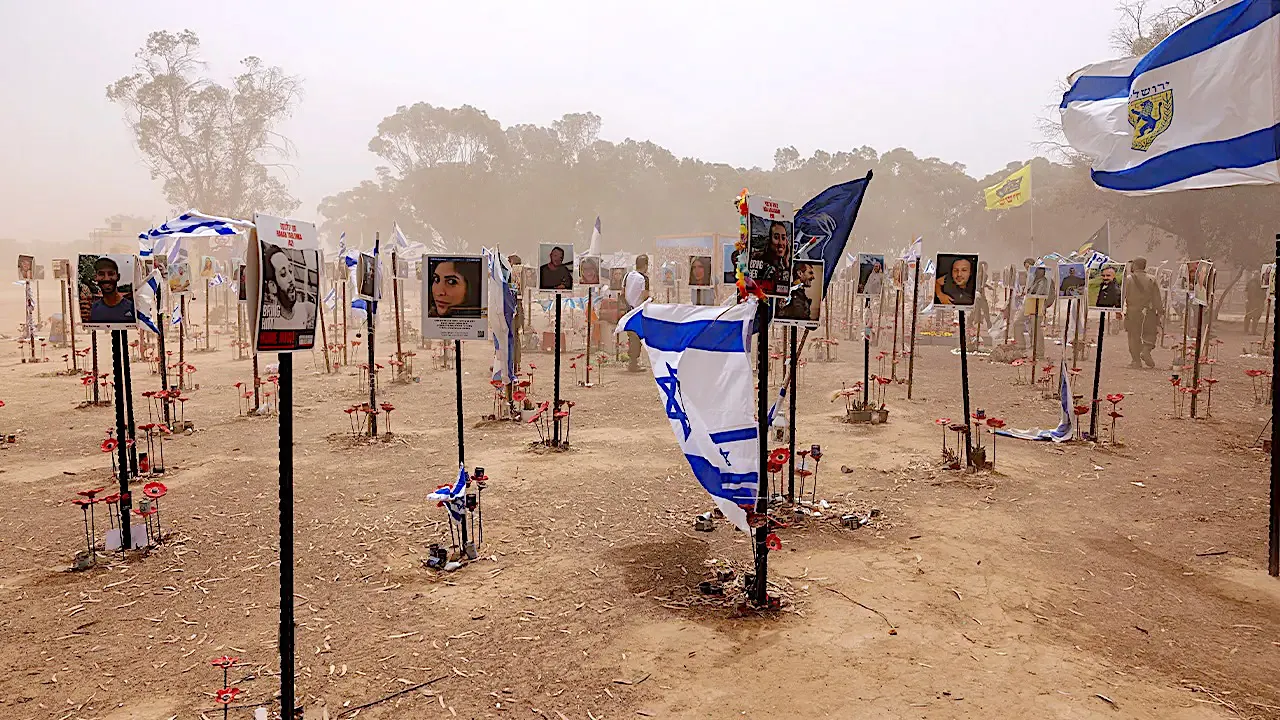
Three years have passed since October 7, 2023, but for those who lived through it, the day has never truly ended. It lingers in the sound of a ringing phone, in the quiet of a safe room, in the faces of the missing. As Israel marks the anniversary of the Hamas-led massacre, the country remains absorbed in a long and painful process of recovery, and among the most powerful testaments to that resilience are the stories of ordinary citizens who transformed into first responders, caregivers, and lifelines in the middle of chaos. Nil Kirsht-Levi, a nurse with Clalit Southern District, lives in Kibbutz Magen, a small farming community near the Gaza border. When the attack erupted on the Jewish holiday of Simchat Torah, she spent the morning in her safe room, treating patients remotely while trying to protect her three children as terrorists moved through the community, going from house to house. At the same time, her phone buzzed with desperate messages from her sister, Rimon Buchshtab-Kirsht, who lived with her husband in nearby Kibbutz Nirim. The day would end with a toll that still feels unbearable: more than thirty of her patients killed, more than two hundred people she knew murdered, and roughly one hundred people she knew taken hostage. Yet in the years since, Kirsht-Levi has somehow found a way to keep moving forward, not despite the grief but alongside it. “I’m lucky to have a job that saves me, healthy children, a healthy husband,” she said quietly. “We work every day to recover and rehabilitate ourselves. Every day, we fall and get back up, but we are here — for ourselves, for others and we have won.”
The personal loss at the center of Kirsht-Levi’s story is almost too much to hold. On the morning of October 7, her sister Rimon sent a message saying she could hear Arabic being spoken outside, that terrorists had entered her home, and then the messages stopped. What followed were weeks of agonizing uncertainty—no answers, no word, no comfort—until Kirsht-Levi finally saw her sister alive in a Hamas propaganda video. That image, terrible as it was, became a kind of proof: Rimon was still breathing, still existing somewhere in the tunnels and hidden rooms of Gaza. Kirsht-Levi threw herself into the campaign for her sister’s release, speaking to anyone who would listen, carrying her sister’s name through the long days of waiting. Fifty-three days later, Rimon was freed as part of a ceasefire deal, returning emaciated and covered in scars, alive but permanently marked by her captivity. The reunion was bittersweet in the most brutal way: Rimon’s husband, Yagev Buchshtab, had been murdered by the terrorists. He would not be coming home. And yet, even inside that unbearable mixture of gratitude and grief, Kirsht-Levi has tried to honor both the living and the dead by continuing to serve. She still works as a nurse, still tends to survivors, still shows up for the community she calls home. “We should never forget,” she said, “but we must move forward, live every moment and keep going. It’s a privilege to be alive.” Her words are not a slogan. They are a hard-won conviction, forged in the rubble of a day that tried to erase everything she loved.
Another woman whose life was upended and reshaped in a single morning is Michaela Koretsky, a midwife with Clalit’s Southern District who lives on Kibbutz Alumim. She was jolted awake at 6:29 a.m. by air raid sirens, the same sound that has become synonymous with terror for millions of Israelis. As rockets streaked overhead and armed men crossed the border, she rushed with her husband and children to the shelter, her mind racing with the ordinary fear of a parent trying to keep her family safe. Then came a message from Eran, a member of the kibbutz’s civil defense squad, asking if she was home. Within minutes, he was at her door, carrying Amichai, a young member of the kibbutz covered in blood. The gunfire outside the kitchen window was constant, but Koretsky felt something shift inside her. “When they entered the house carrying Amichai, he was covered in blood… I switched into nurse mode,” she said. She had him placed on the floor, improvising bandages from whatever she could find, starting an IV, and staying in contact with an emergency room doctor from Soroka Medical Center who was also trapped in the kibbutz. The doctor confirmed that Amichai was stable, but the next wounded man, Eyal, arrived with a bullet lodged in his lung. Koretsky worked quickly, placing him on an IV and giving him oxygen, but it was clear that he needed more help than she could provide in a shelter with terrorists moving through the streets. She did not allow herself to think about the danger. “We needed to save lives, so I switched my brain into action mode and did what needed to be done,” she later said. “The whole time I did not think that the terrorists would enter my house.” But one of her children was terrified that the attackers would discover where the wounded were being taken and come after them. Koretsky told herself a simple sentence to keep going: “I am protected. It will not happen.”
Her husband, Tzviki, became part of the rescue in a way that still seems impossible. Accompanied by members of the kibbutz’s civil defense squad, he reached his car and made a decision that would save lives: he would drive the wounded out under fire. Alone, under a sky full of rockets and in a landscape where Hamas gunmen were still hunting civilians, he evacuated both Amichai and Eyal to Netivot, where ambulances were waiting to take them to Soroka Medical Center for urgent surgery. It is the kind of courage that does not feel heroic in the moment, because there is no time to feel anything except the need to act. Koretsky’s story is not just about her own bravery, but about the unexpected network of neighbors, medical professionals, and ordinary people who turned a kibbutz into a makeshift field hospital and then into an evacuation route. She did not see herself as a hero. She saw herself as a midwife, a woman whose entire professional life had been devoted to bringing life into the world, suddenly forced to fight for lives on the edge of death. Her hands, trained to catch newborns, instead pressed bandages into wounds and held IV lines steady. In the years since, she has had to live with the memory of that morning, with the sound of gunfire outside her kitchen window, with the image of Amichai’s blood on her floor. But she has also lived with the knowledge that she did not freeze, did not turn away, did not let fear make her useless. She stayed, and because she stayed, two men are alive today.
The hospital that received Amichai and Eyal was itself a battlefield that day. Prof. Shlomi Codish, director of Soroka Medical Center in Beersheba, made three lifesaving decisions in the early hours of October 7 that would shape the response to the deadliest terror attack in Israel’s history. First, he and his team decided not to send the night shift home, meaning the hospital began the day with twice its normal staffing. Second, at 7:45 a.m., they declared a mass-casualty incident even before they knew how many wounded would arrive, alerting all available staff to report to the hospital. Third, they ordered additional blood supplies in anticipation of a surge that had not yet reached the doors. “We usually start the shift with 50 units of blood in our blood bank,” Codish said. “By the end of the day, we had given 250 units. If we hadn’t ordered additional blood early that morning, we might have run out and people may have died.” Those three decisions—made in minutes, under pressure, with incomplete information—were the difference between life and death for dozens of people. But even with that preparation, the scale of what hit Soroka was overwhelming. In the first twenty-four hours, the hospital received 674 wounded people. At the peak, more than 80 arrived in a single hour, with an average of just forty seconds between each patient being brought through the doors. The hospital itself was under fire, with dozens of incoming missile warnings from Gaza, while attacks were happening simultaneously at a shocking number of sites across the region. It was, Codish said, one of the largest mass-casualty events resulting from terror in human history, and the doctors and nurses who met it were themselves living through the same nightmare as their patients.
Perhaps the deepest challenge was not logistical but human. Every staff member who walked into Soroka that morning had left a family at home that might be under attack. They drove through air raid sirens in unprotected areas, at significant personal risk, to come save strangers. Once inside, they faced a hospital that had begun the day at full capacity, forcing them to quickly free up intensive care beds and operating rooms while ambulances were rerouted or held back because the roads were too dangerous. In the first hours, transferring patients to other facilities was not an option; sending ambulances into the field risked ambush by Hamas. There was nowhere to go, no way out, no backup beyond the people already in the building. Codish described seeing things that medical professionals are never supposed to see. “When you see babies or children with direct injuries, that is not something you typically see on a battlefield,” he said. “We saw elderly people with severe wounds inflicted directly, with no protection.” The brutality of the attack was not abstract. It was written on the bodies of the wounded, in the faces of the dying, in the silence of children whose parents were gone. “As a medical professional, what we saw was beyond words,” Codish said. “Two babies suffering from dehydration after their parents were killed, simply waiting to be rescued — I defy anyone to find a word other than ‘evil’ to describe it.” Yet even in that evil, he also saw something else: the refusal of ordinary people to abandon each other. The nurses who stayed past their shifts. The doctors who worked without sleep. The civilians like Kirsht-Levi and Koretsky who turned their safe rooms and kitchens into triage units. Three years later, Israel is still counting its dead, still fighting for its hostages, still trying to heal wounds that may never fully close. But the stories of that day are not only stories of horror. They are stories of mothers who became medics, nurses who became generals in small rooms, hospitals that became fortresses of compassion. The grief remains, and so does the determination. As Kirsht-Levi said, “We must move forward, live every moment and keep going.” That is the quiet victory of the survivors: not that they have forgotten, but that they are still here.