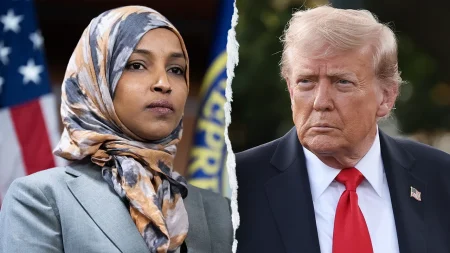


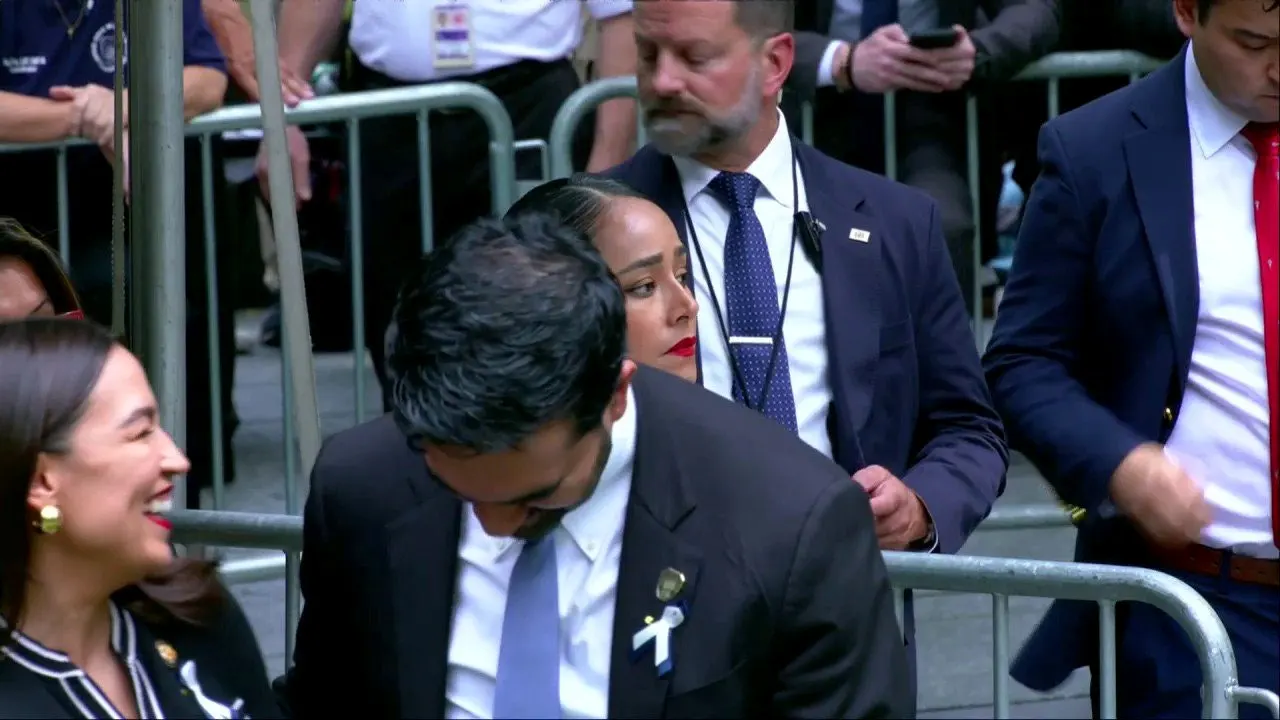
At the National September 11 Memorial in Lower Manhattan, the air was thick with the kind of grief that never really fades, only deepens. Friday’s ceremony marked twenty-five years since the deadliest terrorist attack on American soil, and as family members stepped forward one by one to read the names of the nearly three thousand souls lost, the ritual unfolded with the same aching solemnity it has carried every year since 2001. There were pauses to honor first responders, moments of silence, and tears that seemed to have been waiting all year to fall. And then, caught in a split-screen moment that would ignite a firestorm, the broadcast unexpectedly cut to two politicians on the memorial grounds: Rep. Alexandria Ocasio-Cortez and New York City Mayor Zohran Mamdani. The two were seen smiling and appearing to laugh during a whispered conversation, a flash of lightness that felt utterly out of place against a backdrop of collective mourning. The clip spread like wildfire, and before long President Donald Trump weighed in, calling the behavior “terrible” and “inappropriate” and insisting that Ground Zero was no place for laughter, especially during the reading of victims’ names. His words gave official voice to a wave of raw indignation, but they also opened the door to a deeper, more uncomfortable question: what do we owe the dead, and how do we judge the living when grief and humanity collide?
The controversy did not emerge from a vacuum. Mamdani’s presence at the memorial was already a flashpoint before the ceremony even began. A petition signed by more than 110,000 people, including families of 9/11 victims, had urged him to stay away, citing his political record and what critics described as a long history of hostile positions, particularly around issues relating to Israel and law enforcement. He was labeled by one councilwoman as a “vile antisemite,” and some mourners publicly said his attendance felt like an insult on a day meant to transcend politics. Yet Mamdani attended anyway, standing quietly in the crowd as names were read aloud. Then came the video: Ocasio-Cortez, the polarizing Bronx-born congresswoman known to the world as AOC, and Mamdani, the recently elected progressive mayor, caught in what appeared to be a moment of shared amusement. Their conversation was inaudible, but their expressions spoke volumes to millions watching at home. Within minutes, the internet had turned a split-second of footage into proof of disrespect. Rep. Wesley Hunt of Texas wrote on X that as the names of murdered Americans were read, the two were “laughing and smiling together,” adding sharply, “Ground Zero is sacred ground. September 11 is not a photo op, it is not a networking event.” Meghan McCain reacted with raw fury, asking simply, “Why the f— are these two laughing?” New York City Councilwoman Inna Vernikov piled on, accusing Mamdani of standing and laughing while families wept. The criticism was swift, bipartisan in its outrage, and utterly unforgiving.
But there is another side to this story, one that speaks to the messy, complicated nature of human behavior in moments of extreme emotional tension. Michael Ragusa, a longtime member of former Mayor Rudy Giuliani’s entourage, was standing near Ocasio-Cortez and Mamdani during the ceremony. He took to social media to push back against the viral narrative. “The videos of them laughing are not true. I was standing next to them the whole time,” he wrote. “The camera just caught her greeting him hello. Multiple other politicians were laughing and joking behind me. Republicans and Democrats.” His eyewitness account reminds us that context is often the first casualty of outrage. We are all too ready to believe the worst of those we dislike, and too slow to consider that a fleeting smile can mean a thousand things—nervousness, awkwardness, the reflexive attempt to make social contact in an unbearable situation, or simply the tail end of a somber greeting. The human brain, confronted with overwhelming sorrow, does not always respond with tears. Sometimes it reaches for the smallest gesture of normalcy as a lifeline. People laugh at funerals, not because they are mocking the dead, but because grief is too vast to be carried all at once, and the body must find some way to breathe. There is no evidence that Ocasio-Cortez and Mamdani were joking about the ceremony, the victims, or the families in attendance. There is no audio of their conversation. There is only a brief, ambiguous image and the certainty of those who have already decided what it means.
This episode reflects a broader cultural shift in how we process public tragedy and political figures. We have entered an age where every gesture, every glance, every unguarded facial expression is captured, amplified, and weaponized. No politician, celebrity, or ordinary citizen can pass through a moment of genuine emotion without being judged by millions who were not there. The 9/11 Memorial is perhaps the last truly sacred space in American public life, a place where the usual rules of political combat are supposed to yield to a higher reverence. As such, it demands a particular standard of behavior, and those who violate that standard—even unintentionally—should be prepared to face the consequences. If Mamdani and Ocasio-Cortez were indeed sharing a joke at the expense of the ceremony’s gravity, then the criticism is deserved. But if they were merely greeting one another, exchanging a word of comfort, or responding to the awkwardness of being watched by cameras while surrounded by grieving families, then the outrage is a profound injustice. The irony is that the very solemnity we are trying to protect can be undermined by our own willingness to strip every human moment of its nuance. We become so focused on policing the faces of others that we lose sight of the true purpose of the day: to remember the dead, to comfort the living, and to honor a resilience that transcends political factions.
Perhaps the most important perspective is that of the families who lost loved ones, and who now watch these episodes unfold from a place of unimaginable depth. For them, the reading of names is not a backdrop for social media commentary; it is the raw retelling of their own broken hearts. Every name spoken is a father, a mother, a sibling, a child, a friend. The ceremony is not merely a memorial; it is an act of continued connection, a way of saying to the world that these people mattered, that their lives were not statistics, and that the grief of their families will never end. To see politicians caught up in a moment of laughter, real or perceived, can feel like a betrayal of that sacred trust. But it is also worth remembering that those same families have stood at Ground Zero for twenty-five years, watching presidents and lawmakers come and go. They have seen countless politicians shake hands, hug one another, and occasionally smile in the quiet corners of the ceremony. They know better than anyone that public figures are not robots, and that a camera can turn a moment of human awkwardness into a scandal. Some victims’ families have defended Mamdani, noting that he stood somberly through much of the ceremony and that his presence was no more inappropriate than that of any other elected official. Others remain deeply hurt. Both reactions are valid, because grief does not follow a single set of rules. The challenge for the rest of us is to hold space for that complexity instead of rushing to judgment with the raw fuel of partisanship.
As the controversy continues to churn through cable news cycles and social media timelines, it is worth pausing to ask what we are actually hoping to accomplish with our outrage. Are we truly honoring the memory of those who died on September 11 by devoting hours to debating the facial expressions of two elected officials? Or are we using their image as a canvas onto which we project our own anxieties, resentments, and political battles? The day itself should be a reminder of what it means to be American in the face of horror: we came together, we held one another, we put aside our differences for a season and remembered that we were all part of a larger community. That spirit is fragile. It can be eroded by cynicism, by the constant churn of manufactured controversy, and by a culture that punishes any deviation from the script of public grief. None of this is to say that elected officials should not be held accountable for their conduct. They absolutely should. If Mamdani and Ocasio-Cortez were genuinely disrespectful, they should apologize, and the public has every right to express disappointment. But we should also be willing to accept the possibility that this was nothing more than a misunderstanding caught on camera, an optical illusion of the digital age. We could choose to extend grace to two human beings who stood in a place of profound sorrow, under the gaze of millions, and perhaps made the mistake of allowing themselves a moment of ordinary connection. That does not diminish the solemnity of the day. It only reminds us that even in the midst of sacred memory, we are still human—flawed, fragile, and forever struggling to find the right way to feel. If we can learn anything from twenty-five years of grieving together, it is this: the most fitting tribute to those we lost is not a perfectly stoic face, but a heart that refuses to let their names be forgotten, even when politics threatens to drown them all over again.