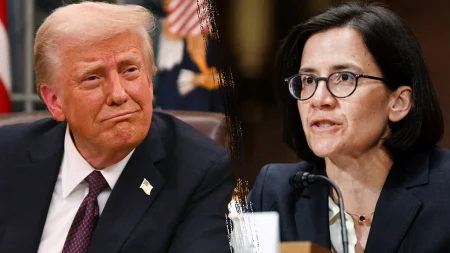



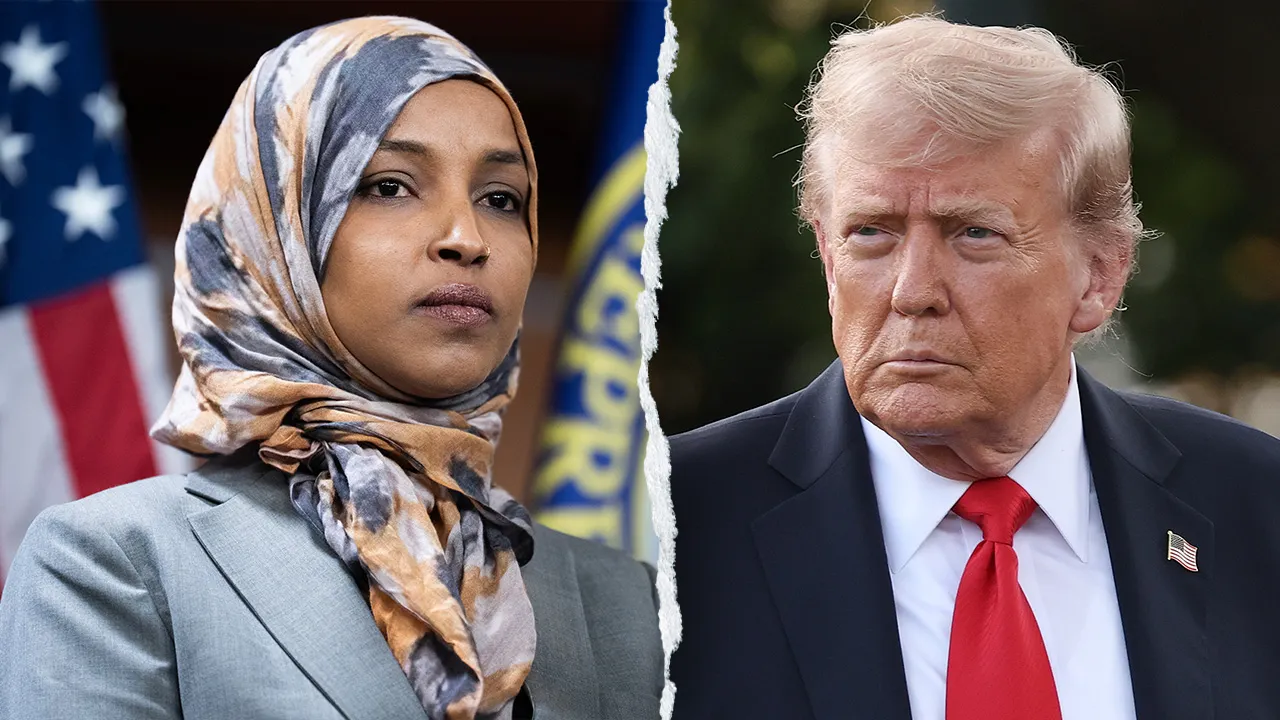
President Donald Trump’s remarks on Tuesday inside the Oval Office were startling not only for their directness, but for what they signaled about the escalating collision between political power and personal fate. Speaking during an event meant to highlight a federal program aimed at curbing fraud, Trump responded to a reporter’s question about Representative Ilhan Omar of Minnesota with a blunt and ominous assessment. “Well, she could be. She could also go to jail,” he said, referring to the possibility of deportation. The president did not cite a specific charge, nor did he present new evidence, but he doubled down on his characterization of the Democratic congresswoman as “a disgrace to our country” and “a very dishonest person” who “hates our country.” His comments were the latest and most severe yet from a president who has repeatedly used his platform to single out individual political opponents, and they came just days after federal agents searched Omar’s Washington, D.C., home and seized her cellphone and other possessions. The search was part of an ongoing federal investigation into allegations that Omar, or her father, misrepresented her birth year on immigration paperwork — a question that could ultimately affect the legality of her citizenship and, by extension, her place in American public life. Trump’s remark went beyond the legal uncertainty, though, by speculating openly about imprisonment. In doing so, he transformed a complicated legal matter into a deeply personal threat, one that Omar and her supporters would interpret as the culmination of years of targeting by the right.
The investigation at the center of this uproar is anything but simple. It hinges on a narrow but consequential detail: whether Omar was a minor when her father became a naturalized United States citizen in 2000, which would have allowed her to derive citizenship automatically through him, or whether she was already 18 and should have applied for naturalization on her own. If the allegations are proven, it could mean that Omar was not lawfully a citizen when she ran for and took her seat in Congress, and that she may have been in violation of immigration law for years. Border czar Tom Homan, who has been one of the administration’s most outspoken figures on immigration enforcement, has said that if investigators prove immigration fraud, the consequences could be severe. “Of course, if you lie during the naturalization process, there is a process to denaturalize somebody. We’ve done it before,” Homan said over the weekend. “And certainly, if the evidence points that way, that could happen.” He also confirmed that the investigation is criminal in nature and suggested that he has been briefed on its direction. “I’m not going to get ahead of the bureau or HSI,” he said, “but I’ve been told they have a strong case, and we’ll let the evidence lead where it leads.” For Omar, that is a chilling phrase. She has denied any wrongdoing, and her legal team has indicated that the documents and testimony surrounding her family’s immigration history will demonstrate that she did not knowingly or intentionally mislead authorities. Nonetheless, the investigation has already upended her life in ways that are hard to overstate: a search of her home, the seizure of her devices, the threat of losing both her citizenship and her freedom, and a public anatomy of her private family history conducted through the lens of partisan politics.
Omar’s defenders see all of this as a political vendetta rather than a straightforward legal inquiry. House Minority Leader Hakeem Jeffries, along with many other Democrats, has denounced the investigation as persecution aimed at a prominent critic of the Trump administration. Former President Barack Obama, in a lengthy and unusually forceful statement, accused the administration of “appalling” targeting of Omar and warned that the treatment of the Somali-born congresswoman sent a dangerous message about who is allowed to belong in America. The timing of the raid, weeks before the midterm elections, has only deepened suspicions that the investigation is designed to intimidate and to use the machinery of federal law enforcement to influence political outcomes. Omar’s supporters point out that she has long been a lightning rod: a woman, a Muslim, an immigrant, and a progressive who has not hesitated to criticize U.S. foreign policy, including the actions of Israel and the American military. She has been the subject of heated rhetoric and has faced threats to her safety even before becoming a member of Congress. Her home state of Minnesota has a significant Somali-American community, and many immigrants see in Omar’s ordeal a reflection of their own anxieties about citizenship, documentation, and belonging in a country where the rules can feel less like a path to safety and more like a trap. The human dimension of this story is not about abstractions like legal standards or federal jurisdiction. It is about a woman whose family fled war-torn Somalia, who grew up as a refugee, who worked her way into public service, and who now faces the sudden possibility of being ripped away from the country she chose and served.
Trump’s own comments further animated the controversy, and his tendency toward personal attacks made the situation more volatile. During the Oval Office exchange, he questioned Omar’s right to criticize American governance after arriving from Somalia. “Then she comes over here, and she says that she wants to tell us how to run America,” he said. “She wants to tell us how to run the United States of America.” He also expressed amazement that she was elected to Congress at all, and he attacked her for asserting constitutional rights, as though those rights were not hers to claim. The president’s words were echoed by his supporters, as they often are. At a recent rally, the crowd chanted “deport” as Trump ripped into Omar and the federal investigation. That chant, and the broader mood it reflected, revealed the degree to which the case has become a symbolic battle over national identity. For Trump and his allies, Omar represents a certain idea of illegitimate entrance, of loyalty divided against the United States, and of the arrogance of a newcomer who dares to critique her adopted homeland. For her supporters, the same facts are reframed as the story of an immigrant who survived war, embraced democracy, arrived through legal channels, and worked her way to a position where she could help shape the country she loves. The same woman is seen by different Americans as either a fraud or a trailblazer, a threat or a triumph. The truth of her immigration history will ultimately be decided by documents and testimony, but the meaning of the moment will be shaped by something larger: whether political figures can define citizenship as conditional, subject to revocation when someone disagrees too loudly with the government and its policies.
Beyond the immediate controversy, Omar’s turbulent week has reopened painful questions about the fairness of the immigration and naturalization system itself. Many legal experts have noted that birth-year discrepancies are not uncommon in refugee communities, where records are often destroyed, lost, or inconsistent due to war, displacement, and the chaos of fleeing a home country. Parents may not remember exact dates, or they may alter them for reasons unrelated to fraud, such as protecting a child from conscription or securing asylum under conditions of extreme duress. In Omar’s case, her supporters argue, the discrepancy might reflect the complicated realities of a family fleeing violence, not a calculated scheme to deceive the U.S. government. They also note that she was a child at the time, and that even if her father provided incorrect information, holding an adult woman responsible decades later for what was done in her name as a minor raises troubling questions about fairness and proportionality. Republican lawmakers, however, have been unforgiving. Some have called for Omar to be jailed and deported immediately if the allegations are proven, arguing that no one is above the law and that citizenship fraud undermines the integrity of the entire immigration system. They point to past cases where denaturalization was pursued, and they insist that Omar should be treated exactly as any other person would be. That insistence on uniformity, however, has been undermined by the tone of the political reaction, which has made Omar’s case a spectacle rather than a quiet administrative proceeding. The GOP reminder about past raids on other members of Congress, including Democrats, adds another layer: political leaders have long used the law as a weapon, and those who celebrated such tactics in the past cannot now feign outrage when their own allies are targeted. Yet the intensity of the response also demonstrates the special vulnerability of naturalized citizens, whose citizenship can be revisited and revoked in ways that are almost never applied to those born here.
At the heart of this story is a profound and uncomfortable truth about belonging in America. The president’s words, Tom Homan’s threats, the chants at rallies, and the furious responses from Democrats all point to a country deeply divided over who counts as an authentic American. Omar herself, despite the allegations, is a symbol of the immigrant story that has long been celebrated in American mythology: a person who came from elsewhere, endured hardship, embraced education, entered public life, and rose to a place of influence. Her critics, though, see her as the embodiment of a more recent fear: that immigrants are entering the country not to become Americans, but to recreate the problems they left behind and to impose foreign sensibilities on the nation. Trump’s repeated attacks on her, including his statement that she “hates our country,” suggest that for some, no degree of achievement or service can overcome the sense that she does not truly belong. That is what makes this case so painful to watch. It is not just a legal dispute over dates and documents. It is a public reckoning with the fact that citizenship, for some Americans, is a fragile shield — and that even the most prominent public official can be reduced, in an instant, to the status of an unwelcome outsider. There is also a deeply personal cost. Whatever the outcome, Omar’s family will have to relive the trauma of fleeing Somalia, the uncertainty of refugee status, and the fear of exile. Her children will have to watch their mother being publicly demonized. Her constituents, many of whom are immigrants themselves, will have to decide whether their own place in America is safe or whether they too are one legal technicality away from being erased.
Trump ended his Oval Office exchange by saying, almost as an afterthought, “I hope they treat her fairly.” It was a strange and contradictory note, following moments in which he had already declared her guilty in the court of public opinion. But perhaps it was also an acknowledgment that even he understands the gravity of what is at stake. If Omar is found to have committed fraud, she could lose her citizenship, be deported, and spend time in prison — a life-altering punishment for a woman who built her entire political career as a voice for the marginalized. If she is cleared, she will have endured a months-long torture of legal limbo, public humiliation, and the threat of exile, all because of questions that may never have had clear answers in the first place. The forces surrounding this case are enormous: presidential power, media scrutiny, partisan rage, and the everyday lives of ordinary people caught in the crossfire. In moments like this, it is worth remembering that behind every headline is a person who can feel fear, shame, anger, and hope. Omar is a public figure, but she is also a human being — a mother, a lawmaker, a refugee, an American. Whether one believes she is guilty of wrongdoing or innocent of every accusation, her story deserves to be told with the complexity and dignity it warrants. The nation’s promise has always been that justice would be blind and that the law would apply equally to everyone. The test of that promise now lies with a federal investigation, a legal system, and a society that must decide whether loyalty to the United States is measured by one’s birth certificate or by the content of one’s citizenship and service. As the case unfolds, the answer will shape not only Omar’s future, but the meaning of belonging at a time when that meaning is being fought over more fiercely than ever.