


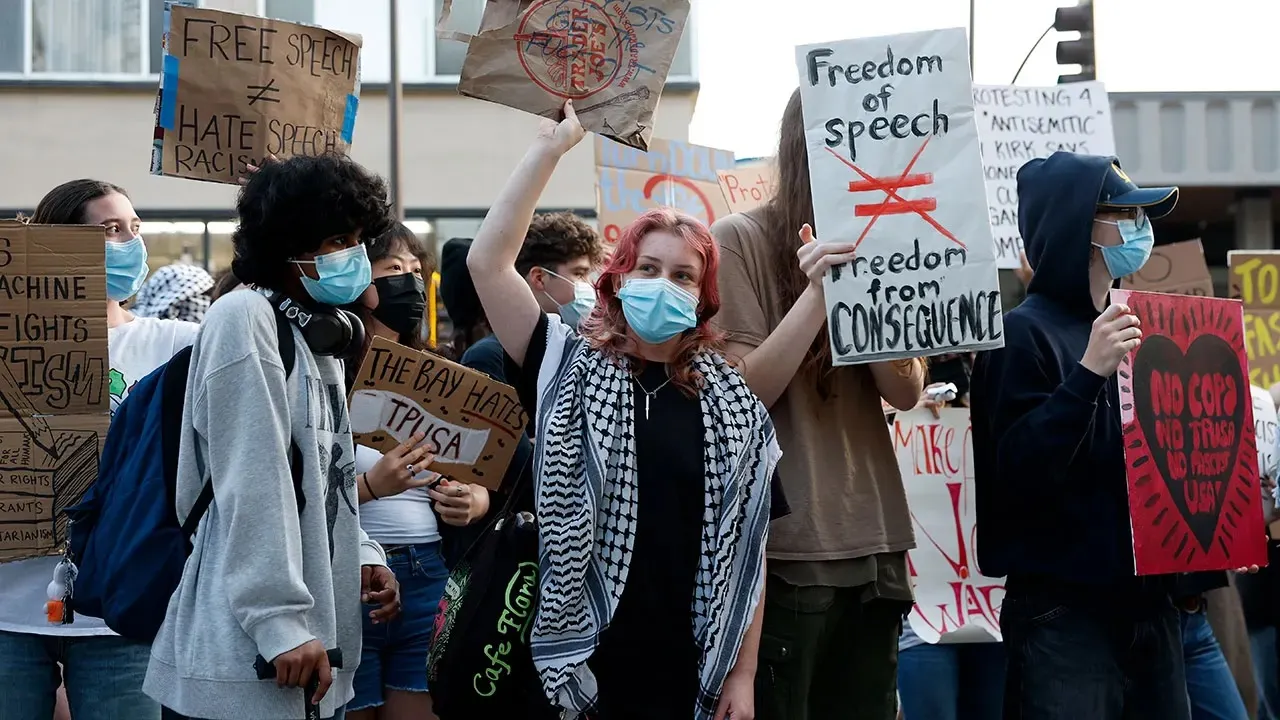
Imagine a university campus where the central question isn’t what you think, but how forcefully you’re willing to act on what you feel. That’s the unsettling picture painted by a new national survey, which suggests that a large portion of today’s undergraduates are willing to embrace violence in the name of stopping speech they don’t like. The Buckley Institute’s 2026 National Undergraduate Student Survey, conducted by Inquire LLC among 803 full-time undergraduates at four-year colleges and universities, found that 45 percent of students believe physical violence can be justified to shut down what they consider “hate speech.” That number rises to 54 percent among self-identified liberals, but it isn’t confined to one political tribe: 36 percent of moderates and 30 percent of conservatives also agreed. For those of us who grew up believing that the antidote to bad speech is more speech, not broken noses, these numbers feel less like a policy debate and more like a cultural alarm bell. It suggests that many young people have come to see force as a legitimate tool for managing disagreement—a dramatic shift from the old ideal of dialogue, persuasion, and the messy, difficult work of listening to people you think are wrong.
The findings don’t stop there, and each new statistic makes the picture more troubling. Nearly half of students—46 percent—said they support the practice of “shout downs,” drowning out speakers whose views they oppose. Forty percent believe offensive speech should be subject to criminal prosecution, a position that would turn America’s First Amendment tradition on its head. And in a finding that will make many economists and historians wince, 42 percent said they would rather live under a socialist system, while only 28 percent chose capitalism. Even more jarring, 22 percent of the undergraduates surveyed said the United States deserved the September 11, 2001, terrorist attacks. That last number is enough to stop you cold. It’s one thing to critique American foreign policy; it’s another to say that thousands of civilians were deserving targets. Taken together, these responses reveal something deeper than a generational preference for certain policies. They suggest a fundamental disorientation, a loss of moral bearings that many students carry with them long after graduation. It’s easy to dismiss survey data as just a snapshot, but when the snapshot captures a campus culture that normalizes violence, celebrates censorship, and blames America for attacks on its own soil, it’s worth asking what kind of future we are building.
Dr. Gerson Moreno-Riaño, president of Cornerstone University in Grand Rapids, Michigan, believes the answer lies not in free speech theory but in moral formation—or the lack of it. “American colleges and universities for a long time now have really ceased to form students morally and are teaching resentment, teaching grievance politics, teaching violent entitlement,” he told Fox News Digital. “So when graduates leave these universities, they leave with that. They’re not leaving with a moral formation of their hearts, their minds, their lives. They’re leaving with resentment.” For Moreno-Riaño, the survey isn’t really about “hate speech” or campus policies. It’s about what happens when education stops asking students to become better people and starts teaching them to see themselves as victims of a system that must be torn down. That kind of education, he argues, creates a “violent entitlement”—a belief that because your cause is just, you are justified in using force against those who disagree. It’s a worldview that treats political opponents not as fellow citizens with different views, but as enemies to be silenced or eliminated. And it is, he insists, a significant problem for the whole republic.
Moreno-Riaño, who has led the private Christian university since 2021, is blunt about the roots of this crisis. He says American higher education has “lost its way,” becoming, in his words, “godless.” “When there is no moral compass in higher ed, there’s a vacuum, and what fills it? Ideologies, communism, socialism, grievance culture. That’s what’s happened, and it’s been happening for years,” he said. He also laments what he calls an “anti-history bent” in universities, pointing out that many students simply don’t know the real evils of communism and socialism, and so can romanticize them as inspirational. If you don’t know what happened under Mao or Stalin or Pol Pot, he suggests, then the word “socialism” can seem like a bright idea rather than a graveyard of human hope. And if you don’t understand the hard, unglamorous work of building a free society, you can easily come to believe that violence is a reasonable shortcut. That’s the moral bankruptcy he sees—not just in students, but in the institutions that were supposed to educate them. For him, the university’s abandonment of a shared moral language hasn’t created neutral ground; it has created an ideological garden where anger and resentment grow wild, untended, and increasingly dangerous.
This toxic mixture has consequences beyond the ivory tower. Moreno-Riaño argues that employers are beginning to notice that many college graduates come with expensive degrees but poor preparation for real-world problem solving—and a worldview that makes them difficult to work with. He warns that many colleges and universities are preparing, as he puts it, “socialists and Marxists” who want to “destroy the system” rather than build it, refine it, and improve it. “I think what’s happening is that employers are seeing this and many employers are saying, maybe we should train our own people or maybe we should go into the high schools directly and educate the future at the high school level and forget colleges altogether, because colleges are morally bankrupting our future,” he said. Then he added a chilling phrase: “If you combine that with artificial intelligence, you have sharp minds without a moral compass. That’s a very dangerous thing because a sharp mind without a moral compass is a weapon looking for a target.” In other words, it’s not enough to be smart; you also need to know what is good, true, and worth pursuing. A generation that is intellectually brilliant but morally unmoored isn’t just a workforce problem. It’s a national security problem, a civic problem, a human problem.
So what is the way forward? Moreno-Riaño believes higher education has to undergo a fundamental shift. “It has to take moral formation seriously and not be grounded in entitlement and grievance culture,” he says. That doesn’t mean returning to some imagined golden age or forcing every classroom into a particular religion. It means recognizing that education is always moral education. Every curriculum, every campus culture, every institutional priority teaches students something about what matters, what deserves respect, and how to treat people who disagree with them. The hidden curriculum matters as much as the syllabi. If a student spends four years learning that the world is divided into oppressors and oppressed, that speech can be violence, and that the only moral imperative is to resist—then it should come as no surprise that they show up to work, and to citizenship, with an orientation toward outrage rather than responsibility. But it doesn’t have to be this way. We can still teach students to reason, to deliberate, to speak with those with whom they disagree, and to pursue what is good with courage. We can still remind them that democracy is not a machine that runs on anger, but a fragile garden that requires patience, humility, and moral conviction. For anyone who cares about the next generation—and about the country they will inherit—this survey is a wake-up call. The question is whether we will answer it with more of the same, or whether we will finally begin the difficult work of forming students’ hearts and minds in ways that make violence unthinkable and wisdom possible.