

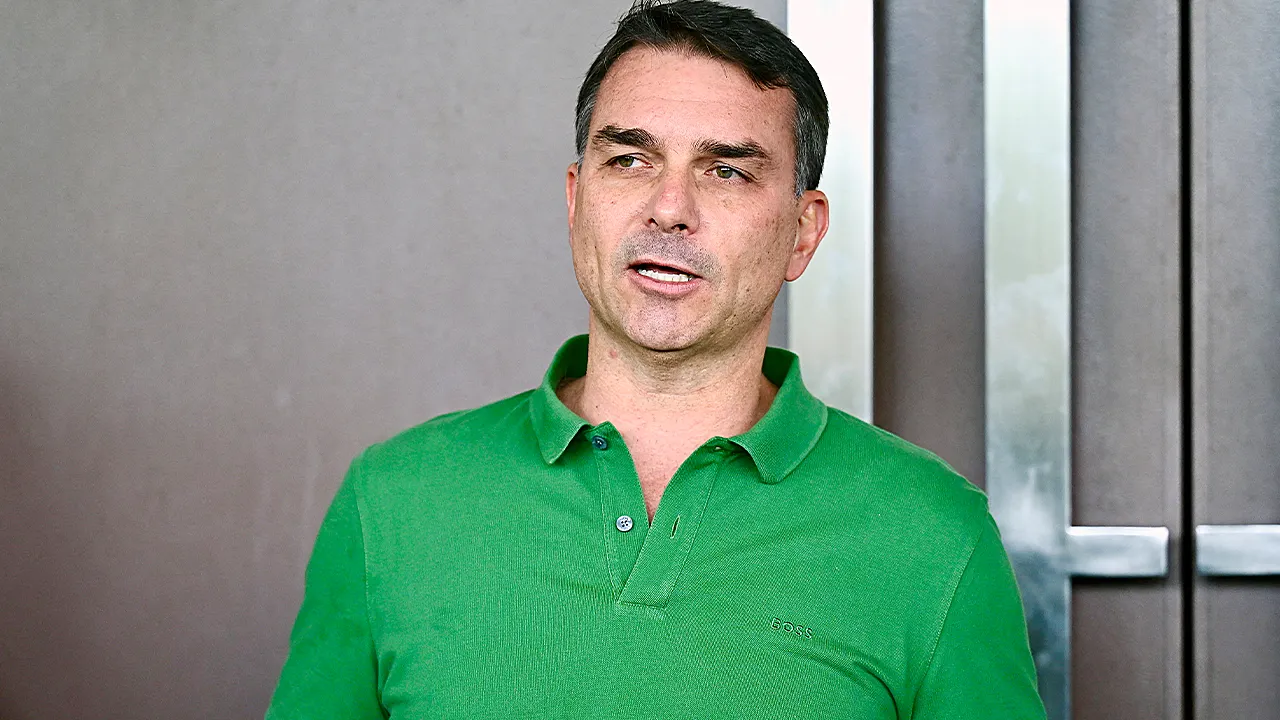
By the time Brazilian Sen. Flávio Bolsonaro stepped onto an airplane on Tuesday, his country had already moved on without him—at least in political terms. The 45-year-old lawmaker, a towering figure on Brazil’s conservative right, had slipped out of public view that morning, leaving the capital and, ultimately, the country as the clock passed the noon deadline for him to surrender both his regular and diplomatic passports. A political ally confirmed to Reuters that he had departed Brazil, and Brazilian outlet Metropoles reported that the flight was bound for Florida, a destination long favored by Brazilian politicians and celebrities looking for refuge or reinvention. The U.S. Department of State, meanwhile, quietly confirmed that it would issue visas to Flávio and his family, allowing them to enter the United States. There was no dramatic farewell, no crowd chanting his name on the tarmac—just the quiet, almost surreal act of a politician leaving the country he had helped shape, with his legal troubles trailing behind him like an unclosed suitcase. For a man who had spent years in the glare of public life, the silence was deafening. His departure was not a vacation or a diplomatic mission. It came two days after his political world had been upended by an election result that seemed unthinkable to many of his supporters: Luiz Inácio Lula da Silva, the leftist former president and union leader, had defeated the conservative ticket in a presidential runoff, sealing a stunning comeback that would return him to power. For Flávio, the journey to Florida felt less like a chosen exile and more like the closing of a door. The Brazilian newspaper Folha de São Paulo reported that he was under investigation for alleged money laundering and other crimes, and the passport surrender order was no mere bureaucratic formality—it was a legal noose tightening around a family already known for its combative relationship with the courts. The Associated Press noted that it remained unclear whether he had actually complied with the order before boarding his flight. But the image of a politician fleeing to Miami with his family in tow was already taking shape in the public imagination: a portrait of defeat, fear, and the strange limbo of life after power.
The election that pushed Flávio Bolsonaro out of Brazil was a dramatic and deeply polarized affair, one that gripped not only the South American nation but also observers around the world. With 100 percent of the vote counted, Lula had secured 51.8 percent of the ballot, defeating the incumbent Jair Bolsonaro by nearly 4.4 million votes. It was not a landslide in the historical sense, but it was decisive—and for the Bolsonaro family, it was devastating. Jair Bolsonaro, Flávio’s father and the outgoing president, had spent months casting doubt on the integrity of the voting system, speaking ominously about fraud and refusing to offer any commitment to a peaceful transfer of power. After the results became final, he did not call Lula to congratulate him. He did not appear on television with a gracious concession speech. Instead, he remained silent, and then he and his allies began calling for the election to be annulled, alleging irregularities without presenting concrete evidence. The refusal to concede was not just a political maneuver; it was a signal to millions of Brazilians who had embraced him as a populist strongman that the fight was not over. For Flávio, the stakes were personal as well as political. His own political career had been built on his family’s name and the polarized energy of the anti-establishment right. With his father leaving office and a leftist government returning, the entire edifice of Bolsonaro-era power appeared to be cracking. The election was not simply a change of leadership; it was a repudiation of a political style defined by confrontation, conspiracy theories, and the erosion of institutional norms. And now, with his own legal problems looming, Flávio was faced with a choice: stay and fight, or leave and regroup in a country where the Bolsonaro name still carried weight among certain circles of Brazilian exiles and their American allies. In the end, he chose the plane, and with it, a new chapter of uncertainty.
Flávio’s decision to board a flight to Florida was shadowed by the legal case that had made him a target. According to Folha de São Paulo, he was under investigation for alleged money laundering and other crimes—charges that had loomed over the Bolsonaro family for some time. The passport surrender order, which expired at noon on Tuesday, was a serious measure, often used by Brazilian courts to prevent suspects from leaving the country. It was, in a sense, the last legal barrier between him and freedom of movement. Whether he had actually complied with the order remained unclear, as the AP noted, but the fact that he was airborne suggested that either he had found a legal way around it, or that the authorities had not yet moved to stop him. What made the scene even more human was the apparent silence surrounding his exit. A man who had grown up in the glare of Brazilian politics, who had been re-elected as a senator and served as a prominent voice in his father’s political movement, did not hold a press conference. He did not issue a defiant statement. He simply vanished from public view in the morning and reappeared, hours later, in the abstract coordinates of a flight path to Miami. The image evokes the loneliness of political collapse: a family leaving behind not just offices and security details, but the very country that had made them famous. Florida has long been a refuge for conservatives from Latin America, and for Brazilians with ties to Bolsonaro’s movement, it offers a kind of parallel universe—one where the political defeats at home can be recast as victories in exile, and where the legal system that once chased you has no jurisdiction. But exile is never clean. Leaving also means abandoning the fight, at least in its most direct form. For Flávio, the flight to the United States was both a retreat and a reinvention, a gamble that the Bolsonaro brand might survive better abroad than in a Brazil now turned toward Lula.
While Flávio Bolsonaro’s flight captured the imagination of the political world, the man who had defeated his family’s project was already turning toward the future. Lula, speaking to supporters after the results were announced, did not gloat in the style of his opponents. He spoke instead of responsibility and reconciliation, even if the pain of the campaign still hung in the air. “No one is required to like the president-elect, but he must govern for everyone,” he said, in a line that seemed designed to contrast with the divisive rhetoric of the Bolsonaro years. He went further, framing the election as something more than a personal victory. “This was a defeat for denialism and lies,” he said, in a pointed reference to the misinformation campaigns that had plagued Brazilian politics, including false claims that the voting machines were vulnerable to fraud. For Brazilians who had watched their country grow increasingly polarized, the words carried both hope and warning. Lula inherits a nation that is deeply fractured, with millions of voters who genuinely believe the election was stolen and millions more who are exhausted by the daily combat of politics. His promise to govern for everyone is easier said than done. The conservative movement that Bolsonaro built did not disappear with his defeat; it lost an election, but it retained a powerful base of supporters, a network of media outlets, and a clear sense of grievance. Lula’s victory speech was an attempt to lower the temperature, to offer a hand to those who did not vote for him, and to begin the hard work of rebuilding trust. But the image of Flávio Bolsonaro leaving the country the same week Lula was calling for unity was a reminder that the rift between Brazil’s political tribes is not just about policies—it is about identity, family, and the refusal to accept the legitimacy of the other side. Lula’s words were generous, but the wounds they were meant to heal go deep.
The broader significance of the moment extended well beyond Brazil’s borders. The election in the world’s largest South American country had been watched closely in Washington, where concerns about voting security and democratic resilience had become central to American political debates. The rapid election count in Brazil, and the refusal of the outgoing president to accept its results, raised comparisons to challenges facing the United States ahead of its own midterms. Brazil had become, once again, a test case for the health of democracy in a region that has seen more than its share of instability. For the conservative movement in Latin America, meanwhile, the Brazilian runoff was another stage in a wave that had once seemed unstoppable. Bolsonaro’s defeat—and his son’s flight—represented a roadblock in that wave, a sign that the populist right, so successful in countries like Argentina, Chile, and Brazil itself in recent years, could also lose at the ballot box. Yet the movement was not dead. Its supporters remained mobilized, suspicious, and ready to believe in conspiracies about stolen elections. The departure of Flávio Bolsonaro to Florida could be read in many ways: as a personal escape, as a strategic retreat, as a final insult to his father’s enemies, or simply as the beginning of a long fight waged from abroad. In the United States, the image of a Brazilian conservative senator taking refuge in Florida resonated with a certain kind of political romance—the exile who continues to speak, the family that refuses to yield. But it also carried a darker implication: democracy had triumphed, perhaps, but the forces it had defeated had not gone home. They had simply boarded a plane and moved to a friendly jurisdiction, where they would continue to shape the story of what happened in Brazil, and perhaps prepare for the next chapter. For those who believe in the future of Brazilian democracy, the sight of Flávio Bolsonaro leaving was a cause for relief. For his supporters, it was a wound. For everyone else, it was a reminder that electoral victories are not the same as reconciliation, and that the aftershocks of a divided nation can be felt far beyond its borders.
At the end of the day, the story of Flávio Bolsonaro’s hurried departure is not only a political story. It is a story about what happens to a family when the world they built begins to crumble. The 45-year-old senator leaves behind a Brazil where his name evokes either fierce loyalty or bitter anger—and very little in between. He also leaves behind a father who lost the presidency, a movement that lost its patron, and a legal system that wanted him to stay put. Florida, by contrast, offers sunshine, distance, and a community of like-minded exiles. It offers the chance to reinvent himself as a victim of persecution, a patriot in temporary exile, a man who will return one day. But it also offers a kind of quiet. In Miami, he can walk down a street without the weight of Brazil’s political crisis pressing on every syllable. He can watch the news from afar, surrounded by family and familiar faces, while his country tests its new path without him. There is something profoundly human about that escape—the desire to protect one’s children, to avoid the courtroom, to find a place where the past no longer has to be answered for. Yet there is also something unresolved. Leaving does not erase the investigation, nor does it silence the voters who rejected the Bolsonaro vision. It simply moves the struggle to a new geography, where the measures of victory are less clear. Lula, for his part, has begun the work of governing a divided nation. Flávio may be on a beach or in a hotel room, watching the news in a language that is not his own, wondering whether he made the right choice. There is no certainty in his future, no guarantee that this exile will be temporary or triumphant. But there is, at least, a beginning—a breath, a pause, a chance to think about what comes next. That uncertainty is the most human thing of all. Politics may have brought him to this moment, but the moment itself is pure life: a person, a plane, a future unknown.