

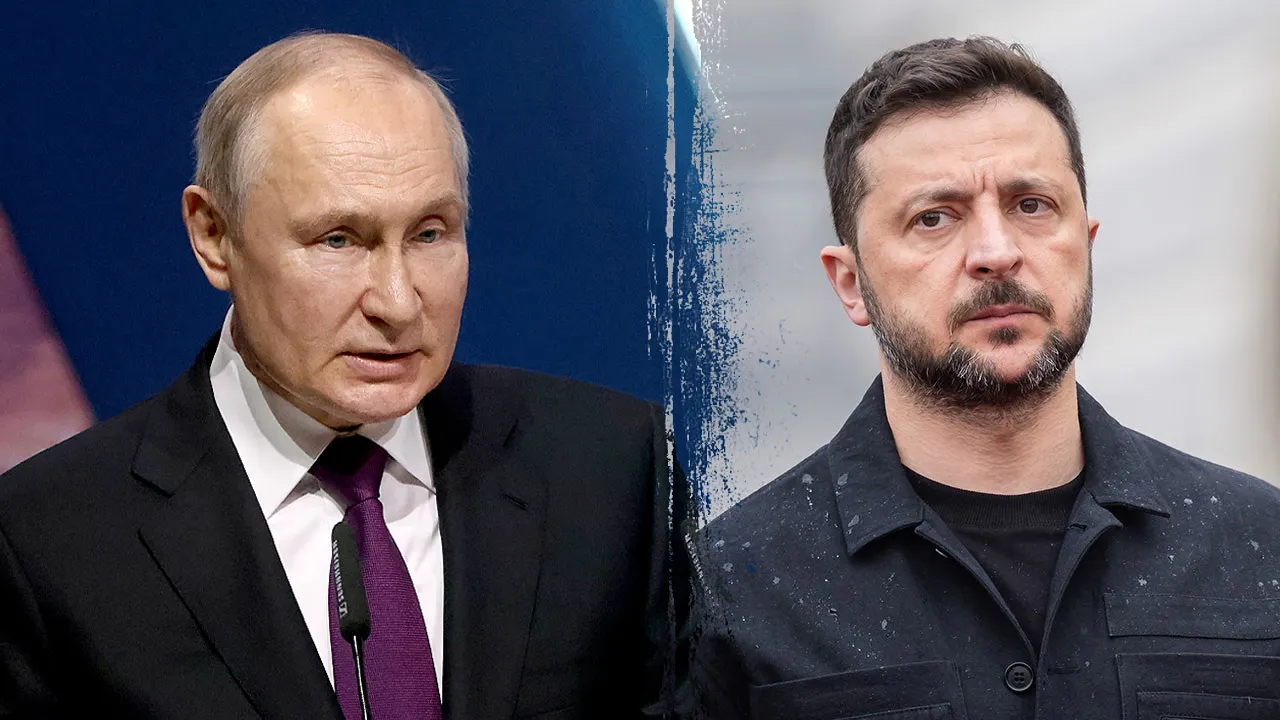
1. In a striking and deeply personal appeal, Iuliia Mendel—who once stood at Volodymyr Zelenskyy’s side as his official spokesperson—has urged the Ukrainian president to do something that would have seemed unthinkable just a few years ago: travel to Moscow and sit down face-to-face with Vladimir Putin. Mendel, speaking to Fox News Digital, argued that before Zelenskyy became the embattled wartime leader of Ukraine, he was a successful entertainer who made his name, his connections, and his first real fortune in the Russian capital. She believes those old ties, forged in the smoky corridors of Russian television studios and at private parties for the wealthy and powerful, could somehow be the key to unlocking a peace deal that has eluded diplomats for years. “When Zelenskyy was an entertainer, he often performed in Moscow,” Mendel said. “He knows a lot of people from Putin’s elite.” She went further, suggesting that the Ukrainian president’s public reinvention as a staunchly anti-Russian leader has papered over a more complicated past. “He actually professionally grew in Moscow and earned his first millions in Moscow, and today he pretends that he has nothing in common with them,” she said. Mendel didn’t mince words about what she believes Zelenskyy needs to do now: “He needs to go to Moscow and needs to agree on compromises that are acceptable,” she said, adding that he “doesn’t need to play his maximalist games and to play this noble actor.” Her comments landed at a delicate moment, as Ukraine, Russia, and the United States prepared for another round of technical-level peace talks, potentially in Abu Dhabi or Switzerland, with U.S. envoys Steve Witkoff and Jared Kushner working behind the scenes to lay the groundwork for direct leader-to-leader negotiations.
2. To understand Mendel’s argument, you have to go back to the strange, glittering world Zelenskyy inhabited long before he ever stood at a podium in a khaki-green fleece. Born in Kryvyi Rih and raised in a Russian-speaking Jewish family, he studied law but found his calling in comedy. In the late 1990s, he joined Kvartal 95, a comedy troupe that would become a cultural phenomenon across the post-Soviet world. He competed on KVN, the enormously popular Russian-language game show that turned young comedians into stars, and then moved into acting, writing, and producing. His shows and films were not Ukrainian niche productions; they were made for the vast Russian-speaking market, which meant they were shown in movie theaters and on television screens from Moscow to Minsk, from Almaty to Riga. Mendel points out that Zelenskyy kept working in Russia even after the country annexed Crimea and began fomenting war in the Donbas in early 2014. She specifically recalls that he traveled to Russia to work on the comedy film Eight New Dates, which hit Russian theaters in 2015—long after the first shots of the conflict had been fired. David Dodson, an American movie editor who worked with Zelenskyy, told Business Insider that the Ukrainian president was genuinely beloved in Russia as a comedian and actor. “People need to realize that Volodya’s movies were very big in Russia. Most of his market was in Russia,” Dodson said. “He’s always been a popular comedy star in Russia.” The movie Eight First Dates, released in 2012, was even named Best Russian Comedy of the Year at the Russian National Movie Awards in 2013. When investigative journalists later revealed that Zelenskyy and his business partners still owned three Russian companies, the future president promised to relinquish his stake in a Cyprus-registered firm operating a film studio in Russia. It was a quiet, awkward attempt to untangle a life that had been deeply intertwined with the country he would one day be forced to defend against.
3. For Mendel, that history isn’t just trivia—it’s a missed opportunity. She remembers the Zelenskyy who won the 2019 presidential election in a landslide, taking roughly 73% of the runoff vote on a vague but powerful promise to fight corruption and bring peace to Ukraine. That promise resonated because the country was already reeling from years of low-level war in the east, and people were desperate for someone who could end the bloodshed. “Zelenskyy became the president with 73% record support,” Mendel said. “Because he promised to bring peace to Ukraine.” But instead of peace, Ukraine has endured the largest war in Europe since World War II, a brutal and grinding conflict that has killed tens of thousands of soldiers, displaced millions of civilians, reduced entire cities to rubble, and left Ukraine’s economy and infrastructure in tatters. “And now he has been presiding for almost five years over the largest war in Europe since World War II. This shows a lot,” she said. Her language is unusually blunt for someone who once represented the president. She frames it as a matter of human survival, not political pride. “When his country is bleeding, he needs to make a peace deal for his people,” she said. “He needs to put the interests of his people first, just for Ukraine to exist as an independent state.” Mendel acknowledges that the war is not Zelenskyy’s fault—Russia invaded unprovoked, and Putin bears ultimate responsibility for the destruction. But she insists that the Ukrainian president’s own stubbornness and personal animosity toward Putin have become genuine obstacles to ending it. “Today there are diplomatic efforts to try to stop this brutal and bloody war that Russia started,” she said. “But what we see now is a personal opposition between Zelenskyy and Putin that continues to grow into constant escalation in which people suffer tremendously, Ukraine’s infrastructure, energy grid, and businesses are in ruins, and refugees are fleeing.”
4. The question of whether Zelenskyy should set foot in Moscow has become a flashpoint in the search for peace. Putin has actually offered to host him there—an offer that Zelenskyy rejected outright, saying he could not visit a city that launches missiles at his homeland while the attacks continue. When Russian journalists pressed him on the matter at the United Nations General Assembly in September, he gave a darkly sarcastic answer: “On a missile.” More than four years after Russia’s full-scale invasion began in February 2022, the peace negotiations remain deadlocked over the same painful issues: territory, security guarantees, and the nature of a lasting ceasefire. Moscow has demanded that Ukraine cede land, including areas that Russian forces do not even fully control. Kyiv, for its part, has refused to recognize the annexation of any sovereign territory and insists that any agreement must include enforceable guarantees that Russia will not simply regroup and attack again. The human cost of that deadlock is incalculable. Front-line towns have become graveyards of homes and hopes. Families have been torn apart. Children have grown up with the sound of air raid sirens as their lullabies. Mendel seems to feel the weight of all that suffering in her voice when she speaks. She wants her former boss to step outside the role of stoic wartime hero and think about what can actually be achieved, not what he wishes could be achieved. “A sustainable peace deal cannot be reached solely between Zelensky and Putin; it requires the involvement and initiative of a strong third party to halt the ongoing devastation,” she said. That third party, in her telling, may not come from the usual diplomatic circles. It may come from someone completely unexpected: a former first lady who has taken on a quiet, humanitarian mission in the middle of a war.
5. In a development that caught many by surprise, the White House announced that Melania Trump had helped broker a temporary ceasefire in Oleshky, a Russian-occupied town in southern Ukraine’s Kherson region, to allow humanitarian aid deliveries, demining operations, and civilian evacuations. Around 1,700 to 2,000 people remain in the devastated front-line town, many of them living without adequate food, medicine, or basic supplies. The ceasefire was set to begin on October 29, with operations possibly starting as early as October 27. Pope Leo also reportedly spoke with both Zelenskyy and Putin about the humanitarian crisis, adding a moral and spiritual dimension to the diplomatic scramble. Mendel was visibly moved by the news. “Melania Trump has become synonymous with the words of a saver and a hero, since she has brokered the deal for Oleshky,” she said. “This is something that is going to save around 2,000 people and that neither Ukraine nor Russia could have solved for months and months.” For Mendel, the Oleshky ceasefire is more than just a good news story—it’s proof that peace doesn’t have to be about maps, borders, or geopolitical leverage. It can be about simple human beings trying to survive another day. “That is why, you know, what Melania Trump has done is actually a case to show that where two men are fighting, a woman can actually save lives,” she said. “And this is the new approach that would show that peace really should focus on human lives, not on maps and territories.” It is a sharp, unexpected rebuke to the macho posturing that has defined so much of the conflict, and it reflects a growing frustration among ordinary Ukrainians who are exhausted by the endless tug-of-war between two male egos in suits.
6. Mendel also turned her critical eye toward Andriy Yermak, Zelenskyy’s longtime chief of staff and closest political ally, who has been widely seen as the architect of the president’s hardline diplomatic stance. She accused Yermak of coaching Zelenskyy to be a “strong man” in negotiations, with disastrous results. “Mr. Yermak was teaching Zelenskiy to be a strong man in diplomacy. And what today we see is actually diplomacy that doesn’t exist,” she said. “It’s a diplomacy of humiliation, diplomacy of constant threats, diplomacy of demands.” It’s a devastating assessment from someone who was once inside the inner circle. But Mendel insists she is speaking out not out of bitterness, but out of love for her country. She praises President Donald Trump as the first Western leader to break the mold and consistently push for an end to the war, saying many Ukrainians place enormous hope in his ability to force a resolution. “For this reason, many Ukrainians place great hope in his ability to bring peace,” she said. The real solution, she believes, will not come from a grand romanticized image of a heroic leader refusing to bend. It will come from gritty, unglamorous compromise—the kind that requires swallowing pride, acknowledging uncomfortable realities, and prioritizing human life above national myth. Whether Zelenskyy will ever take her advice and walk into the Kremlin is anyone’s guess. But Mendel’s words carry the weight of someone who has seen the wheels of Ukrainian politics from the inside, and who fears that without a radical change of course, the country she loves may not survive. “When his country is bleeding, he needs to make a peace deal for his people,” she repeats. It is a simple, heartbreaking plea from a former loyalist who still believes in the man she once served, but who has lost faith in the choices he is making now. Whether anyone in Kyiv is willing to listen remains to be seen, but her voice adds a powerful, human dimension to a conflict too often defined by statistics and missile counts. In a war that has taken so much, Mendel’s message is ultimately about what still remains worth saving: ordinary people, caught between empires, who just want to live in peace.