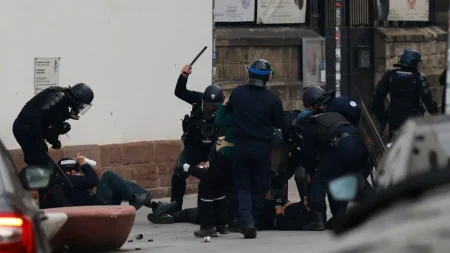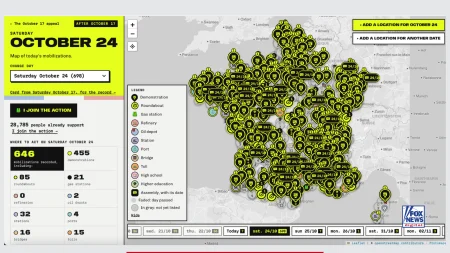
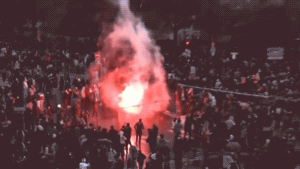


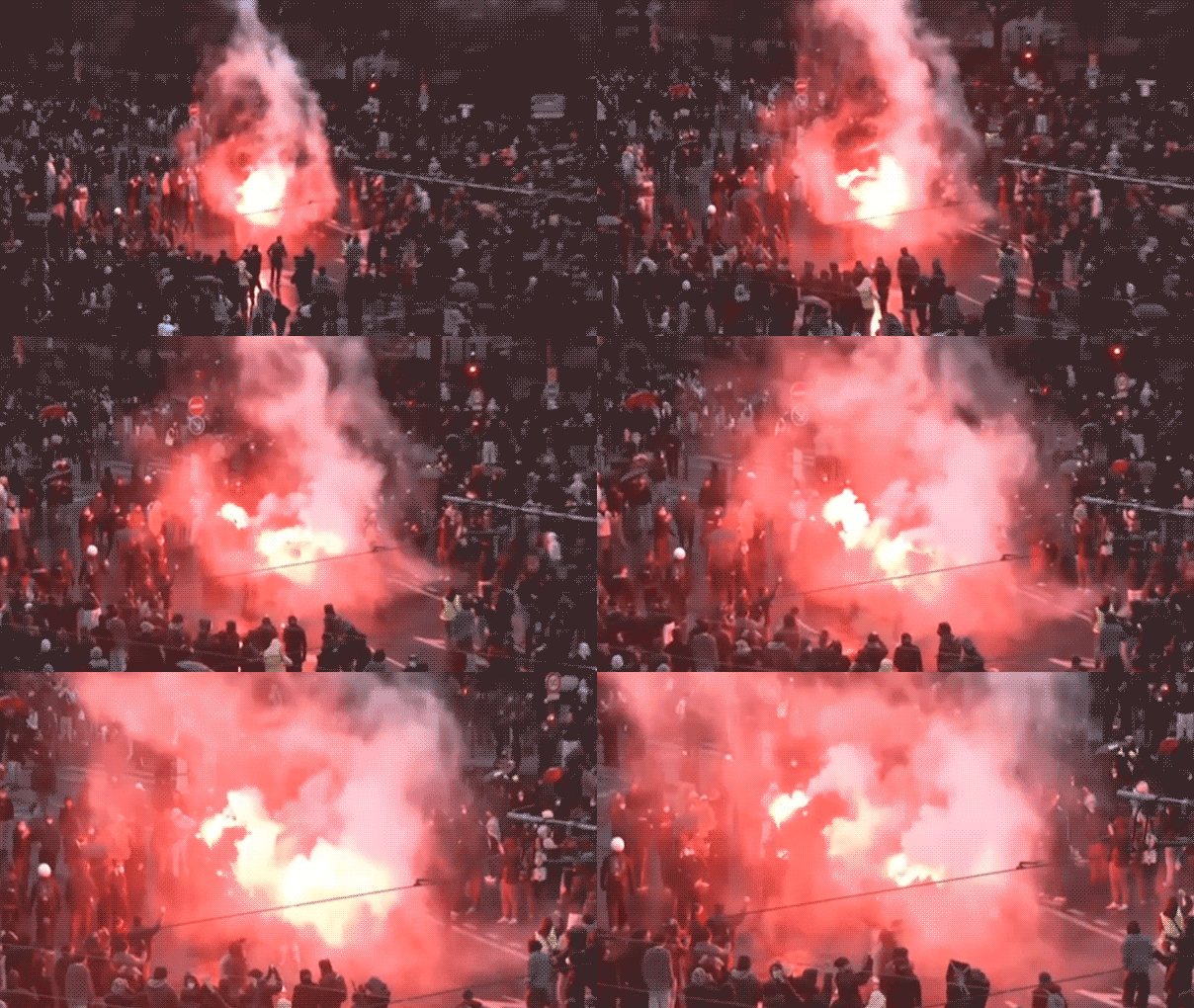
I. The streets of Paris felt less like the city of light and more like a city under siege on Saturday, as the rhythmic beat of marching feet and the sharp crack of police sirens replaced the usual cafe chatter and tourist bustle. Nearly one thousand people were arrested across France as nationwide protests once again surged, according to Interior Minister Laurent Nuñez, a number that speaks to the raw tension gripping the country. The scale of the demonstration was staggering: police estimated 110,000 people marched in the capital alone, while union organizers claimed the real number was closer to 250,000. Nationwide, the gap in counting was even wider—the Interior Ministry cited 410,000 participants, while union leaders insisted 800,000 had taken to the streets. Behind these stark statistics were human stories: a teacher from the suburbs exhausted by overcrowded classrooms, a retired worker worried about a shrinking pension, a student who had not seen a permanent teacher in months. They walked shoulder to shoulder, not as a single unified force but as a chorus of grievances, and for many, the simple act of being present was a desperate plea to be heard. Yet their voices were now entangled with a more chaotic element. Police conducted thousands of preemptive checks, searching protesters for weapons and confiscating fireworks and ball bearings, tools often used by a violent fringe. Shopkeepers boarded up their windows as if bracing for a storm; museums closed their doors; more than twenty metro stations suspended service, leaving the city center eerily quiet, a strange, uneasy calm punctuated by occasional bursts of tear gas.
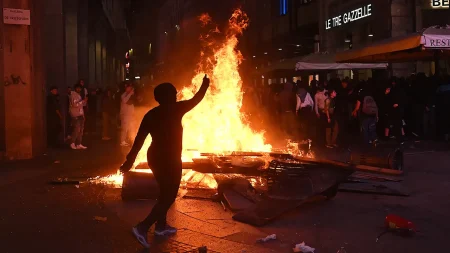
II. The unrest was not confined to France’s borders. On the same day, similar scenes of rage and desperation unfolded in Italy and Albania, a reminder that the grievances boiling over in Paris were part of a wider European unease. In Rome, police deployed water cannons against demonstrators protesting rising living costs and the war’s toll on everyday life. Footage showed riot police standing firm as a water cannon sprayed a relentless jet at a crowd that refused to retreat, while in Turin and Bologna, clashes broke out between protesters and law enforcement, leaving a trail of broken glass and smoke. Only Milan remained largely peaceful, a rare exception in a weekend of fury. Even more alarming was the situation in Tirana, Albania’s capital, where high school and university students set fire to government buildings and hurled projectiles at officers. These young people were not merely acting out of teenage rebellion; they were demanding lower tuition fees, greater investment in education, and an end to corruption that has hollowed out their futures. Their anger had blossomed into a broader anti-government movement, with many calling for the resignation of Socialist Prime Minister Edi Rama. He responded by offering dialogue, while simultaneously warning that violent protesters would face serious penalties. The image of students—books and laptops symbolically replaced by stones and fire—was both heartbreaking and terrifying. It revealed a generation that felt abandoned, one that saw no future in the system that was supposed to protect them. The connection across borders was undeniable: whether in Paris, Rome, or Tirana, ordinary people were saying they had reached their breaking point.
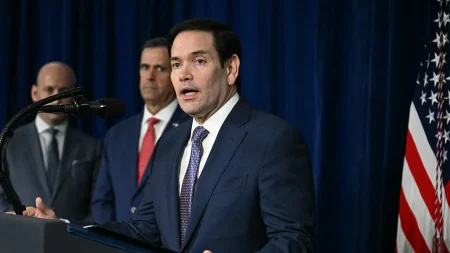
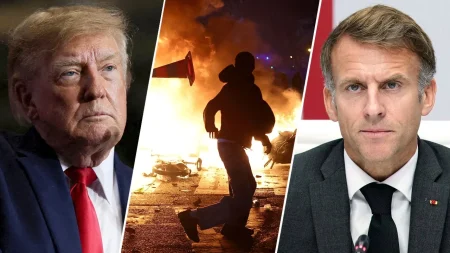
III. Across the Atlantic, the chaos in France became a political weapon. President Donald Trump, after casting an early ballot in West Palm Beach, Florida, for the 2026 midterm elections, told reporters that the turmoil was a direct warning for America. He lashed out at the country’s previous leadership, claiming that the United States had been “laughed at” and “led by idiots and morons and bad people and radical left people.” His words were sharp and unmistakable: “Just take a look at France because that’s what they’d like to have for our country—and I don’t let that happen.” For Trump, the French protests were not a complex social crisis but a cautionary tale of left-wing governance collapsing into chaos. Yet, for the people on the ground in Paris, his comments likely felt distant and reductive. They were not thinking about American politics as they coughed in clouds of tear gas or nervously watched a hooded youth overturn a car. They were thinking about how to pay their rent, whether their children would get a decent education, and why their government seemed so out of touch. Still, the president’s remarks added a layer of international intrigue to an already volatile situation, framing the protests as a battle in a global ideological war. It was a reminder that the streets of Paris, Rome, and Tirana were not just local crises but symbols that resonated far beyond their borders, shaping the way leaders and citizens around the world interpreted the struggle between the establishment and those who felt left behind.
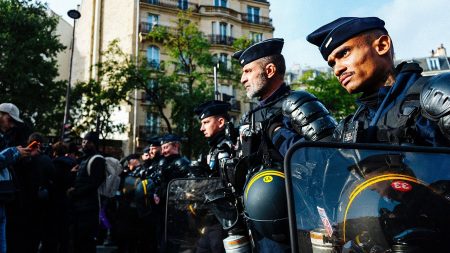
IV. The police response was massive and, in many ways, effective in containing the violence—but at a cost. Some 70,000 officers were deployed across France, a staggering show of force intended to prevent the kind of destruction seen during the previous weekend, when cars were torched and the city hall in Limoges was set ablaze. In Paris, officers conducted more than 3,000 individual checks and arrested 65 people, while the Paris Police Department issued a defiant social media statement: “Violent individuals have no place in the marches. The objective is clear: to prevent troublemakers from joining the procession, and to ensure the safety of the demonstrators.” But for many peaceful protesters, the heavy-handed security felt like an occupation rather than protection. The sound of helicopters thudding overhead, the rows of helmeted officers, the acrid smell of tear gas—these were not the hallmarks of a healthy democracy. In cities like Clermont-Ferrand, Grenoble, Lille, and Nice, police resorted to firing tear gas to disperse unruly crowds, and in Nice, a water cannon was brought out when demonstrators refused to pull back. In Marseille and Lyon, hooded youths engaged in running battles with law enforcement, turning residential streets into temporary war zones. For the average citizen, the anxiety was palpable. Parents worried about their teenagers attending school; small business owners counted the cost of boarded-up storefronts and lost revenue; residents of neighborhoods near protest routes stocked up on supplies and avoided public transit. Even those who supported the protesters’ cause found themselves exhausted by the relentless cycle of demonstrations and crackdowns, wondering if there was any peaceful path forward.
V. To understand why the streets had emptied into such a ferocious display of anger, one had to look at the deeper roots of the crisis. The protests initially began weeks earlier, led by high school and university students who were at the end of their rope. They faced teacher shortages so severe that entire classes were left unsupervised or canceled; they studied in overcrowded classrooms and dilapidated buildings that crumbled around them. A student in a crowded lecture hall might have spent his day sitting on broken chairs, trying to focus while the rain leaked through the roof, knowing that his teacher had already left for a better-paying job elsewhere. These were not abstract political grievances; they were daily, tangible humiliations. The movement gained momentum when the country’s major labor unions threw their weight behind the students, broadening the protests into a national outcry against austerity policies, stagnant wages, inadequate pensions, and the soaring cost of living. Now, a bus driver struggling to afford groceries marched side-by-side with a student who had no permanent teacher. A nurse, exhausted from understaffed shifts, linked arms with a grandmother whose pension had not kept up with inflation. This was not a simple protest; it was a collision of existential pressures, a collective realization that the social contract had been broken. The French government, with its promises of reform and dialogue, seemed to many to be speaking a different language. Every time a minister called for calm, protesters heard only ignorance of their pain. Every act of police force, justified or not, added fuel to the fire. The demonstrations became a mirror reflecting the deep inequalities and institutional failures that had been simmering for years, now boiling over into the streets.
VI. As Saturday wore on, the full magnitude of the unrest became impossible to ignore. The previous weekend had already seen more than 2,700 arrests during protests that degenerated into rioting and looting, and now, with nearly a thousand more arrests in a single day, the country was clearly at a crossroads. The nationwide marches were a visceral expression of dissatisfaction with the French government, but they were also something more personal: a cry from a people who felt unseen, unheard, and undervalued. The international spread of the violence—to Rome, Turin, Bologna, and Tirana—suggested that this was not a uniquely French malady but a broader European symptom of economic strain and political disconnect. In Tirana, students were setting government buildings on fire to demand an education worth having; in Paris, workers were facing water cannons to demand a livable wage; in Rome, families were desperately asking how they were supposed to survive as prices climbed and wages stayed flat. For the protesters, the violence was a last resort, a frantic attempt to be acknowledged when every peaceful avenue seemed exhausted. For the authorities, it was a threat to public order that had to be met with decisive force. And for the people caught in the middle—the shopkeepers, the commuters, the parents—it was a terrifying glimpse of how fragile everything truly is. With 70,000 officers deployed and a government vowing to clamp down on agitators, the short-term future seemed likely to bring more of the same: more marches, more clashes, more arrests. But beneath the tear gas and the broken glass, there was a deeper question that no water cannon could answer: how long can a society ignore the cracks in its foundation before they become chasms? The streets were telling the story that no government report could capture—a story of desperation, resilience, anger, and hope, all tangled together, demanding to be heard. Whether the leaders would listen, or simply continue to contain, remained the most pressing question of all.