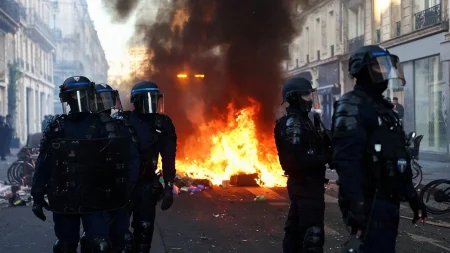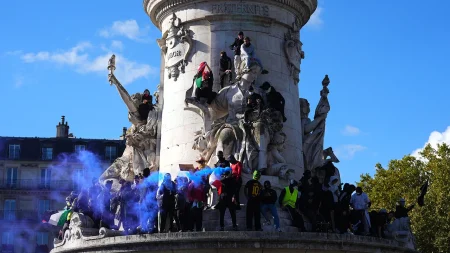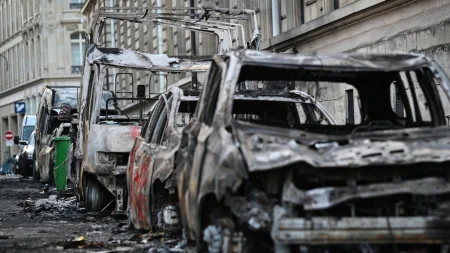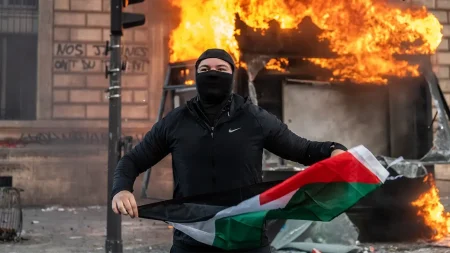


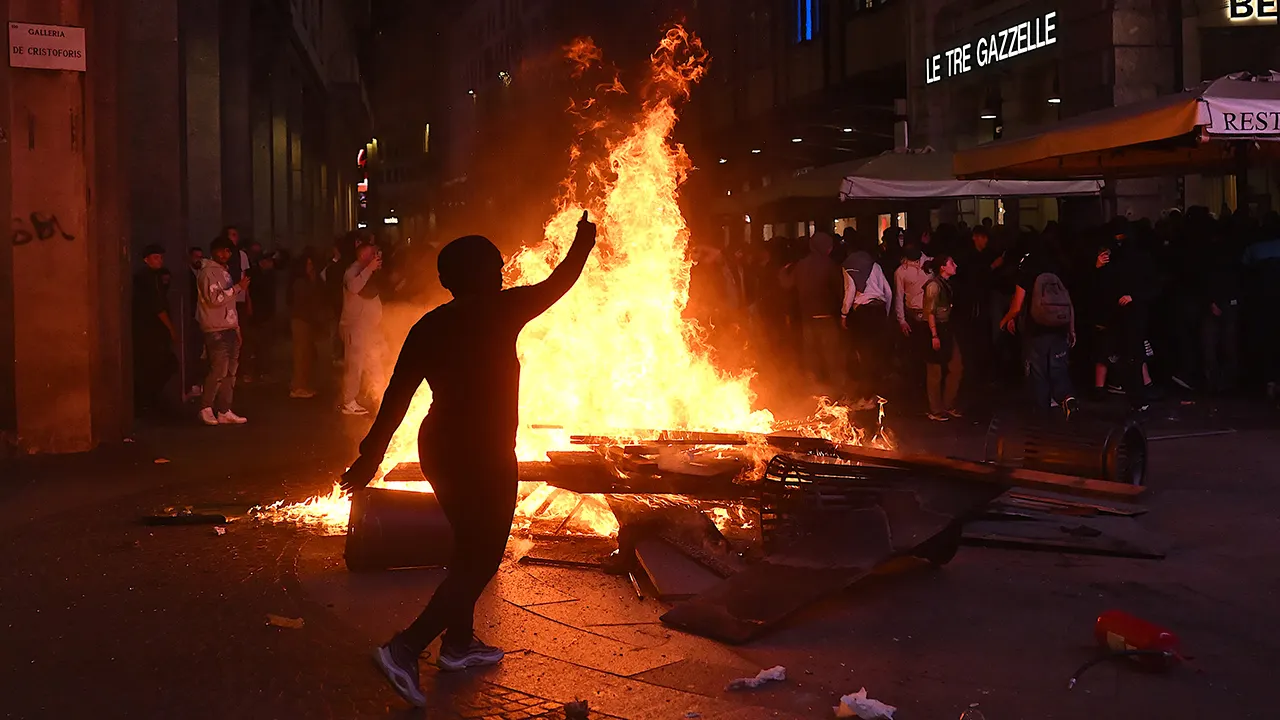
On a gray Saturday that should have been defined by the power of collective voice, Italy found itself instead wrestling with the chaos that erupted alongside it. In cities across the country, thousands of people took to the streets to express their frustrations, their presence a reminder that peaceful assembly remains one of democracy’s most vital tools. But as dusk settled, the story was no longer only about those who marched with signs and chants; it was also about the masked figures who broke away from the crowds, hurled stones at police, shattered storefront windows, and turned historic public squares into battlefields. The scenes were hauntingly familiar, echoing the violence that had gripped France just days earlier. For ordinary Italians—the shopkeepers sweeping up broken glass, the families walking past cordoned-off streets, the officers tending to their wounded colleagues—the day raised a painful question: when does a protest stop being a demand for change and begin to resemble something much darker? Prime Minister Giorgia Meloni, watching the events unfold from Rome, offered her own answer early Sunday morning. In a message posted to X, she condemned the violence in unmistakable terms, describing those responsible not as demonstrators but as “criminals” who exploit legitimate rallies to seek confrontation and sow chaos. Her words were sharp, deliberate, and aimed at reassuring the nation that law enforcement would not be left to face the storm alone.
Meloni’s statement was more than a political reflex; it was a call for moral clarity in a moment of confusion and fear. She praised the men and women of Italy’s law enforcement agencies, who had stood between the mob and the city, absorbing blows and enduring injuries while trying to protect the safety of citizens, workers, and merchants. Her language was personal, almost familial, as she insisted that everyone had the right to live in their city without fear, without seeing it “laid to waste and set ablaze by gangs of thugs.” For many who had watched the violence unfold on television, her words resonated with a simple, visceral truth: no grievance, however deeply felt, justifies arson and assault. Yet Meloni also directed a pointed message toward her political opponents, urging them to avoid ambiguity and to condemn the violence unequivocally. She asked them to issue a clear appeal for peace, warning that hesitation could be interpreted as justification and silence as acceptance. This was not merely a clash between left and right; it was a demand that the entire political class stand together against lawlessness. But in a country already fractured along ideological lines, her appeal seemed destined to deepen the very tensions it sought to address, with some seeing it as a genuine call for unity and others as an opportunistic attack on the left.
The most visible eruption occurred in Milan, where the protest reached the very heart of the city: the magnificent Piazza del Duomo, dominated by the cathedral’s spires and surrounded by centuries of history. There, what had begun as a demonstration organized by Italy’s oldest and largest labor union, the Confederazione Generale Italiana del Lavoro, or CGIL, descended into open confrontation. According to reports, around fifty demonstrators—including minors—were detained by police, and at least two officers were injured before water cannons were used to disperse the crowd. The violence spread into the Galleria Vittorio Emanuele II, one of Italy’s most beloved nineteenth-century arcades, where rioters looted stores and smashed the windows of boutiques that had stood for generations. For those who knew the Galleria, with its glass vaulted ceilings and mosaic floors, the images were heartbreaking. This was not just property damage; it was an assault on a place that symbolizes Italian elegance and resilience. Milan’s center-left mayor, Giuseppe Sala, walked a careful line in his response. He acknowledged that the reasons for the protest were understandable—people were hurting, wages were stagnant, and the future felt uncertain—but he insisted that violence against law enforcement and serious damage to the city could never be justified. His words reflected the sorrow of a civic leader watching his city bleed, caught between empathy for the frustrated and outrage at the destructive minority.
Beyond Milan, the unrest spread to other cities, each with its own story of fear and disruption. In Turin, police reported that some people had been stopped while carrying cobblestones and hammers intended to break windows, evidence that the violence was not entirely spontaneous. Around thirty arrests were made, and roughly one hundred officers were injured across the demonstrations, according to the interior ministry. In Bologna, the situation grew so tense that the railway station had to be closed as a precaution, stranding commuters and travelers who had nothing to do with the protest. The police union reported that fifty-six officers were hurt in Bologna alone, a staggering number that underscored the ferocity of the clashes. For the ordinary people caught in the middle, the day became a test of patience and resilience. Commuters watched their trains disappear from departure boards; parents hurried their children past lines of riot police; nurses and factory workers wondered whether they would make it home. The violence had a chilling effect, turning every crowded street into a potential flashpoint. Meloni, monitoring the situation from Rome, ticked off the details with grim precision: stones thrown at officers in Milan, injuries, the forced interruption of the procession; in Turin, the confiscation of weapons; in Bologna, the closure of the railway station. For her, the pattern was unmistakable. These were not isolated incidents but coordinated acts of destruction, planned by organized groups that had no interest in dialogue or democracy.
Meloni’s response, repeated across social media and in interviews, was designed to rally the nation against this threat. She had already laid the blame squarely on the extreme left on Saturday night, calling those responsible “thugs” who exploit demonstrations to sow chaos, attack those who ensure security, and hold entire cities hostage. Her words were intentionally inflammatory, yet they also captured the frustration of many who felt that a minority was hijacking the legitimate grievances of the many. Francesco Filini, a parliamentarian from Meloni’s Brothers of Italy party, went even further, declaring that it was no longer tolerable for left-wing extremists to take to the streets and unleash organized destruction. He insisted that the authorities were not dealing with mere demonstrators but with groups that planned violence in advance. The protests, after all, had been organized by the CGIL, a union with more than five million members and deep ties to Italy’s left-wing political parties. This connection made the situation politically explosive. Meloni, however, was careful not to condemn the entire demonstration. She expressed great respect for the thousands who marched peacefully, calling participation the foundation of any healthy democracy. But she refused to look away from what had happened in those other squares, where officers were injured, shops were looted, and trains were stopped. Her insistence on a unanimous rejection of violence was both a plea and a warning: any hesitation, she argued, becomes justification; silence is not acceptable.
In the end, the day left Italy with more questions than answers. The violence in Italian cities was part of a broader wave of unrest sweeping across Europe, most notably in France, where protests had also turned deadly and destructive. French President Emmanuel Macron had warned that the unrest was being exploited by extremists, a sentiment Meloni echoed with her own sharp rhetoric. But beneath the political calculations lay a simpler, more human tragedy. Families who had gone to Milan to enjoy a Saturday afternoon instead found themselves running from tear gas. Elderly residents in Turin watched from their windows as young people hurled cobblestones at police. Workers in Bologna missed their trains and worried about the safety of their colleagues. The damage to historic buildings and beloved public spaces would take months to repair, but the damage to public trust might take even longer. People on all sides of the political spectrum were left to wonder how a country could channel its anger without tearing itself apart. The right to protest is sacred, but so is the right to live without fear. For many Italians, the hope is that the next time the streets fill with demonstrators, the voices of the peaceful will drown out the violence of the few—and that the city squares, with all their history and beauty, will never again be set ablaze by gangs of thugs. In the meantime, there is only the quiet work of rebuilding: sweeping the glass, healing the wounded, and trying to understand how a day that began with hope could end in so much sorrow.