


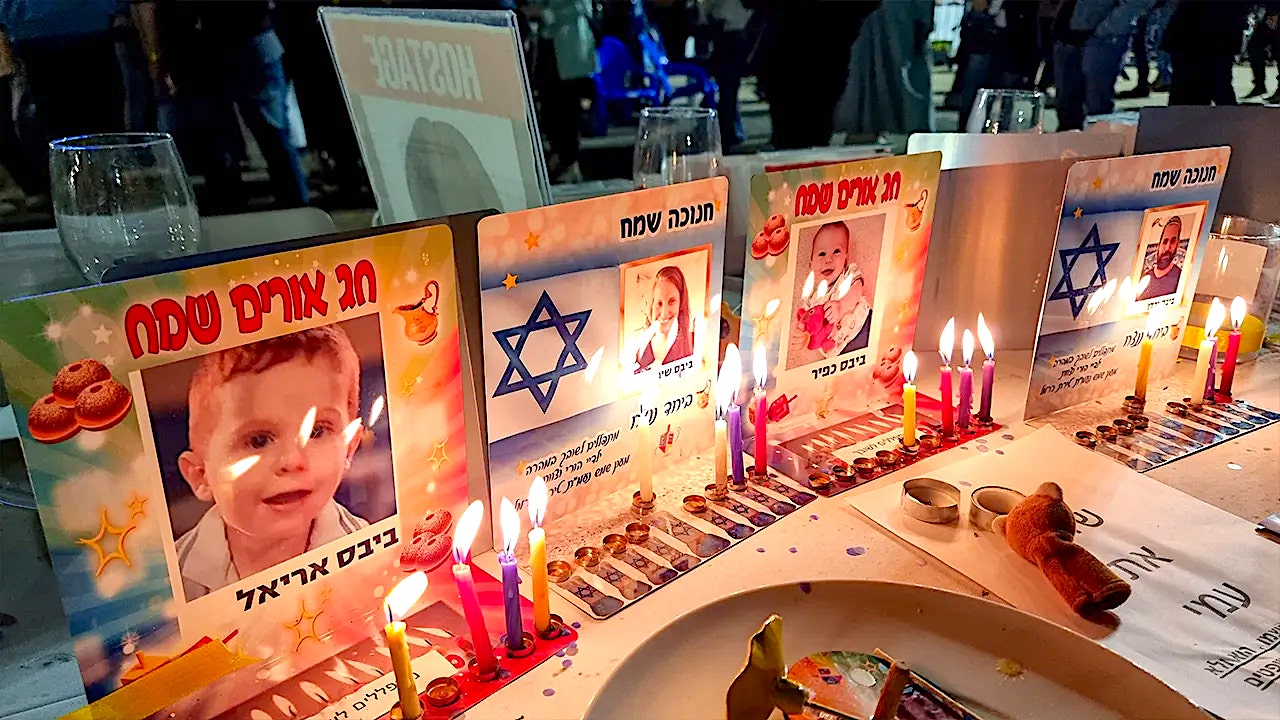
1. The world first came to know Shiri Bibas through a photograph that shattered hearts across the globe. There she was, a young mother with bright red hair, clutching her two tiny boys—Ariel, only four years old, and Kfir, a helpless nine-month-old baby—wrapped in a blanket as armed men surrounded them. That image, taken on October 7, 2023, during the deadliest terrorist assault in Israel’s history, turned the Bibas family into the living symbol of the hostages dragged into Gaza by Hamas. They were not soldiers. They were not combatants. They were a mother and her babies, ripped from the safety of their home in Kibbutz Nir Oz and driven into the tunnels of terror. For weeks, the world waited, prayed, and hoped. Then came the news no one wanted to hear: Shiri, Ariel, and Kfir had been brutally murdered in captivity. The details of their deaths were so horrific that even hardened officials struggled to speak of them. For Maurice Shnaider, Shiri’s uncle, the loss was not just a tragedy—it was the latest chapter in a family history stained by genocide. His sister and brother-in-law, who also lived on the kibbutz, were murdered that same morning, burned inside their home in a way Shnaider says is impossible to describe, impossible to explain, impossible to answer. When the family went to bury them, there was almost nothing left to place in the caskets. Shnaider now carries a grief that he says “doesn’t compute in my body.” He finds himself choking on tears, struggling to make sense of a world that allowed such evil to flourish. And while he acknowledges he will never understand the rationale behind such hatred, he has decided that the most powerful thing he can do is fight back in the only way he knows: through the pursuit of justice.
2. Yet the institution that was created to deliver that justice has, so far, turned a blind eye to the Bibas family. The International Criminal Court, established to prosecute the world’s worst crimes, has remained silent on the murder of Shiri and her children, even as their faces became synonymous with the October 7 massacre. Instead, under the leadership of Chief Prosecutor Karim Khan—who has since been removed over allegations of sexual misconduct—the ICC issued a series of controversial arrest warrants in 2024. Those warrants targeted Israeli Prime Minister Benjamin Netanyahu, former Israeli Defense Minister Yoav Gallant, and Hamas terror commander Mohammad Deif, accusing them of war crimes and crimes against humanity. For many observers, the move reeked of moral equivalence, placing the leaders of a democratic nation defending itself on the same level as the architects of a terrorist pogrom. Legal expert Elliot Malin, president of the Stratos Council, called it “selective justice.” According to Malin, the ICC under Khan seemed far more eager to prosecute Israelis than to hold accountable the true perpetrators of the October 7 atrocities—the Iranian-backed Hamas terrorists who butchered, burned, and kidnapped innocent civilians, including the Bibas family. Malin decided that he could not stand by. In 2025, he filed two cases with the Office of the Prosecutor, demanding that the court investigate and issue warrants against the individuals he argues are genuinely responsible for crimes against humanity, war crimes, and genocide in Israel and Gaza. His first case, filed in September 2025, focused on two senior Iranian officials. His second, filed in December 2025, targeted more than a dozen Hamas leaders. Both cases were filed with a simple, searing purpose: to force the ICC to live up to its founding promise, and to do justice for people like Shnaider, who have lost everything.
3. Malin’s first case was filed on behalf of Maurice Shnaider, and it aimed directly at the Islamic Republic of Iran. For decades, Iran has funded, armed, and directed a network of terrorist proxies across the Middle East—Hamas, Hezbollah, the Houthis, and others—serving as the regime’s long arm of destruction. Malin argues that Iran is not merely a sponsor of terrorism; it is the principal, and the proxies are its agents. “It is very clear that the Islamic Republic is the principal to these proxies who are operating as agents of the regime,” Malin told Fox News Digital. “We should hold the Islamic Republic directly accountable.” The filing requested an investigation into crimes against humanity, war crimes, and genocide committed in Israel and Gaza on and after October 7, 2023. For Shnaider, the case carried profound personal weight. His family has lost five generations to violence intended to destroy Jews—from the Holocaust to the murder of his niece and her children. The filing was not just a legal document; it was a testament to a family’s enduring trauma. Shnaider’s plea was rooted in a painful contradiction: that the world’s court, built to prevent the horrors of the past from repeating, had so far failed to even acknowledge the crimes committed against his family. He does not claim to understand hate. He admits that the cruelty of October 7—the abduction of a mother and her babies, the murder of his sister and brother-in-law in flames—defies comprehension. But he refuses to surrender to despair. “The most I can do is fight them in the way I can,” he said. And for him, that means placing his faith in the ICC, the only international body capable of issuing arrest warrants. But if the court fails to act, Shnaider says it “should be condemned” for its bias. It is a powerful, painful ultimatum: either the ICC serves justice for all, or it does not deserve to call itself a court of law.
4. The emotional weight of Shnaider’s testimony is almost impossible to bear. He recalls October 7 in vivid, aching detail. He turned on the news and saw his niece, Shiri Bibas, being taken away—not as a prisoner of war, but as a terrified mother clutching her children, surrounded by armed men. He has spent countless sleepless nights wondering what Shiri endured in those final moments. He prays that she did not witness what they did to a four-year-old and a nine-month-old. The thought alone is overwhelming. Ariel, with his bright red curls, had turned four just days before the attack. Kfir, the baby, was only nine months old—still nursing, still learning to smile. They were not threats to anyone. They were innocent children, and they were murdered in cold blood. Shnaider’s sister and brother-in-law suffered an even more unimaginable fate. They were burned inside their home at Kibbutz Nir Oz, a place that was supposed to be a peaceful agricultural community, not a funeral pyre. When the time came to bury them, Shnaider explained, there was “hardly anything left” to put in the caskets. He has had to grieve without closure, mourn without remains, and seek justice without a body. The grief, he says, does not compute. It lodges in his throat, in his chest, in his bones. He chokes on tears that never seem to stop. And yet, amid the pain, there is a fierce determination. Shnaider believes that the ICC has a responsibility to put a stop to the cycle of violence and genocide. He wants the world to see that the murder of his family was not an isolated act of terrorism, but part of a broader pattern of hatred that has followed the Jewish people for millennia. He wants the court to answer for its silence. And if it refuses, he wants the court itself to be condemned as a biased institution unworthy of its mandate.
5. In December 2025, Elliot Malin filed his second case with the ICC—this time against more than a dozen Hamas leaders. The request sought investigation and arrest warrants for a wide range of “war crimes and crimes against humanity committed against Palestinians in Gaza.” At first glance, this may seem surprising. After all, Hamas is not typically seen as a defender of Palestinian rights. But Malin’s argument is both legal and moral: Hamas has systematically committed crimes against its own people, using them as human shields, torturing dissidents, and embedding military operations within civilian populations. According to Malin, there is years of evidence showing Hamas’s criminal conduct against Palestinians. By filing this case, he aims to shed light on the brutality of a terrorist organization that claims to represent the Palestinian people while sacrificing their lives for its own cynical political goals. Malin also emphasized that Hamas leaders must be held “directly accountable for the crime of genocide.” The evidence, he says, is chilling. In the moments during and after the October 7 attack, Hamas terrorists themselves documented their intentions. They told victims that they would continue their attacks into Israel “until there are no Jews left in Palestine.” They made phone calls to their families, celebrating that they had killed Jews—not soldiers, not combatants, but civilians, women, children, grandparents. “They’re not talking about soldiers. They’re not talking about people who, in the course of combat or conflict, would be allowed to be targeted. They’re talking about civilians,” Malin said. Those words, captured on video and audio, prove that there was no military objective on October 7. It was a massacre, pure and simple, and its purpose was to destroy as many Jewish lives as possible. Malin argues that anyone who tries to justify Hamas’s actions is now “justifying the actual crime of genocide.” The law, he insists, must not look away.
6. The ICC’s response, so far, has been silence. The Office of the Prosecutor told Fox News Digital that it is “actively investigating all crimes committed within the Court’s jurisdiction since 13 June 2014” in the Situation in the State of Palestine, and that the investigation is ongoing. The office added that it carries out its mandate independently and impartially, but does not disclose details to ensure the integrity of its processes and the safety of witnesses. For Malin, that response is deeply unsatisfying. “If we don’t shed light on that at the ICC and the ICC refuses to do anything about it, then the only question for me… is what is the purpose that you serve?” he asked. The court, he argues, was supposed to be the last resort for victims when national systems fail. But if it refuses to investigate the very crimes that triggered its jurisdiction—the murder of the Bibas family, the massacre of October 7, the use of Palestinian civilians as human shields—then it becomes an institution of empty promises. The case against Iranian officials is complicated by the fact that Iran is not a state party to the Rome Statute, the ICC’s founding treaty. But Malin argues that because the ICC has jurisdiction over Gaza, it is responsible for overseeing crimes committed there, regardless of the nationality of the perpetrators. He also noted that one of the Iranian officials named in the case was killed during the ongoing conflict, but that does not erase the need for accountability. In the meantime, the ICC itself has come under increasing pressure. Earlier this month, Secretary of State Marco Rubio imposed sweeping financial sanctions on the court, calling it a “fake ICC” and declaring that the United States and the American people are not subject to its jurisdiction. For the Bibas family, for Maurice Shnaider, and for the thousands of other victims of October 7, the fight for justice is far from over. The world has moved on. Headlines have faded. But Shnaider still wakes up every day with the image of his niece being dragged into captivity, and a baby in her arms. He still wonders what Ariel and Kfir saw before they died. He still hopes that the ICC will finally do the right thing. And if it doesn’t, he will carry his grief and his demand for justice to any institution, any nation, any court that will listen—because some truths are too important to be silenced, and some murders are too monstrous to be ignored.