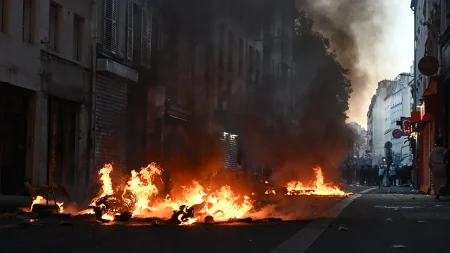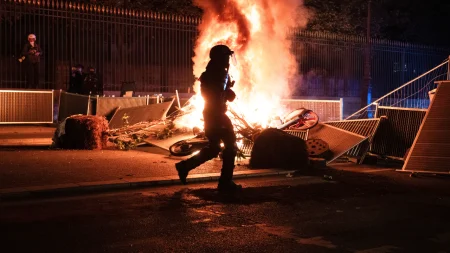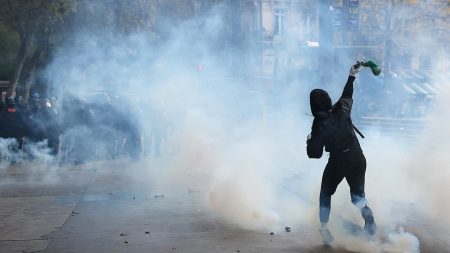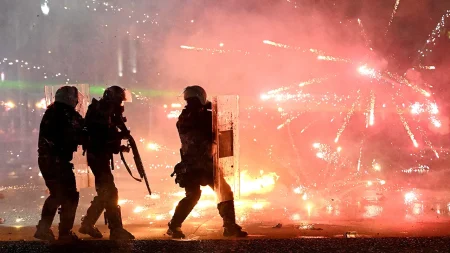



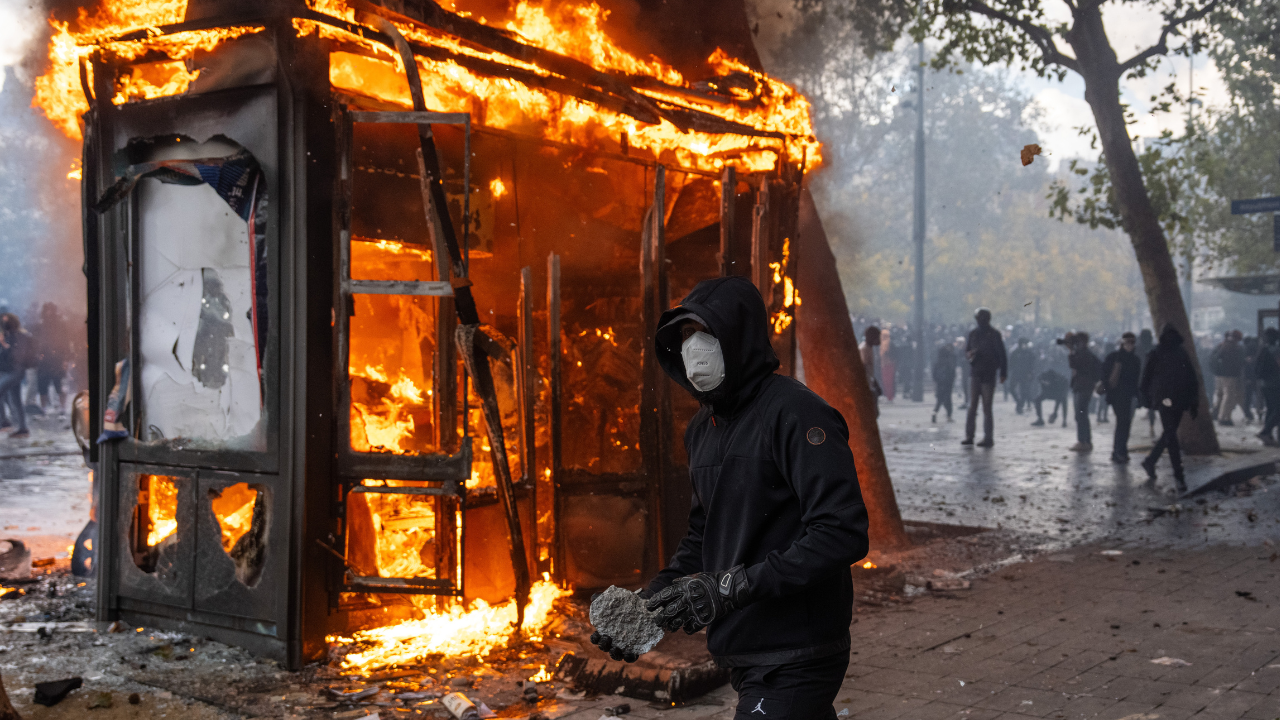
For two days, the streets of France told a story of anger, exhaustion, and rupture. An estimated half-million demonstrators surged into cities across the country, leaving parts of Paris and other urban centres scorched by clashes with police. It was the kind of explosion that makes a government uneasy not just because of the broken windows, but because of what it represents: a population that has lost faith in the system. Now, the organizers behind that upheaval are not slowing down. French activists have called supporters back to the streets for Saturday, October 24, for what they are billing as “Acte II.” According to their own digital map, some 212 separate “mobilizations” are planned across the country. The energy is not confined to France. A coalition of communist, socialist, and hard-left groups is pushing for a coordinated European youth strike on Friday, November 20. What began as a school protest over conditions in French classrooms has mushroomed into something far larger—a rolling rebellion against austerity, housing costs, militarism, and a political establishment perceived as deaf to the young. President Emmanuel Macron has warned that the unrest is being exploited, but the protesters have their own reply: “Macron must leave and make way for the people.” The political theater, once again, is gearing up for another act.
Behind this street-level passion, however, lies a complex web of organizational machinery. A Fox News Digital investigation has now identified 101 organizations across nine countries—including the United States—that are coordinating, organizing, or amplifying the protests. That number has grown from just 54 in a matter of days, suggesting not a spontaneous combustion but a deliberately cultivated ecosystem. The organizers represent what investigators call a “red-green alliance,” a somewhat unusual marriage of far-left, communist, and socialist groups—symbolized by red—with Islamist organizations—symbolized by green. It is a coalition of strange bedfellows, but one that has proven effective at putting bodies on the street. Only about one in three of the organizations is actually student-led or youth-led; the rest are adult formations, from revolutionary communist parties to labor unions and antifascist collectives. Some wear the “Antifa” label proudly, such as Action AntiFa16, which appears in the Angoulême, France, announcement for Acte II. There are Trotskyist groups, Marxist-Leninist parties, anti-war coalitions, and environmental direct-action movements. The common thread is a rejection of the current economic and political order, and a willingness to mobilize around multiple grievances at once—housing, climate, Gaza, pensions, education, and war. It is a potent mix, and one that makes simple demands difficult to answer.
The American connection adds another layer to the story. Across the Atlantic, voices linked to the U.S. franchise of this protest network are amplifying the European unrest. Hatem Bazian, a University of California at Berkeley academic and founder of organizations such as Students for Justice in Palestine and American Muslims for Palestine, shared videos from the French protests and drew a sweeping historical connection. He linked the October 17 riots in Paris this year to the explosion at Al Alhi Hospital in Gaza on October 17, 2023, and to the bloody police confrontation in Paris on October 17, 1961, when Algerian demonstrators were killed. In doing so, Bazian wove a narrative that collapses time and place, connecting the anger of French students to the Israeli-Palestinian conflict and to France’s colonial past. He did not respond to a request for comment. Meanwhile, a network of pro-communist media and activist organizations is providing sympathetic amplification. BreakThrough News, CodePink, and the Party for Socialism and Liberation are all funded or supported by Neville Roy Singham, an American-born tech tycoon living in Shanghai. Singham has expressed admiration for the Chinese Communist Party and Xi Jinping, and his media outlets frame the French unrest as part of a broader global uprising. BreakThrough News announced an online discussion titled “Europe’s Youth Uprising,” declaring, “A rebellion is sweeping Europe.” The promotional copy reads like a manifesto: “From student barricades in France, to Spain’s housing encampments, to Albanians marching to save their coastline from Jared Kushner, Gen Z is rising up against austerity, soaring rents, and governments pouring money into weapons and war instead of their future.” The framing is clear: these are not riots, but a righteous generational struggle.
The logistical backbone of the French protests reveals careful planning rather than pure spontaneity. Organizers are using the website 17octobregiletjaune.net to coordinate logistics, communication, and people. The domain was registered on September 15 by an anonymous user, according to online records. A Telegram messaging channel serves as the command center, where leaders share detailed logistical information and polished, ready-made graphics. The choice of the domain name is telling—it merges the October 17 date with the “gilet jaune” (yellow vest) movement, signaling continuity with the mass protests that shook France in 2018. The organizers have already mapped out a schedule that extends far beyond this week. After Acte II on October 24, they have planned Acte III on October 31, featuring “yellow vests, demonstrations and roundabouts, all over France.” More actions are scheduled for November 5 and November 14. The calendar even includes activities listed for April 3, 2027, under the name “Noisy spring,” and May 29, 2027, for a “Day against agrochemistry.” The location for these future events is simply listed as “Everywhere in France.” This is not the quickly extinguished flame of a momentary anger; it is a long-term campaign with dates chosen months or years in advance. The organizers clearly intend to keep pressure on the French state, using a rotating calendar of street actions to maintain visibility and momentum. For a government already struggling with a fractured society, the prospect of endless protests is a formidable challenge.
The international dimension culminates in the planned November 20 “International Youth Strike.” The coordinating coalition behind the strike has its own website, youthstrike.org, registered on August 2 by an unidentified person. The coalition is a broad left-wing alliance, with organizations from Belgium, Germany, Italy, Spain, Ireland, France, and the United Kingdom. The manifesto is unapologetic in its radicalism: it declares that “the exploitation of workers, climate breakdown and war are not failures of the system but the essence of capitalism.” It calls for “radical system change,” demands that NATO—which it calls an instrument of “imperial interests”—be dissolved, and urges “demonstrations,” “walkouts,” “assemblies,” “actions,” “blockades and occupations.” The British organization Socialist Students, which describes itself as building the student fightback for “socialist change,” says it will participate in coordination with 30 other European youth and student groups. Its campaign statements are explicitly Marxist: “Our fight for socialism is based on Marxism” and “workers and young people must actively fight and organise.” Other supporters include Counterfire, a revolutionary socialist and anti-war group; Stop the War Coalition; Left Unity; the Universities and Colleges Union; and Young Greens. In Germany, groups like Die Linke’s youth wing and the communist SDAJ are involved. Italy’s CGIL labor confederation is planning a general strike that converges with the student mobilization. The slogan is “Welfare, not Warfare,” under the banner of the Stop ReArm Europe campaign. World BEYOND War, a global anti-war organization, is explicitly promoting the strike and urging supporters to “join this resistance.” These are not fringe voices in the margins; they are established organizations with membership bases, institutional networks, and the ability to mobilize across borders.
What does all this mean, stripped of the slogans and the fiery graphics? At its heart, the story is one of deep human unrest—young people who feel locked out of affordable housing, burdened by a future of climate catastrophe and endless war, and skeptical that democratic institutions will respond to their needs. That despair is real, and it is shared across Europe. But the investigation reveals that the protests are also being shaped, amplified, and in some cases directed by a network of adult-led political organizations with explicit ideological goals. The “red-green alliance” is not a spontaneous youth movement; it is a coalition of revolutionary socialists, communists, Islamist groups, and anti-imperialist activists who see the street protests as a vehicle for systemic change. The American connection, through figures like Bazian and the Singham-funded media network, adds a global dimension, framing local grievances as part of a worldwide struggle against capitalism and Western power. The careful planning, the registered domains, the Telegram channels, the long-term calendar of actions, and the coordinated strike dates all point to a sophisticated protest ecosystem that operates like a well-oiled machine. For the casual observer, it may look like chaos. But beneath the burning cars and the barricades is a strategy. Whether the protesters will achieve their aims—or whether the movement will fragment into more of the same political theater—remains to be seen. What is certain is that the forces gathering under the banner of “Chaos Inc.” are not going away anytime soon. They have the organizational tools, the ideological clarity, and the international connections to keep the streets alive—not just in France, but across Europe, and perhaps beyond. The rebellion, in their telling, is only just beginning.