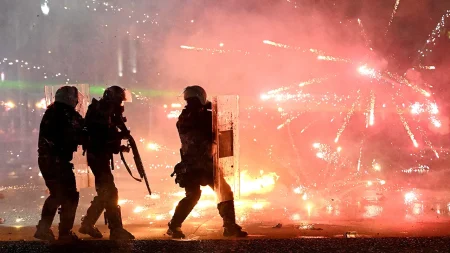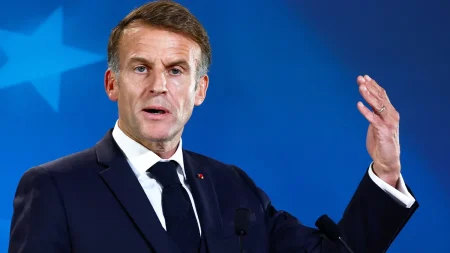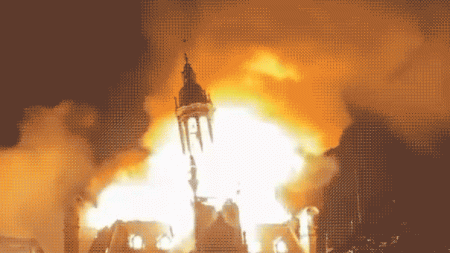


When the smoke began to clear over French streets, the images were hard to reconcile with the postcard version of France that so many travelers carry in their minds. Shopfronts were shattered, cars overturned, libraries and public buildings scorched, and thousands of young people had been swept into detention. The riots that tore through cities and suburbs were not a single, simple event; they were a collision of many frustrations, angers, and anxieties, some of them decades in the making. In the midst of this chaos, President Emmanuel Macron stepped before the cameras on Sunday, visibly embattled, and tried to make sense of what was happening. His explanation, however, was not what many expected. Instead of focusing only on domestic failures, he reached across the globe and pointed a finger at the United States and its war against the terrorist regime in Iran. He suggested that the widespread unrest, the looting, and the burning were not merely criminal acts or political insurrection, but also the bitter fruit of an international crisis that France did not start. According to Macron, demonstrators were expressing deep concern about the cost of living and the price of fuel, and both of those pressures, he argued, were driven by the conflict launched in the Persian Gulf. France, he said, had taken no part in that conflict, and yet it was suffering the consequences. It was a striking moment: a European leader looking at the wreckage of his own streets and choosing to frame it as a global energy crisis, not just a domestic breakdown. For many French families watching from their living rooms, the message felt distant. They wanted to know why their neighborhoods were burning, why their businesses were being looted, and why their children were so angry. Macron’s words offered a geopolitical explanation, but for many, the anger was far closer to home.
Macron’s televised address was meant to calm a frightened nation, but it also opened up a new set of questions. He said that he fully understood the concern about fuel and the cost of living, and he noted that similar worries were being expressed in other European capitals. He went on to say that he had taken several international initiatives to secure fuel and gas, and to act on energy markets. He announced that he would be traveling to the Gulf on a three-nation visit to discuss the energy crisis, a move designed to show that France was not passive in the face of global turmoil. Yet there was something puzzling about his words. It was unclear which demonstrators Macron was referring to when he spoke of fuel prices and the cost of living. The riots were massive and messy, and they were not all the same. Some people genuinely were struggling to fill their cars and heat their homes, and they may well have taken to the streets out of economic desperation. But many of the groups involved in the worst of the violence were not concerned with the price of diesel. Fox News Digital had reported on the inner workings of the large-scale riots, and many of the named groups were seeking something far more radical than cheaper fuel. They wanted to abolish the free enterprise system itself, to tear down the structures of capitalism, and to remake society in a completely different image. This made Macron’s framing feel incomplete. Yes, there was economic pain, and yes, global conflicts were driving up prices, but the chaos on the streets was also being fueled by organized political movements, criminal networks, and ideological extremism. By attributing the unrest largely to the war in Iran, Macron may have been trying to redirect blame away from his own government’s struggles with inflation and inequality. But in doing so, he risked ignoring the very real domestic forces that were actively working to destabilize the republic.
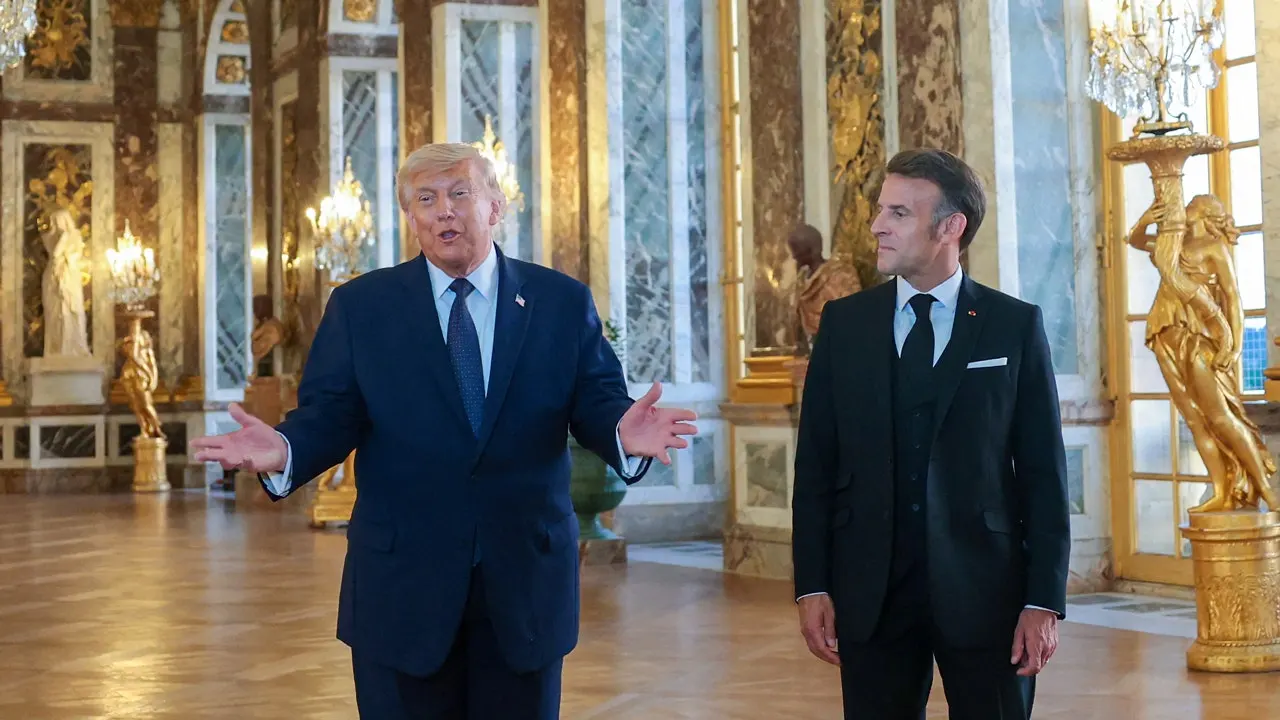
The law-and-order side of Macron’s speech was more forceful. He stressed that those who had tried to bring down the republic would be held accountable. That message was aimed at the rioters, the looters, and the organizers, and it was meant to reassure the public that the state would not collapse. But even this was complicated by the political noise around him. Former President Donald Trump, speaking to reporters on Monday, did not hold back. He said that he had warned Macron at their first meeting to close France’s borders, telling him, “You’re going to ruin your country.” Trump’s blunt assessment was that France had indeed been ruined, and he doubted whether it could come back. It was a harsh statement, and it reflected a broader debate about immigration, assimilation, and national identity that has been raging across Europe for years. Meanwhile, the French foreign ministry declined to add much beyond Macron’s address, and the Élysée press office did not respond to follow-up questions. The silence was telling. The government seemed to be struggling to find a unified message. On one hand, Macron was blaming the war in Iran for the economic pressures behind the protests. On the other hand, his own prime minister, Sébastien Lecornu, was accusing the “ultra-left movement” of orchestrating profound disorder in the country leading up to the presidential election. These two explanations did not fit together neatly. If the riots were spontaneous expressions of anger over fuel prices caused by a foreign war, then why were ultra-left groups organizing and coordinating the chaos? And if the riots were a premeditated attempt to destabilize the government, then why blame the United States and Iran? The truth, as always, was probably somewhere in the middle. Real economic grievances were being exploited by political extremists, and global energy prices were making life harder for ordinary French families. But the result was a combustible mix that no single speech could tame.
Experts were quick to push back on Macron’s framing. Lisa Daftari, an Iran expert and the Foreign Desk Editor-in-Chief, told Fox News Digital that Macron was pointing at the Iran war, but the real problem was that Iran’s regime had closed the Strait of Hormuz and held the world’s energy supply hostage. She questioned whether this was really about students and fuel prices at all. Major infrastructures and landmarks had been set on fire, shops were looted across the country, and nearly 2,400 people were arrested in a single day. In her words, that was not a protest over the price of diesel. It was organized lawlessness, and even Macron’s own government admitted it by blaming ultra-left groups and criminals. France, she insisted, had a domestic crisis, and current geopolitics were not an alibi for it. This was a powerful point. By linking the riots to an external enemy, Macron risked giving a free pass to the domestic actors who had spent months, even years, preparing for confrontation. The people who smashed windows and torched cars were not acting out of concern for the global oil markets. They were acting out of a radical ideology that saw violence as a legitimate tool for political change. To humanize this, one only needs to look at the shopkeepers who spent the night protecting their stores, the bus drivers who had to navigate through burning barricades, and the families who woke up to find their neighborhood transformed into a war zone. They were not thinking about the Strait of Hormuz. They were thinking about survival, safety, and whether the republic could protect them.
Other analysts went even further. Barak Seener, an associate research fellow at the Henry Jackson Society in London, argued that illegal immigration from the Middle East, North Africa, Sub-Saharan Africa, and also from Afghanistan, Pakistan, and Bangladesh to European states was serving as a kind of Trojan horse to dominate the West. He claimed that calls to “globalize the intifada,” “Free Gaza,” and “Stop the genocide” were codes to subvert and ultimately dominate Western civilization and impose Sharia law. Macron, he said, was still making the mistake of ignoring this. Vice President JD Vance echoed similar sentiments in a social media post, writing that Western liberals had imported the third world into France and other countries in the name of diversity and compassion. They ignored fundamental questions of assimilation and compatibility, he said, and they were told it would lead to this, but they did not listen. Seener added that the French political establishment’s political correctness and unilateral support of a Palestinian state had come home to roost. He pointed to Macron’s declaration at the 81st United Nations General Assembly that Hamas “has never been active” in the West Bank, calling it remarkable that Macron was reframing reality to suit his political agenda. Seener also noted that Macron had chosen to address students, teachers, trade unions, lawmakers, and business leaders about increased oil prices due to the U.S.-led war against Iran, but that this was unrelated to the riots. More fundamentally, he argued, Macron was ignoring the “Red-Green alliance” that had contributed to the unrest across France. This included 38 radical Left and Muslim organizations, and 16 student organizations, among them communist youth groups and the Muslim Students of France. These are deeply contested claims, and they touch on some of the most sensitive issues in French society. But they reflect a growing belief among many observers that the riots were not simply spontaneous outbursts of economic frustration. They were, in their view, the result of a long-term failure to integrate immigrant communities, to enforce French values, and to confront ideologies that reject the very idea of a secular republic.
In the end, the French people are left with more questions than answers. The riots have exposed a deep fracture in the nation, one that cannot be healed by blaming a foreign war or by arresting thousands of young people. The cost of living is real, and the war in Iran has indeed disrupted energy markets. But the violence on the streets has a different texture. It is the violence of people who feel they have nothing to lose, who have been radicalized by social media, who have been told that the state is their enemy, and who have found meaning in destruction. It is also the violence of a society that has not come to terms with the challenges of immigration, identity, and belonging. For ordinary French citizens, the past weeks have been terrifying and exhausting. They have seen their public spaces desecrated, their neighbors threatened, and their government struggling to maintain order. They deserve a leader who can speak honestly to them, not one who reaches for geopolitical excuses. They deserve a conversation about integration that is not shaped by fear or political correctness, but by a genuine commitment to the values of liberty, equality, and fraternity. They also deserve a response that distinguishes between peaceful protest and criminal insurrection, between legitimate grievances and organized chaos. The world is watching France, not because France is alone in these struggles, but because France is a mirror for so many other Western democracies facing similar tensions. The path forward will not be easy. It will require humility, courage, and a willingness to hear uncomfortable truths. But it will also require a firm defense of the republic and its laws. If Macron can learn from this moment, he might still help France find its way back. If he continues to point fingers at distant wars and ignore the fires burning at home, the country may continue to spiral. The human cost of this crisis is already enormous, and the scars will take years to heal. But the French people have endured far worse before, and they have always found a way to rebuild. Whether they can do so again depends not on the price of fuel, but on the strength of their common bonds and the wisdom of their leaders.