

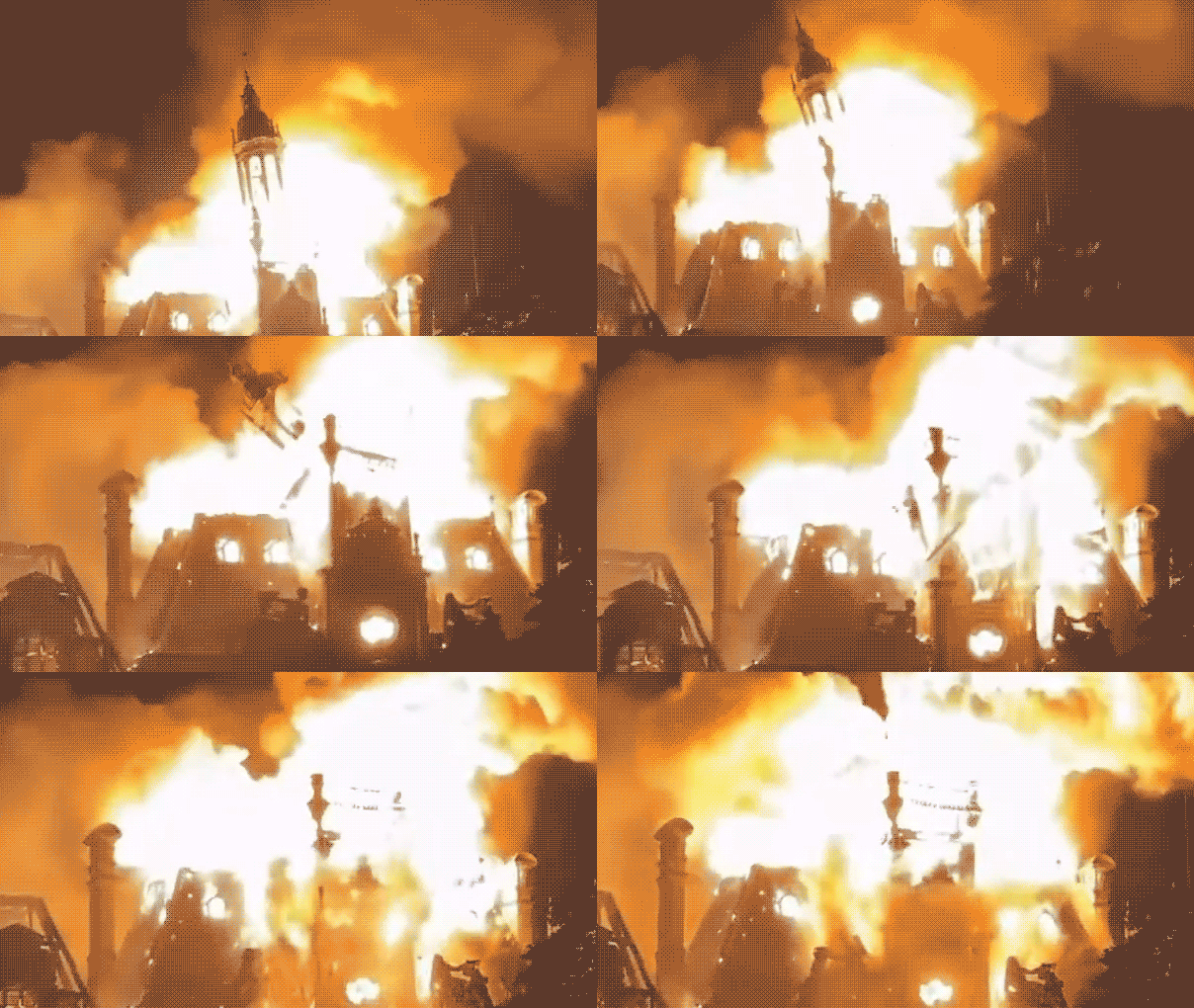
On a night that should have been like any other in Limoges, about three hours south of Paris, flames rose from one of the city’s most beloved landmarks. The Hôtel de Ville, a proud symbol of civic pride since 1883 and a protected historic monument since 1975, was turned into a roaring inferno. Firefighters battled the blaze as the structure’s roof collapsed, sending sections of the building down into lower floors. Only the west wing remained intact, according to Maurice Barate, the local prefect. “Two-thirds of the exterior has already disappeared,” he said, his voice heavy with disbelief. For a city that has survived wars, revolutions and time itself, the loss felt personal. Limoges is not just a place on a map; it is a community rooted in craft and tradition, known around the world for porcelain and enamel. Its town hall was more than an administrative hub—it was a gathering place, a point of pride, a quiet monument to the everyday life of the Republic. Now, in a single violent act, much of that history has gone up in smoke. Barate did not mince words: this was “a deliberate act by hooligans” and “a catastrophe for heritage.” The phrase “hooligans” seemed almost too small for the scale of the loss. Standing in front of the smoking shell, residents watched with a mixture of horror and grief. Some held phones; others simply stared. The smell of charred wood and damp ash drifted through the streets, carried by a wind that seemed to whisper the city’s sorrow. It was a scene that would be painful anywhere, but in Limoges, where the town hall had anchored the heart of the city for nearly a century and a half, it felt like a wound that would not easily heal. In the days ahead, historians and architects would assess what could be saved, but for now the people could only look at the sky, where smoke still rose, and wonder how a symbol of their city had become a casualty of a national crisis. The fire was not an accident, and that made the grief even sharper. This was not a faulty wire or a careless match; it was an act of destruction aimed at the heart of the community, and it would take years to understand the full cost.
The fire in Limoges did not happen in isolation. It erupted during the fourth week of protests that have shaken France, a wave of anger rooted in the rising cost of living and directed at a government many feel has turned away from ordinary people. What began as peaceful demonstrations has repeatedly exploded into violence, and on Saturday the country braced for another day of unrest. In Limoges, the town hall became the most tragic casualty of that anger. For the demonstrators, the building may have represented the state—the institution they blame for economic pain, inequality and a political system that seems out of reach. But for the people who live and work in Limoges, the town hall was something else entirely. It was where couples came to be married, where families registered births, where citizens attended public meetings. It was a place of bureaucracy, yes, but also of belonging. The loss is therefore double: a physical structure destroyed and a psychological anchor torn away. The protests have spread far beyond the capital, touching cities and towns across the country, and each clash leaves behind new scars. In Rennes, Toulouse, Montpellier and Grenoble, violence has flared; in Lille and Calais, masked groups have tried to storm city halls; in Brest, a police station came under attack. The authorities speak of “extremely violent, radical far-left groups” trying to hijack the movement, and there is evidence that a small, organized fringe has taken charge of the streets. But the anger that fuels these riots is broader, born of frustration that has simmered for years. For many French citizens, the right to protest is sacred, but the images of burning buildings and shattered storefronts have begun to blur that line. The town hall of Limoges, once a symbol of stability, now stands as a reminder of how quickly the social contract can be broken. And as the smoke rises, so do questions about the future of a nation caught between legitimate grievance and destructive rage. What happens to a country when the very buildings that hold its memory become targets? What happens to the trust that once allowed people to see their government as a protector rather than an enemy? These are questions with no easy answers, but they hang over every protest, every riot, every arrest.
President Emmanuel Macron has watched this crisis unfold from a position of unusual weakness. Already an outgoing president, with only six months left in office, he is running out of time and political capital. On Saturday, he turned to social media to address the nation, and his words were both stern and defensive. “There is no place for violence in our republic,” he wrote. He promised that those who had broken into buildings, attacked prefectures and businesses, and looted town halls would be prosecuted and punished. He expressed support for the law enforcement forces, calling them “guarantors of the right to demonstrate.” And he urged the nation to stand together against the “sowers of chaos” who, he said, wanted only to bring down institutions and silence those who express their demands peacefully. The speech was classic Macron: republican, legalistic, determined to defend the state. But it also reflected the difficult reality of a leader in his final months. With elections looming and the political landscape fragmented, Macron cannot simply wish the violence away. His calls for unity may resonate with some, but for many on the streets, they ring hollow. The president’s authority has been tested before, but this wave of unrest—stretching from the provinces to the capital, from the young to the old, from the left to the far left—has created a particularly dangerous moment. The phrase “sowers of chaos” was chosen carefully, designed to isolate the vandals from the broader protest movement. Yet the distinction is not always easy to make. When a town hall burns, when masked figures hurl fireworks at police, when violence becomes a routine part of demonstrations, the line between protester and rioter begins to blur. Macron’s message was aimed at both the public and the police: the state will not fall, and order will be restored. But with six months left, his ability to shape events is limited. He can condemn, he can promise punishment, he can express support. Whether he can heal a fractured nation is another matter entirely. For now, his words remain just words, and the smoke over Limoges remains a powerful counterargument.
Saturday’s unrest was not limited to Limoges. According to Interior Minister Laurent Nuñez, around 400 people were arrested across the country, while more than half a million protesters took to the streets in more than 100 separate marches. The scale was staggering, and yet the day ended with a familiar pattern: peaceful marches in the morning, violence in the afternoon, and a trail of destruction by night. In Lille and Calais, masked groups attempted to force their way into city halls, but were repelled. In Brest, a police station came under attack. In Rennes, Toulouse, Montpellier and Grenoble, clashes erupted between demonstrators and security forces. Nuñez placed the blame squarely on “extremely violent, radical far-left groups.” For him, the trouble was not the protest movement itself, but a minority of militants who had infiltrated it with the deliberate intention of confronting the state. The evidence supports that view in part: many of the most violent acts have been carried out by people wearing hoods and masks, their faces hidden, their movements coordinated. They are not the pensioners, students or workers who make up the bulk of the demonstrations. They are, in the words of one minister, hooligans. But the broader question of why France has reached this point remains unanswered. The cost of living has risen sharply, and many people feel left behind by a globalized economy. The government’s policies, seen by some as favoring the wealthy, have fueled resentment. And the tradition of French protest—from the Revolution to the gilets jaunes—has always contained the seeds of violence. What makes this moment different is the convergence of economic anxiety, political instability and a sense that the institutions themselves are out of touch. When a historic town hall burns in Limoges, it is not just a building that is lost. It is a symbol of the Republic’s promise, and of the trust that once held it together. The arrests, the police lines, the broken windows—all of these are symptoms of a deeper crisis. The question is whether France can address that crisis before more of its heritage goes up in flames.
In Paris, the heart of the protest movement, the day unfolded with the now-familiar choreography of chaos. At the Place de la République, where generations of French citizens have gathered to demand change, police in riot gear faced off against masked demonstrators. Water cannons blasted through the air, soaking protesters and scattering crowds. Tear gas drifted across the square, stinging eyes and throats, turning the space into a battlefield. On one side stood the security forces, ordered to maintain order and protect public property. On the other stood a mixture of activists, students and, by all accounts, a violent fringe that came ready for confrontation. Fireworks—the kind used in celebrations—were hurled at officers like missiles. Objects of every description flew through the smoke. It was a scene that has become all too familiar in French cities, repeated weekend after weekend. And yet, for all the violence, there were also moments of peace. Many of the more than 100 marches across the country were calm, filled with families, workers and ordinary citizens exercising their democratic right to dissent. They carried signs about wages, pensions, taxes and the future of the country. They marched for hours without incident, their voices loud but peaceful. The trouble, officials insist, comes from a small minority—the “extremely violent, radical far-left groups” described by Nuñez. But the presence of that minority has a corrosive effect. It shifts the focus from the protesters’ grievances to the chaos they leave behind. It gives the state reason to tighten control, and it gives the public reason to turn away. At the Place de la République, the images broadcast around the world were not of families with placards, but of burning barricades and police charging through tear gas. The peaceful majority was pushed to the margins, overshadowed by the militants. For a country that prizes its revolutionary history, this is a deeply uncomfortable position. The right to protest is sacred in France; so, too, is the idea of the Republic as a community of citizens. When the two come into conflict, the result is not just broken windows and burning cars, but a wound in the national soul that can take decades to heal.
The destruction of the Limoges town hall is a tragedy that transcends politics. It is a loss for the city, for France, for anyone who believes that the past matters. The building was not just an architectural monument; it was a living repository of memories. It had seen declarations of war and celebrations of peace. It had welcomed presidents and poets, brides and mourners. It had stood through the Belle Époque, two world wars, the economic booms and crises of the 20th century, and the transitions of the 21st. To lose it to a deliberate act of arson—to a group of people who likely saw it only as a symbol of power—is a kind of cultural vandalism that no arrest can undo. The authorities have promised to prosecute those responsible. Macron has promised that the state will stand firm. The interior minister has promised that the radical groups will be stopped. But promises, however sincere, cannot rebuild stone. They cannot restore the sculpted facades, the grand staircases, the painted ceilings. They cannot bring back the sense of security that has been shattered. What they can do is remind the country that order and heritage are worth defending. The challenge for France in the coming months is to find a way out of this cycle of anger and violence. The cost-of-living crisis is real; the frustration is real; the grievances are real. But so is the need for a society that can express those grievances without burning down its own history. The town hall in Limoges was a place where the Republic met the people, where the abstract idea of citizenship became concrete. Its loss is a reminder that democracy is fragile, that institutions are precious, and that the difference between protest and destruction is often a matter of choice. As the embers cool and the smoke clears, the people of Limoges will begin the slow work of mourning and rebuilding. They will argue, as the French do, about what happened and why. They will demand answers. They will hope that something can be saved. But the building that once anchored their city square will never be quite the same. And neither, perhaps, will France. The fire in Limoges was not just an act of vandalism; it was a signal of how far the country has drifted from the values it claims to hold. The question now is whether it can find its way back.