


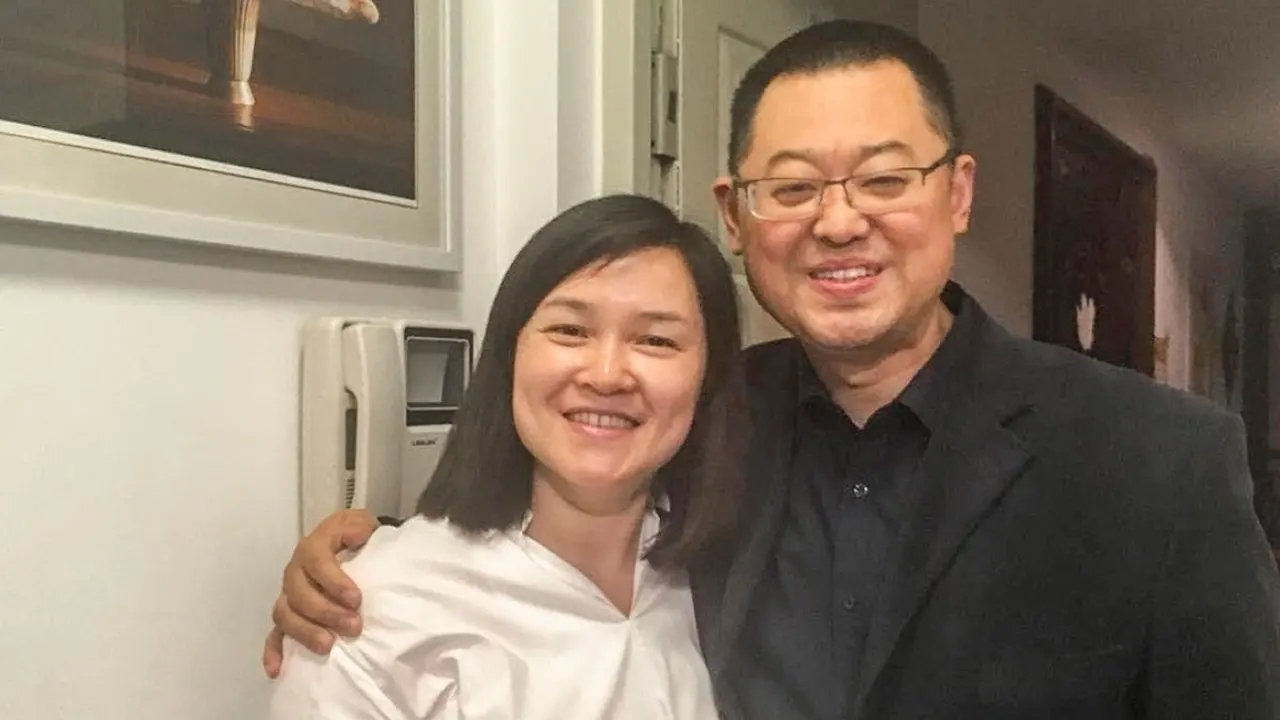
It is impossible to think of Pastor Wang Yi without also thinking of the people who love him: his wife, Jiang Rong, who has endured her own ordeal; his son, who has grown up with a father in prison; and his elderly parents, who should be spending their final decades with family, not waiting by a telephone for news that may never come. Wang, the founding pastor of Early Rain Covenant Church in the southwestern Chinese city of Chengdu, has been locked away since December 2018. He was sentenced to nine years on charges of inciting subversion of state power and illegal business operations—charges that his supporters, including the U.S. State Department, have long dismissed as punishment for his peaceful religious faith. Now, a new fear is rippling through the small circle of people who still fight for him: Wang may be seriously ill, possibly with advanced liver cancer. If that is true, the clock is ticking, and the people who care about him are being kept in the dark.
The man raising the alarm is Rev. Dr. Bob Fu, the founder and president of ChinaAid, a Christian human rights organization. Fu has spent decades tracking the fates of religious believers in China, and he told Fox News that reports about Wang’s failing health are “very worrying.” The information is coming from multiple sources inside China, which gives it a degree of credibility, but Fu is honest about the limits of what he and his organization can know. They cannot independently verify the diagnosis. They cannot visit Wang. They cannot demand his medical records. They can only listen, and wait, and hope that the rumor is wrong. ChinaAid first went public with its concerns on September 28, urging Chinese authorities to let Wang’s family see him and to disclose what treatment he has received. What followed was not transparency but a strange and unsatisfying phone call. Prison officials told Wang’s family that an examination had been conducted on October 1 and that Wang was in good health. But if that is true, why won’t anyone let his family see him? Why is there no independent medical check? Why is there no face-to-face meeting, no moment when his wife can look into his eyes and see for herself that he is okay? The officials offered words; the family was offered no proof. Fu noted that the family has written letter after letter asking for permission to visit, and “no meeting had been granted at all” since the latest health concerns surfaced. It is a heartbreaking situation: a medical report delivered by telephone, a family left to wonder whether the report is real or merely a formulaic reassurance meant to make the problem disappear.
Wang’s own church, Early Rain Covenant Church, has also spoken out. In an open letter dated October 3, the church acknowledged the reports but conceded that it could not determine whether its founding pastor had actually fallen ill. The church asked prison authorities to allow regular family visits, correspondence, and phone calls, and to provide information about any medical care Wang might need. That request may sound modest, but for Wang’s family, even the most basic human contact has been denied for years. According to the church, Wang’s family has been permitted fewer than five visits in nearly eight years of imprisonment. Five visits. Eight years. That is not a family relationship; it is a slow, quiet erasure. Fu described the visits that do happen as brief and heavily monitored. Conversations about Wang’s health or his religious beliefs are apparently met with the termination of the visit. If his wife tries to ask how he is feeling, if she asks about his faith, the guards cut it short. The isolation goes even deeper. “Two years, not a single letter for his wife,” Fu said. He called this unacceptable, adding, in a pointed rebuke, that it is even a violation of China’s own laws. Under Chinese prison regulations, prisoners are supposed to retain certain rights of correspondence and visitation. But laws on paper are not the same as laws in practice, and for Wang, the gap between the two has become the story of his life.
The plight of Wang’s wife, Jiang Rong, deserves special attention. When the crackdown on Early Rain Covenant Church happened in December 2018, she was also detained. She was not merely questioned and released; Fu recounted that she was placed under residential surveillance at a police-arranged location, not allowed to remain in her own home. Imagine the fear, the disorientation, the humiliation of being pulled from the place where you live and held in a setting chosen by the police, uncertain when you will be allowed to go home. Jiang has since been released, but Fu said the emotional consequences have lingered. She has lived through the arrest of her husband, her own detention, the sudden intrusion of the state into every area of her life, and now the grim possibility that her husband may be dying in a cell while she cannot reach him. There is something deeply cruel about this combination of secrecy and helplessness. A family should be able to accompany a loved one through illness. A wife should be able to sit by her husband’s bed. A son should be able to speak with his father. Instead, Wang’s family is left to piece together fragments of information, relying on reports from sources they cannot identify and officials who will not show their work. The isolation is not incidental. It is the mechanism by which fear succeeds. When no one can know the truth, the truth becomes whatever the authorities say it is, and even that is offered sparingly, almost reluctantly.
Fu is not only speaking out about Wang; he is also raising broader concerns about the treatment of prisoners of conscience in China. He described reports of mistreatment ranging from forced medication to serious physical and psychological harm. He was careful to say these allegations were part of a larger pattern of concern, not established evidence of what happened specifically to Wang. But the broader context matters. If the system routinely mistreats prisoners, then the lack of access to Wang becomes even more alarming. Fu is calling for concrete, verifiable steps: allow Wang’s wife, son, and elderly parents to meet with him privately; permit an independent medical examination in the presence of legal counsel; release Wang’s medical records, including information about any medications he has been given during his imprisonment. These are not radical demands. They are the minimum conditions of basic human dignity. A private family visit, an independent doctor, a paper trail of medical treatment—these are things that any family in any country would want for a loved one in prison. The fact that these requests are extraordinary in Wang’s case tells us everything about the conditions he has been forced to endure. Fu’s voice carries an urgency that is impossible to ignore. He knows that time is running out. Liver cancer, if it is advanced, does not wait for diplomatic breakthroughs or formal inquiries. It moves. It takes. And when it does, the family will be left with nothing but an official phone call and a void where their questions should have been answered.
There is a diplomatic dimension to this story, and Fu is pressing it. He wants the Trump administration to raise Wang’s case directly with Chinese officials in the coming months. He pointed to the example of Pastor Ezra Jin Mingri, a Chinese pastor who was reunited with his family in July after President Donald Trump raised his case with Chinese President Xi Jinping during a May visit to Beijing. That release was a genuine victory, a rare moment when high-level political intervention broke through the walls of silence. Fu believes the same approach could work for Wang, although he acknowledged that no two cases are exactly alike. The upcoming schedule provides an opportunity: Trump and Xi are expected to attend the Asia-Pacific Economic Cooperation leaders’ meeting in Shenzhen in November, followed by the G-20 summit in Miami in December. Those meetings will be dominated by trade, security, and geopolitics, but Fu is arguing that human rights must not be pushed off the table. “I think it’s time to hold them accountable,” he said. He wants the names of individual prisoners of conscience spoken aloud in rooms where decisions are made. He wants American leaders to refuse to accept the false choice between economic interests and human dignity. The Chinese Embassy in Washington, for its part, declined to provide specific information about Wang’s case. A spokesperson defended China’s religious policies, saying the government protects freedom of religious belief under Chinese law, does not interfere in religious groups’ internal affairs, and prohibits illegal activities carried out under the guise of religion. The embassy also criticized foreign interference in China’s domestic affairs. It did not answer questions about Wang’s reported medical condition, family visitation, or the possibility of an independent examination. The U.S. State Department did not respond to requests for comment by publication time. And so the story remains unresolved: a pastor in a cell, a family in agony, a world of power and politics moving around them. What Wang needs now is not just legal advocacy or diplomatic leverage. He needs his family. He needs to see their faces, to hear their voices, to know that he has not been forgotten. Everyone deserves that much. The question is whether anyone with the power to make it happen will choose to act before it is too late.