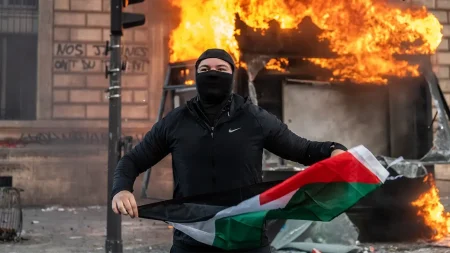



Paris is holding its breath this weekend, and the mood is uneasy. The city of light, known for its cafés, its romance, and its revolutionary spirit, is once again bracing for storms of a very different kind. Shopkeepers in the central districts are nailing plywood over their windows, not against the autumn chill, but against the prospect of masked youth clashing with police, smashing storefronts, and setting cars alight. French President Emmanuel Macron, meeting with intelligence officials on Thursday, offered a stern warning and a firm commitment: he would not allow the country to be held hostage by what he calls “ultra-left groups” whose apparent aim, in his words, is to “bring down the Republic.” The news rippled through France like a sudden gust of wind, stirring hope in some, anger in others, and a deep, lingering anxiety in nearly everyone. At the heart of it all is a simple but profound question, one that every democracy eventually faces—how do you protect the public from violence without silencing the legitimate cries of dissent?
Macron’s words were unusual in their bluntness. Following a meeting with intelligence officials, he told reporters that the strategy for the coming days would be to ban protests requested by “individuals or groups with no legitimate authority.” It was a phrase heavy with meaning, directed squarely at the organizers of the weekend’s planned demonstrations, which included both the so-called “yellow vest” movement, which shook France in 2018 and 2019 with furious demonstrations over fuel prices, and the powerful CGT labor union. For those groups that do have standing—like the unions—Macron offered a compromise: prefects would examine their requests in accordance with the law and propose alternative routes that avoid city centers, businesses, and public buildings. But his overall message was clear, almost paternal in its simplicity: “The rules are simple, and I think they’re just common sense. The general recommendation is that there should be no demonstrations in the coming days.” It was the kind of statement that sounds reasonable in a press conference, but on the streets of France, where the right to assembly is sacred and anger runs deep, it felt like a gauntlet thrown down.
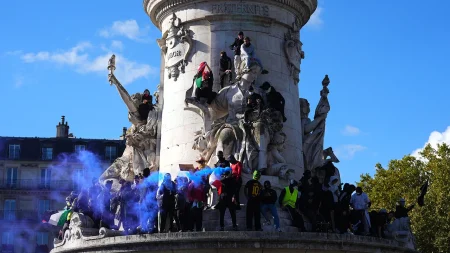
The immediate flashpoint was a protest in Paris on Thursday, a day that was supposed to be a prelude to something much larger. Thousands gathered in the southeastern part of the city, chanting and holding placards, watched over by a heavy police presence that lined the boulevards like gray shadows. That rally had been initially banned by the Paris police prefecture, which cited the risk of street violence after the weekend’s chaotic scenes. But organizers challenged the ban, and an administrative court overturned it—a reminder that France’s legal system remains fiercely protective of civil liberties, even in times of crisis. The crowd that day was largely peaceful, a mix of students, union members, retirees, and ordinary citizens who felt that their voices were being drowned out. They stood in the cold, some wearing face masks not against illness but against tear gas, their banners bearing slogans about education, pensions, the cost of living, and a government they feel is out of touch with their daily struggles. Their presence was both a testament to democratic expression and a kind of warning.
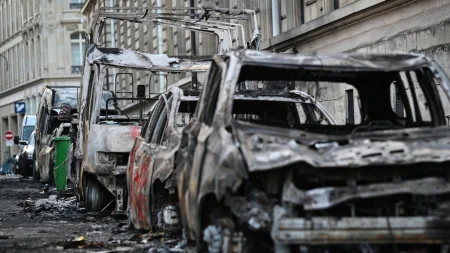
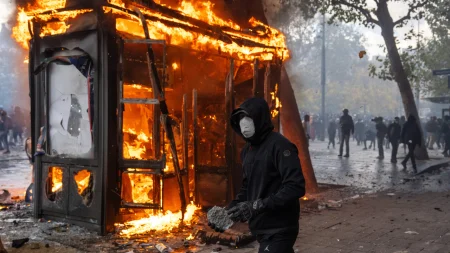
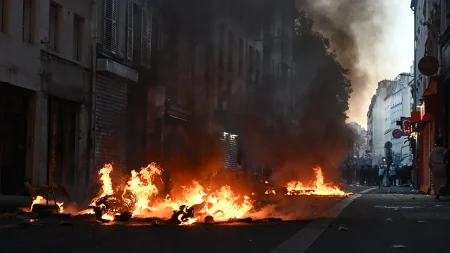
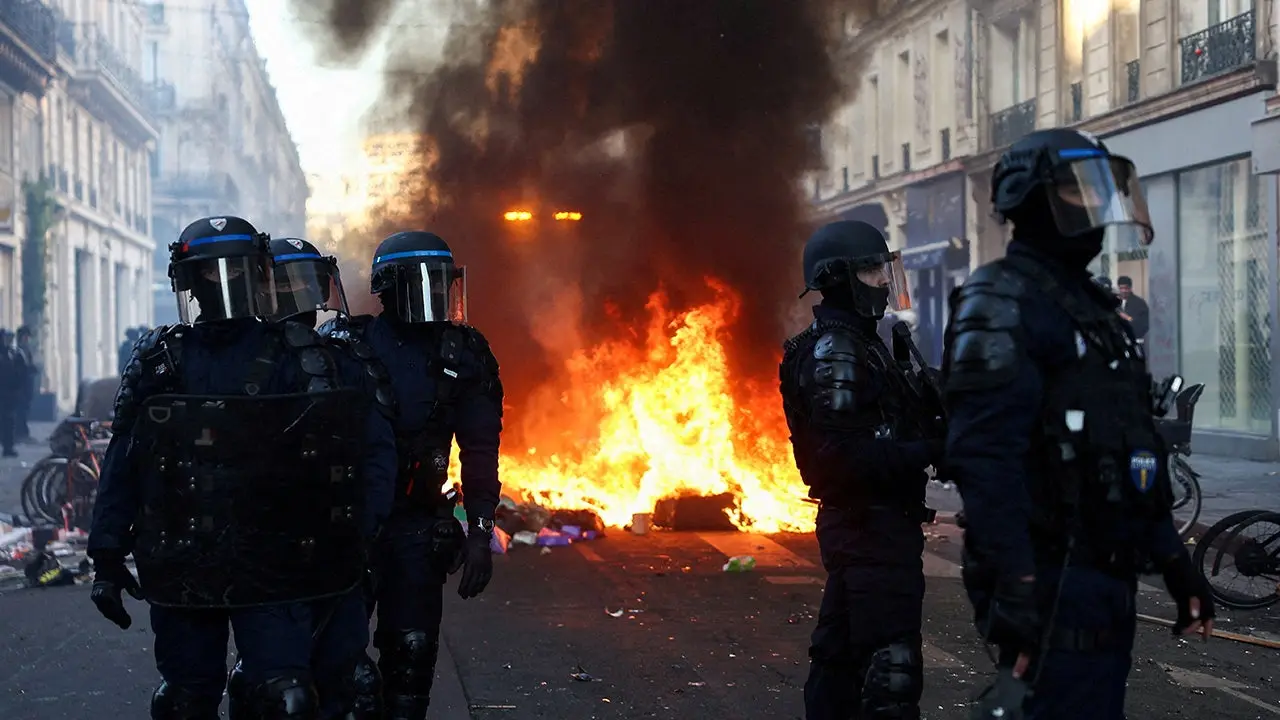
But what began as a call for education reform in September has morphed into something far more volatile. French officials say the movement has been infiltrated and steered by far-left groups eager to escalate tensions. The weekend saw masked youths clash with police, loot shops, and torch vehicles, transforming neighborhoods into scenes reminiscent of urban warfare. The images played on a loop on television networks, fueling fear and outrage in equal measure. To Macron and his allies, these are acts of political sedition, not social protest—a deliberate attempt to destabilize the state. To the protesters, though, the corruption is more personal: a government that raises the retirement age, squeezes wages, and ignores the working class; a president they see as arrogant and enamored with his own power. The two sides are not just politically opposed; they seem to be speaking different languages entirely, each convinced of their own virtue and the other’s destructiveness.
At ground level, this is a crisis of real lives, not just politics. The bakery owner in the Marais who has watched her neighborhood become a fortress; the young father who can’t afford fuel to drive his children to school; the nurse who works double shifts and still can’t pay her rent—these are the threads that make up the fabric of the movement. Yes, there are troublemakers in its ranks, the ones who throw stones and set fires, but there is also a deep well of frustration that cannot be dismissed as mere criminality or conspiracy. Macron’s vow to ban protests touches on the most delicate nerve of French identity: the belief that the street is the last resort of the people when all other avenues have failed. The state has a legitimate duty to prevent violence and protect property, but it also has a duty to listen. When it chooses order over dialogue, it risks turning even peaceful protesters into enemies.
The warnings from abroad heighten the tension. The U.S. State Department has advised Americans about the dangers of traveling to Paris, citing the possibility of even worse destruction on the second weekend of planned riots. That travel advisory feels like a metaphor for the country itself: a beautiful, vital nation that has become unpredictable, fragile, and charged with electricity. Behind the scenes, diplomats in Berlin, Brussels, and Washington are watching with concern, hoping that Europe’s second-largest economy can find its footing, and that its president can navigate this crisis without resorting to heavy-handedness that will only store up more rage for the future.
As the weekend approaches, the world waits to see what will happen. Saturday’s demonstration promises to be enormous, with activists and unions planning a show of force that could rival the yellow vest protests that once paralyzed the nation. Macron’s pledge to ban “individuals or groups with no legitimate authority” is a gamble—an attempt to draw a line in the sand, to separate the reasonable from the radical. But in a country where protests are almost a national sport, where the barricade is an historical icon, banning the street is like banning the tide. What France needs, perhaps more than scattergun bans and security cordons, is a renewal of trust. It needs leaders who see protesters as citizens, not enemies; and it needs protesters who can mourn the injustices of the present without burning down the future. The odds of that are uncertain, but the very act of asking is a beginning. Meanwhile, Paris boards up its windows, and the people, as always, watch and wait—hoping, fearfully, that the light will not go out.