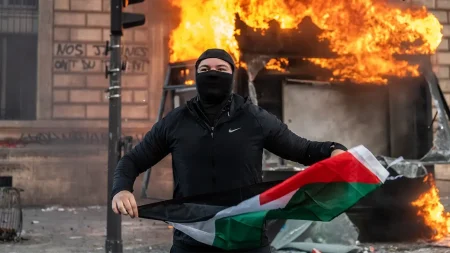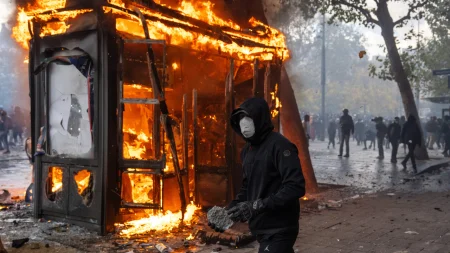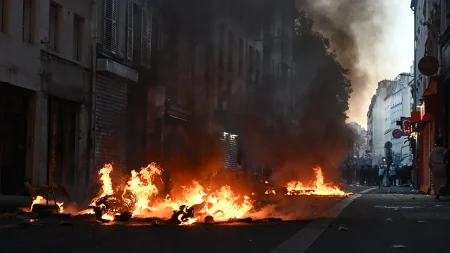


It begins with a warning that sounds more like a cry from the heart than a political slogan. Michele Teboul, a French business owner whose family has spent generations building a retail empire across some of the country’s most vibrant cities, stood amid the aftermath of chaos and delivered a message that cut through the noise of official statements and press briefings. “Next Saturday is your last chance to save France,” she said, addressing President Emmanuel Macron and Interior Minister Laurent Nunez directly through a Fox News Digital interview. The words were not hyperbole; they were the exhausted conclusion of a woman who watched looters reduce her family’s hard work to rubble in a single night. Teboul lost more than merchandise when rioters ransacked fifteen of her family’s stores, leaving five completely destroyed. She lost something far harder to rebuild: faith in her government’s ability to protect its own citizens. For her, the violence was not an abstract political crisis or a statistics-laden news report. It was the shattering of a sense of safety, the kind of quiet assumption that allows ordinary people to open shutters each morning, sweep their storefronts, and believe that the Republic stands behind them. Now, that trust lies in splinters alongside broken glass and shattered display cases, and her plea is not for sympathy but for action.
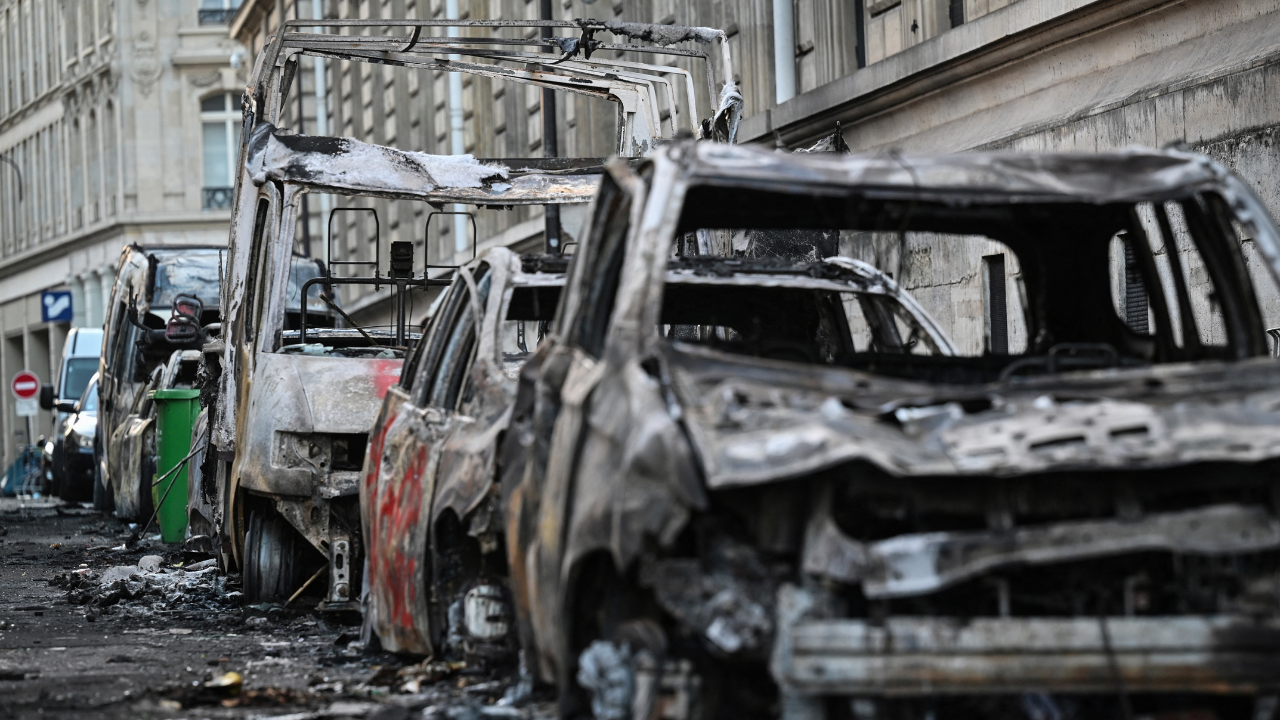
The scale of the destruction is almost too large to process. Teboul’s family retail operations stretch from Paris to Bordeaux, from Lyon to Marseille and Montpellier—a map of France itself, a testimony to years of patient entrepreneurship. Her sons work within the same company, running their own brand, and for them this was not just a financial loss but an attack on their identity. The protections put in place before the violence proved to be alarmingly fragile. Attackers used axes to break through boarding, prying their way into stores as if dismantling a stage set, and leaving behind scenes of devastation that Teboul described as “completely destroyed.” When the looters moved on, they left behind more than empty shelves. They left a mountain of practical problems that now stands between the family and any chance of reopening. Insurance companies require a certain standard of security before they will continue coverage, and meeting those standards means at least two months of repairs, reinforced doors, upgraded locks, and probably security guards. The cost is staggering, and the timeline is brutal. “I think the winter season is dead,” Teboul said. For a retail business, losing the winter season is not a setback; it is a mortality risk. Even with the government’s promise of help, Teboul remains skeptical, adopting a wait-and-see attitude that has hardened from disappointment. Established companies with financial reserves might absorb the disruption, she noted, but younger businesses face an almost impossible climb. The victims are not just wealthy storeowners; they are employees, apprentices, delivery drivers, and families who depended on those wages to put food on the table.
The question that keeps Teboul awake at night is simple: where were the police? She accused authorities of failing to provide enough officers to protect businesses during the unrest, saying that the forces deployed were overwhelmed as large crowds descended on city centers, particularly in Marseille and Lyon. She cited estimates that around 30,000 young people arrived in central Marseille—a figure that could not be independently verified, though French broadcaster BFM reported its own numbers, suggesting between 1,800 and 3,000 people engaged in the ransacking of the city center according to the prosecutor’s estimates. For Teboul, though, the exact count is less important than the underlying failure. “They were not enough,” she said of the police. The French government has acknowledged failures in its response, but those admissions ring hollow for someone whose livelihood now depends on promises rather than protection. Teboul argues that authorities mistook the threat for an ordinary demonstration, treating a gathering that would inevitably attract opportunists, thieves, and organized crews as if it were a routine protest. “Of course they could prevent it,” she said. But they did not. Teboul is careful to distinguish between two separate events that happened on the same day. There were students and citizens protesting genuine grievances, exercising their democratic right to be heard. And then there were looters, waiting in the wings, watching the crowds gather, and calculating precisely when to strike. “The looters, they took the opportunity that there were many people downtown, and then they came,” she explained. The result was a perfect storm—legitimate anger providing cover for blatant criminality, and the state seemingly unable or unwilling to tell the difference.
Beyond the broken glass and empty cash registers, there is a deeper cultural unease creeping through the country, and Teboul, who is Jewish, speaks to it with particular urgency. She knows the community’s pulse better than most, having served as a former director of CRIF, the umbrella organization representing French Jewish institutions. In her world, the subject of security is not abstract. Jewish schools, synagogues, and community businesses all maintain dedicated security arrangements, with guards, barriers, and protocols that have become as routine as opening morning prayers. This is not paranoia; it is lived experience. Teboul said that many Jews are now contemplating leaving France altogether, and she warned that further disorder could deepen that uncertainty if things do not improve. “It is going to be very hard to imagine a future in France for us, especially for Jews,” she said, her voice carrying the weight of history. But she is also careful to insist that this is not a Jewish problem alone. The rioters did not restrict themselves to Jewish-owned shops; they targeted sneaker stores, luxury boutiques, and any storefront with expensive goods, regardless of the owner’s background. “The specific problem of last Saturday is not a problem of Jews,” she stressed. “The whole of France is concerned by this problem.” She is right to make that distinction, because the danger of narrow victimhood is that it allows the rest of society to comfort itself with the illusion that the violence is contained, directed at someone else, separate from the national fabric. The damage to Teboul’s family business is a warning to every shopkeeper in France, whether they sell baguettes or designer clothing, whether they live in a Parisian arrondissement or a provincial village. When the rule of law weakens, everyone becomes vulnerable.
Perhaps the most chilling detail in Teboul’s account is the one that reveals how far the situation has deteriorated: the response of ordinary shopkeepers who are no longer willing to wait helplessly for protection. Her sons have hired security guards with dogs, a costly and unpleasant necessity that adds another layer of expense to an already bleeding business. But she has also heard of other shopkeepers going much further, obtaining weapons or tear gas to defend their property. She emphasized, with evident discomfort, that her sons had not purchased weapons. “Some have bought weapons,” she said. “You know, we are not used to weapons in France.” That last phrase is heavy with meaning. France is a country where firearms are heavily regulated, where the idea of a civilian arming themselves to protect a store would have seemed absurd, almost un-French, just a generation ago. The fact that shopkeepers are now quietly acquiring means of self-defense signals a breakdown not just of physical security but of the social contract itself. When citizens feel forced to prepare for defense against their own countrymen, something fundamental has been lost. Teboul’s recounting of this trend is not an endorsement; it is a lament. She is describing a country drifting into a state of precarity where the state’s monopoly on force is no longer credible, and where ordinary people must improvise their own safety. The purchase of a weapon is not a sign of courage; it is a sign of desperation. And desperation, when it spreads, tends to produce more chaos rather than less.
For Teboul, the coming Saturday is the final test. She has framed it in stark terms, warning that another failure to protect the population could have consequences for Macron’s government itself. “The government may fall down,” she said, speaking not in the language of a political opponent but in the flat, weary tones of someone who has watched too many warnings go unheeded. Her demand is not extravagant. She wants authorities to ensure that enough police are present to protect law-abiding citizens, to allow families to reopen their businesses, to let Jewish community members attend synagogue without fearing for their lives, and to restore the basic assumption that violence will not be allowed to rule the streets. “We have to feel secure,” she said. “We do not feel secure for the moment.” That feeling of insecurity is the most dangerous export of this crisis. It causes investors to hesitate, families to emigrate, and children to grow up believing that the sound of breaking glass outside their window is normal. Teboul’s warning is not just about a Saturday protest; it is about the kind of country France wants to be. If the state fails again, she argues, it may not just be storefronts that are lost, but the very idea of living together in security and mutual trust. Her message to Macron is both an ultimatum and an entreaty, a final request from someone who has not yet given up. “Next Saturday is your last chance to save France,” she said. It is a phrase that will sound overheated until one remembers the axes breaking through the boarding, the shops reduced to skeletons, the shopkeepers buying weapons, and the long line of citizens who now wonder if the Republic can still protect them. For Teboul, the answer to that question remains unwritten. The pen, she hopes, is still in Macron’s hand.