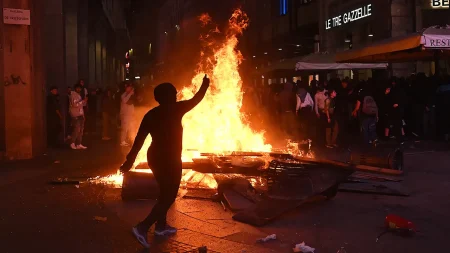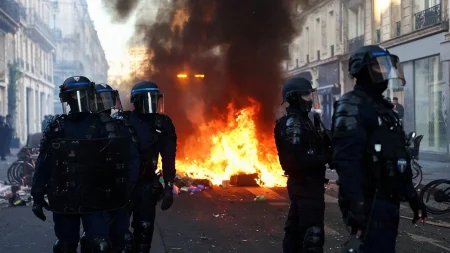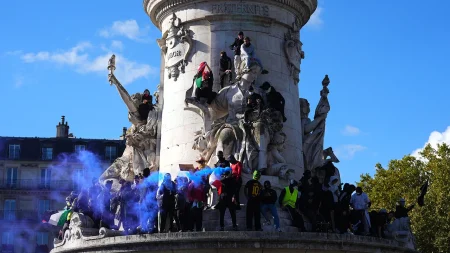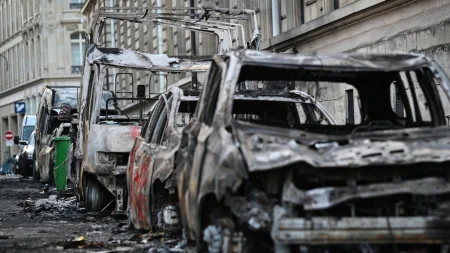



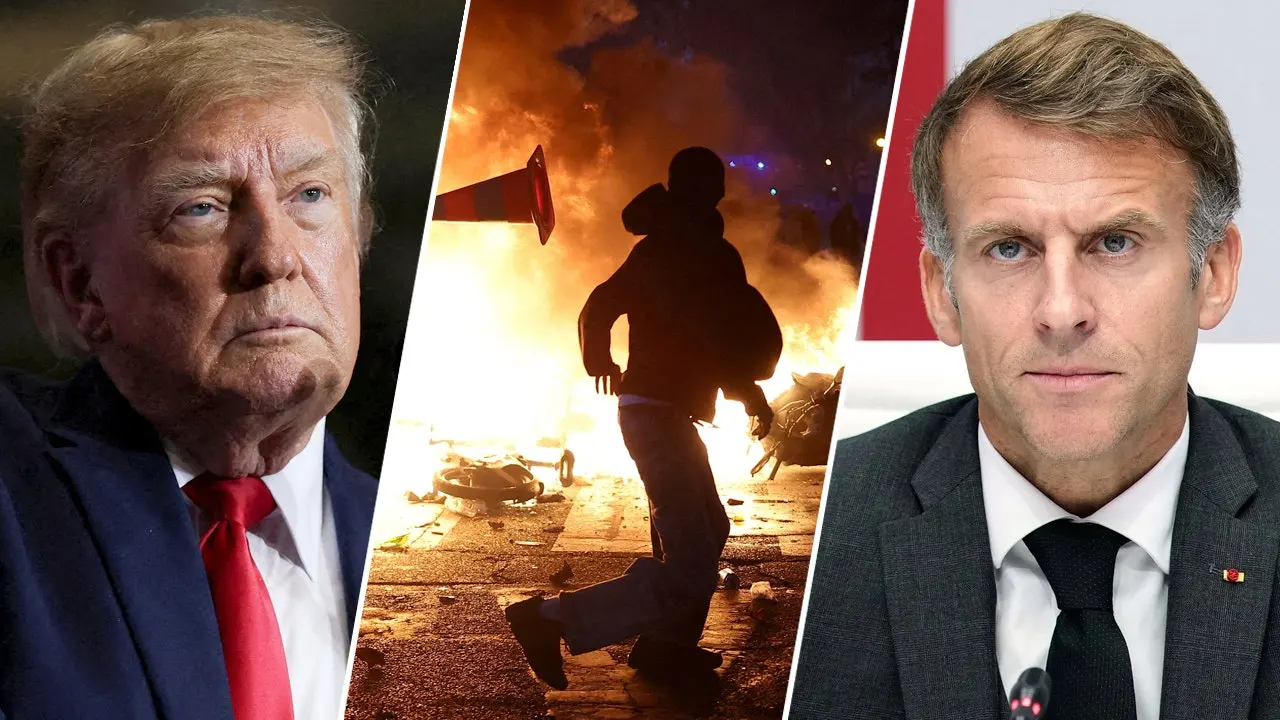
In the middle of a diplomatic storm between two of the world’s oldest allies, the Trump administration has waded into the controversy surrounding President Donald Trump’s sharp remarks about France, saying his assessment of the situation there is exactly right. The tension began after French President Emmanuel Macron took direct aim at foreign leaders who, in his view, had made reckless and misleading comments about the violent protests that have gripped France. Over the weekend, what started as anti-government demonstrations spiraled into scenes of chaos, with rioting, looting, and burning buildings in cities across the country. Trump, speaking at a midterm election rally on Monday, did not hold back. He claimed that “the migrants have taken over France,” and urged the nation to close its borders immediately. He went even further, describing France as a “once great nation” that was now “being conquered, looted and burned to the ground by migrants, jihadists and communists who hate Christianity” and “the Western civilization itself.” Those words landed like a bomb in Paris, and Macron responded days later with a pointed rebuke, suggesting that some international voices were either misinformed or deliberately spreading falsehoods. The whole exchange has laid bare a deepening rift between two leaders who have often clashed on trade, defense, and global governance, and it has raised uncomfortable questions about how allies speak to one another in an era of instant information, social media, and foreign interference.
Macron’s response came during a visit to a French town that had been affected by the unrest, where he addressed the protests and the international reaction to them. He claimed that there had been “foreign manipulation of information” following the demonstrations, including the spread of AI-generated images that showed scenes that never actually happened in France. According to The Associated Press, Macron argued that this wave of fabricated content gave way to “unacceptable and stupid comments from many people including foreign leaders.” When asked directly, Macron confirmed that he was referring to Trump, “among others.” He specifically rejected the narrative that France was being overrun by outsiders, saying, “We’ve had people claiming that we were invaded by hordes of migrants and Islamists, which is completely false.” For Macron, the issue was not just about criticism; it was about the danger of misinformation and the way false narratives can inflame an already fragile situation. His tone suggested a leader who felt both defensive and frustrated, trying to reassure his citizens that the state was still in control while also pushing back against what he saw as an unfair and dangerous caricature of his country. The imagery of a civilized nation being overrun by foreign radicals was, in his view, not only untrue but a deliberate distortion designed to undermine France and the European project as a whole. It was a rare moment of public anger from a leader who usually chooses his words carefully on the international stage.
The State Department, however, was quick to dismiss Macron’s complaint. Spokesperson Tommy Pigott told Fox News Digital that Trump “is on point as he is consistently on point.” That response was not just a defense of the president; it was a broader statement of policy philosophy. Pigott argued that Trump has long warned about the dangers of mass migration, both as a candidate and as president. “He has been clear about the dangers of mass migration for years, especially since the beginning of this administration, but certainly long beforehand as well. The president has secured the border on day one when it comes to the United States of America,” Pigott said. He also took a swipe at international institutions, saying the State Department would oppose any global body that tries to “impose an agenda upon sovereign nations to encourage mass migration.” In other words, the administration views migration not as a humanitarian issue to be managed collectively, but as a matter of national sovereignty and security. Pigott’s language was unmistakably firm, even confrontational. He described mass migration as “inherently destabilizing,” saying, “It is something that we don’t believe solves problems, but actually creates problems.” For the administration, the unrest in France was not just a domestic issue for the French people; it was proof that their warnings about the consequences of open borders and weak enforcement were being borne out in real time, in one of Europe’s most influential nations.
Pigott went on to emphasize that Trump had raised this issue repeatedly on the world stage, including at the United Nations General Assembly, where he called for an end to “destructive policies of illegal amassed migration” two years in a row. He argued that these policies do not help the people who migrate, nor do they help the countries that receive them. Instead, he said, they only benefit criminal organizations. “Illegal amassed migration that, by the way, only helps criminal cartel groups. That’s something we see in our own hemisphere, for example,” Pigott said, pointing to how cartel groups have moved along migration pathways, exploiting vulnerable people and profiting from chaos. He added that the president is “spot on” and is “bringing attention to this issue” and “taking action to address this issue.” From the State Department’s perspective, he said, “we have also taken concrete action to end the era of mass migration.” This is not just rhetoric; it reflects a broader administration agenda that includes restrictive asylum policies, border wall construction, and pressure on other countries to take back migrants who enter the United States. For the administration, France’s troubles are a cautionary tale, an example of what happens when nations lose control of their borders and allow social divisions to fester. The fact that the State Department is willing to say this so openly, in response to criticism from a fellow NATO ally, shows how much the diplomatic landscape has changed in recent years.
Meanwhile, the situation on the ground in France remains tense. The Louvre and other major museums in Paris announced they would be closed on Saturday as more protests were expected in the capital. Reuters reported that businesses in central Paris had begun boarding up their windows, bracing for another wave of violence. French officials said that more than 3,000 shops had been looted over the weekend, and that some 2,500 people had been taken into police custody in connection with the nationwide demonstrations. These numbers are staggering, and they paint a picture of a country dealing with serious civil unrest, not just a few isolated incidents. For many ordinary French citizens, the immediate concern is safety and economic damage, not geopolitics. The violence has disrupted daily life, scared tourists, and left small business owners counting their losses. At the same time, the political debate over what caused the unrest is intensifying. Some blame the government’s policies, others blame deep social divisions, and still others point to outside influences. Macron has attributed some of the violence to “ultra-left groups whose aim is to bring down the Republic,” suggesting that the protests have been hijacked by radicals with a larger agenda. The combination of domestic anger, criminal looting, and foreign disinformation has created a perfect storm, and there is no easy way out. The coming days will be critical, as France tries to restore order while also addressing the underlying grievances that brought people into the streets in the first place.
For Americans planning to travel to France, the State Department has a practical message: stay informed, stay registered, and stay safe. Pigott urged U.S. citizens to sign up for the Smart Traveler Enrollment Program, or STEP, which allows the embassy to provide real-time information to Americans in the country. “That program lets you tell us which countries you’re going to so that we can provide real-time information to Americans in the country that have registered,” he said. He also reassured travelers that the State Department has personnel at embassies and consulates around the world who are working around the clock to assist Americans in need. “If you have an issue when you’re abroad, please contact the embassy or consulate,” he added. “There are people that are there to help you that can provide information. Everything from a lost passport to responses to a security situation, that is something that is hugely important and a huge factor for the State Department.” The advice is practical and straightforward, but it also carries a deeper message: the world can be unpredictable, and even the most beautiful and familiar places can face moments of turmoil. The diplomatic spat between Trump and Macron may dominate the headlines, but for everyday travelers, the real story is about staying safe and being prepared. Ultimately, this entire episode highlights a broader truth about modern alliances. Even close friends can disagree, sometimes sharply, about how to handle the challenges of a changing world. But beneath the heated words and political posturing, there is still a shared interest in stability, security, and the protection of ordinary people. Whether the relationship between Washington and Paris will heal from this particular clash remains to be seen, but for now, both sides seem determined to make their voices heard, no matter how uncomfortable that makes the conversation.