

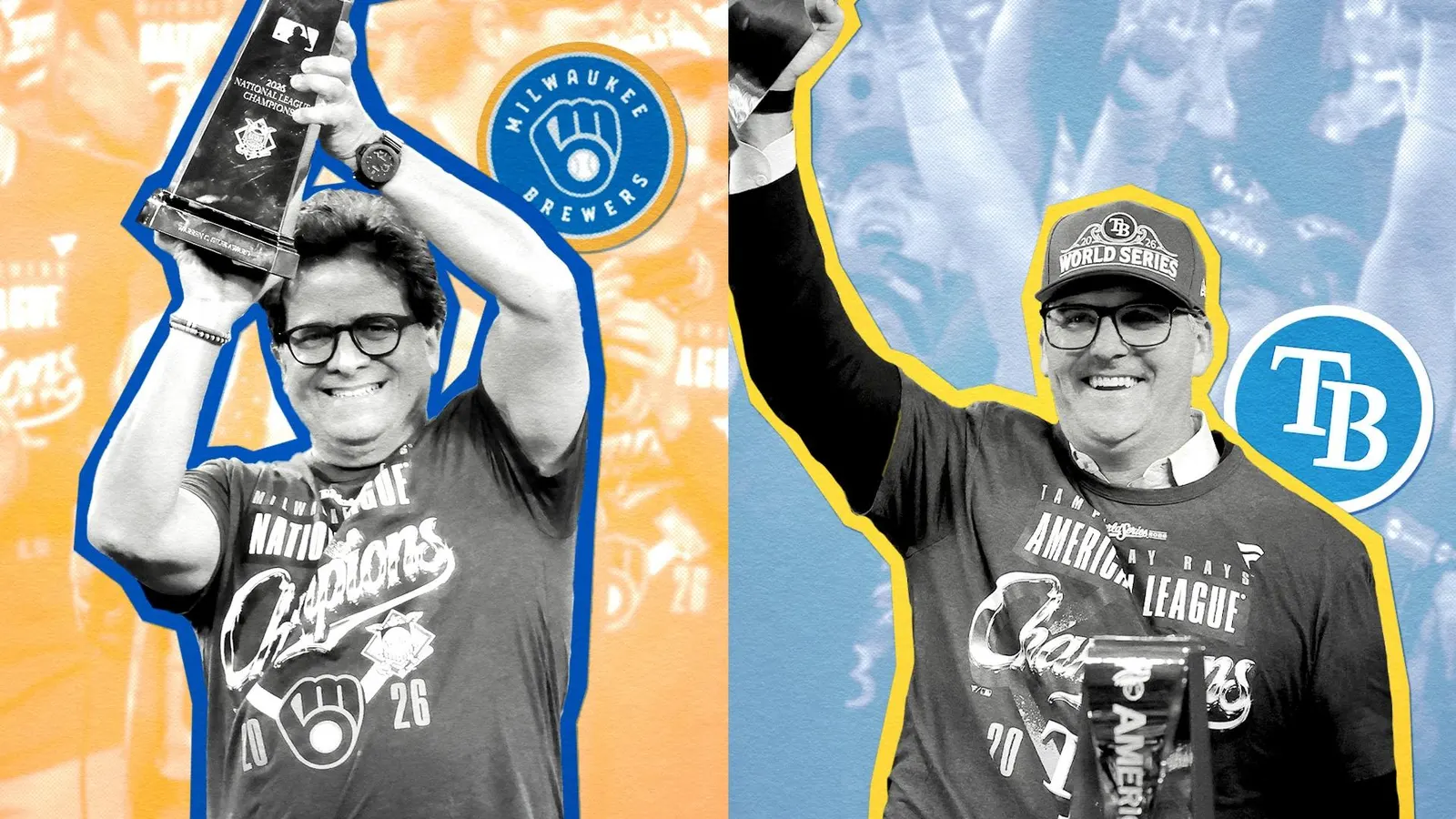
The champagne was still drying on Mark Attanasio’s jacket when his mind floated back to 2004, to a cramped news conference in Milwaukee where a reporter in the front row looked at the man about to take over a struggling franchise and delivered a line that could have been a curse or a challenge: “You won’t be so cheery when you lose for another 26 years.” Attanasio, then a Wall Street money manager with a boyish grin and a Bronx accent, never forgot it. So when he stood on the field at Dodger Stadium last week, watching his Milwaukee Brewers mob one another after clinching the National League Championship Series over the Los Angeles Dodgers, the 69-year-old owner let out a laugh that meant more than any champagne toast. “So here we are, 22 years later,” he said. “We beat the standard.” The moment was delicious for many reasons, not least because the Dodgers had swept Milwaukee in the same round the year before. Los Angeles spent more than $300 million on its roster, plays in the nation’s second-largest market and carries a valuation of $7.8 billion. The Brewers, meanwhile, won 103 games in the regular season, but they arrived in October wearing the same underdog mask they have worn for two decades: ranked 21st in MLB team value at $1.9 billion, carrying a payroll of $146 million, and rooted in the 41st-largest metropolitan area in the United States. Now they will meet the Tampa Bay Rays in a World Series that begins Friday night, and for once the financial gap is not a canyon. Tampa Bay ranks 24th in value at $1.7 billion and 28th in payroll at $96 million. This is not the Dodgers versus the Yankees; it is a pair of clubs with no World Series championships in their histories, built on player development, creative thinking and a healthy dose of stubbornness.
Attanasio’s story starts in the Bronx, where he grew up rooting for the Yankees, but his path to owning a baseball team was neither linear nor obvious. He graduated from Columbia Law School in 1982 and went to work at Debevoise & Plimpton, one of the most prestigious law firms in New York. By his third year, he had a clear view of the road ahead: partnership, stability, a predictable life. That was exactly the problem. “I didn’t want my whole life planned out at 26,” he later said. So he traded the law library for the trading floor, moving to California to join Drexel Burnham Lambert, the investment bank that helped popularize junk bonds and taught a generation of financiers to be fearless. Attanasio started in mergers and acquisitions but found himself drawn to the faster, more instinctive world of trading. In 1991, he left to cofound Crescent Capital Group, a Los Angeles-based investment firm specializing in corporate debt that now manages $53 billion in assets. That success gave him the resources to buy into baseball, and in 2005 he acquired a 45% stake in the Brewers from the family of Bud Selig, who had left the team to become commissioner of Major League Baseball. What followed was not a spendthrift parade of free-agent superstars. Under Attanasio’s ownership, Milwaukee has never ranked higher than 13th in payroll. Instead, the franchise leaned into scouting, development and early bets on young talent. The boldest of those bets came in December 2023, when the Brewers signed an 18-year-old outfielder named Jackson Chourio to an eight-year, $82 million contract extension before he had played a single major league game—at the time a record guarantee for a player with no MLB experience. Chourio has since become the youngest player in league history to record multiple seasons with at least 20 home runs and 20 stolen bases. He is the face of the Brewers’ philosophy: find talent before the world does, trust it, and let it grow on your timeline.
Attanasio’s attachment to Milwaukee runs deeper than spreadsheets, but it is impossible to separate the romance from the return. He bought the Brewers in 2005 for $223 million, a price worth roughly $394 million today after adjusting for inflation. That investment has generated an annual return of 10.7%, which quietly beats the S&P 500’s 9.4% gain over the same stretch. Forbes now estimates his net worth at $1.9 billion, making him one of the more successful owners in sports, not because he inherited an empire but because he built one. He has also reinvested in the city in a way that many small-market owners refuse to do. Attanasio is leading a major renovation of American Family Field, backed by $500 million in public money and more than $100 million from the team, an agreement that keeps the franchise in Milwaukee until at least 2050. The stadium’s next feature, a premium club behind home plate called the Truss Club, is scheduled to open in 2027. His sports portfolio extends far beyond baseball: he owns a majority stake in Norwich City, a second-division English soccer club; holds minority interests in the Milwaukee Admirals of the American Hockey League; and is part of Strategic Sports Group, which agreed in 2024 to invest up to $3 billion in the PGA Tour’s commercial arm, PGA Tour Enterprises. He also sits on MLB’s executive council and chairs the league’s investment committee, meaning he has a seat at the table where the sport’s economic future will be decided. Yet on the night the Brewers finally broke through, he was not thinking about labor negotiations or asset values. He was thinking about a skeptical reporter, a patient city and the quiet satisfaction of proving that small markets do not have to mean small dreams.
On the other side of this World Series stands Patrick Zalupski, a 45-year-old homebuilder whose journey to baseball ownership has the momentum of a housing boom. Born in the suburbs of Detroit, Zalupski moved frequently as a child and eventually earned a finance degree from Stetson University in Florida. He worked in auditing at FedEx, but it was his mother’s real estate business in Jacksonville that captured his imagination. In 2004, he flipped his first property. Four years later, as the housing crash sent construction costs tumbling, he teamed up with Mark McGuigan and his wife, Tobi, to launch Dream Finders Homes. The company built just 27 houses in 2009—a number that would have made a lesser founder walk away—but Zalupski stayed. As the market recovered, Dream Finders exploded. By 2013, it had sold more than 1,000 homes. Zalupski eventually bought out the McGuigans and expanded the company beyond Florida into Georgia, Colorado and Texas. In 2021, he took Dream Finders public on the New York Stock Exchange, and by 2024 his net worth had climbed to an estimated $2.3 billion. The last year has been less kind: the company’s stock is down about 56%, cutting Zalupski’s fortune to roughly $1 billion. But he still owns more than half of Dream Finders’ shares and controls about 85% of its voting rights, giving him the financial flexibility to make baseball moves. In September 2025, his group completed a deal to buy the Tampa Bay Rays from Stuart Sternberg at a valuation of roughly $1.7 billion—about $450 million more than Forbes had estimated the franchise was worth just months earlier. Zalupski paid a premium because he saw something else in the Rays: a team with a devoted fan base, a competitive roster and, above all, a massive real estate problem that a homebuilder might know how to solve.
The Rays’ stadium saga is the stuff of baseball nightmares. Tropicana Field, the 36-year-old domed stadium in St. Petersburg, has long been considered the worst ballpark in Major League Baseball. In October 2024, Hurricane Milton shredded its roof, forcing the Rays to spend the entire 2025 season playing at the New York Yankees’ spring training facility in nearby Tampa. Zalupski has admitted that Rays CEO Ken Babby refused to let him tour Tropicana Field before the purchase because, as he told Sports Business Journal, “I thought if I saw it, I wouldn’t go through with the deal.” The storm also derailed an earlier $1.3 billion plan for a new stadium next to the Trop; Sternberg, who reportedly kept a roughly 10% stake in the team, withdrew from that project, blaming rising costs and financing delays caused by the damage. The Rays did return to a repaired Tropicana Field in April, but Zalupski was already two steps ahead. In August, Tampa’s City Council and the Hillsborough County Commission approved a combined $876 million in public funding toward a $2.3 billion ballpark and mixed-use entertainment district planned for the campus of Hillsborough College. The Rays are committing more than $1.3 billion plus cost overruns, and the stadium is expected to open in 2029 as the anchor of a development that will include housing, entertainment and retail. It is the kind of project that only someone who built a homebuilding empire from nothing would fully appreciate: you break ground, you pour concrete, you trust that the future will follow. And if the future happens to include a World Series championship banner hanging from the new rafters, Zalupski will take that too.
This World Series arrives at a strange and pivotal moment for Major League Baseball. The collective bargaining agreement between the owners and the players’ union expires in December, and owners are pushing for a salary cap, arguing that it would level the playing field between big-market and small-market teams while lifting franchise values across the sport. But the two owners in this Fall Classic are living proof that the current system, messy as it is, has worked out quite well for those who know how to play it. Attanasio’s annual return on the Brewers has beaten the stock market; Zalupski paid a premium for the Rays because he believed their value would grow. Neither team is among baseball’s wealthiest, and neither is among its most extravagant spenders. Yet here they are, on the sport’s grandest stage, competing for the first championship in their respective franchise histories. Tampa Bay is making its third World Series appearance, after falling short in 2008 and 2020. Milwaukee has not been here since 1982. The two owners represent different American dreams: Attanasio, the Wall Street debt trader who swapped junk bonds for the bond between a city and its team; Zalupski, the homebuilder who literally constructed his way into the owner’s box. One is 69, savoring a vindication that took more than two decades to arrive. The other is 45, still young enough to build a stadium and a legacy at the same time. Together, they have given baseball a World Series that its economists could not have predicted and its romantics could not have written better. As Zalupski fine-tunes the design of his new ballpark and Attanasio drinks champagne from a plastic cup, both men know the same truth: they beat the standard, and they are not finished yet.