


On election night in Brazil, the mood outside polling stations is often less like a tense political thriller and more like a well-oiled routine. About 125 million people filed in and out of voting places on Oct. 4, pressed a thumb to a biometric reader, selected a candidate on a screen, and watched their vote disappear into a machine that prints no paper ballot. The country knew the outcome within four hours: conservative challenger Flávio Bolsonaro and leftist President Luiz Inácio Lula da Silva would head to a runoff. For Brazilians, this speed and simplicity are not new. The digital voting system has been in place for more than three decades, and voters have come to trust it the way Americans trust their local polling place, except with far less fuss. The machines never connect to the Internet, they are audited heavily, and the entire operation is the largest digital voting system on Earth. In the days before the American midterms, experts suggested Brazil might have something to teach the United States about security and efficiency. Even President Donald Trump’s 2025 executive order on elections praised Brazil’s biometric voter identification as an example to follow. But there is a twist: the same system he cited as a model still runs on the kind of paperless machines he has vowed to eliminate. It is a strange contradiction, but it points directly to a deeper question about what “secure voting” actually means.
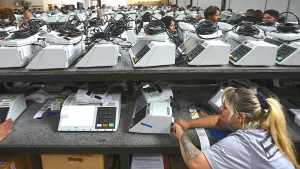
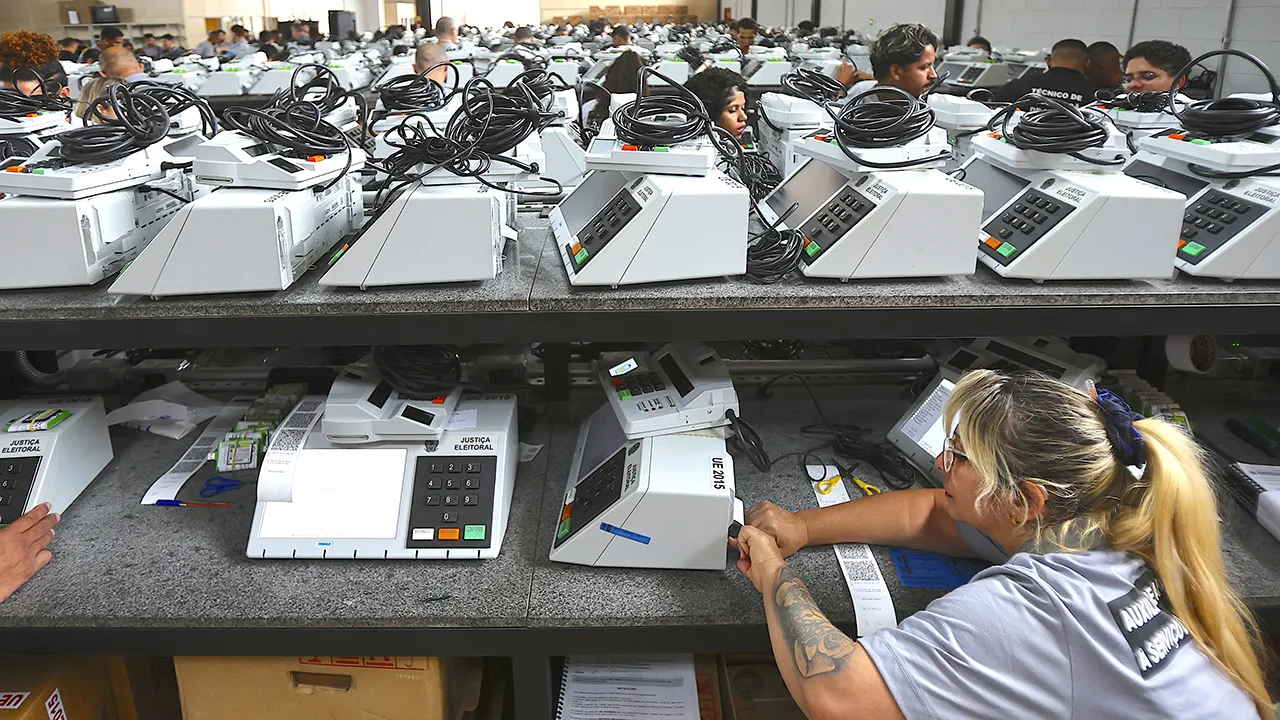
The heart of Brazil’s system is a single national digital voter registry, built by fusing federal, state, and municipal databases into one living record. This lets election officials instantly confirm who a person is, whether they are eligible to vote, and critically, whether they have already voted elsewhere. Nearly nine in ten voters unlock their machines with a fingerprint, making impersonation or double voting almost impossible on a practical level. The Superior Electoral Court, or TSE, which designs the machines and runs national elections, proudly points out that there has been no proven fraud since the system debuted in 1996. The machines used in the latest vote—nearly half a million of them—never touched the Internet. For the eleven months before election day, their software was open to inspection by political parties, universities, and independent watchdogs. Then, in a highly public ceremony, the software was digitally signed and sealed, with the cryptographic keys controlled by the government. In December, the authorities took an extra step: they invited 149 outside specialists to try to break the system. According to the official evaluation, no one found a way to alter results or reveal how anyone voted. Voters do not get a paper receipt, but the machine stores each vote locally in a hashed format, and at the end of the day every machine prints a tally. That tally is posted in front of the polling place with a QR code, allowing any citizen to compare it to the national count. A digital signature ties each printed result to the specific machine that produced it, making an invisible chain of custody from the ballot box to the central tabulation room.
Political scientist Karina Stange Calandrin, a professor at IBMEC, describes the Brazilian system as a rare combination of three traits that usually do not exist together: fully electronic voting, votes stored locally in a way that cannot be anonymously separated from eligibility, and automated tallying that does not involve human mediation. She argues that corrupting the system would require breaking the seal of every single machine and installing software that would somehow match the official version perfectly. If even one machine had different code, its tally would be automatically disqualified. That would take a scale of collusion so enormous that it simply could not pass unnoticed. The system faced its biggest political test in 2022, when former President Jair Bolsonaro spent years attacking its credibility without offering any evidence of fraud. Today, according to the article, Bolsonaro is serving a 27-year sentence for plotting to overturn his 2022 defeat, though under house arrest rather than behind bars. In a strange turn, this year a Bolsonaro appointee, Justice Kassio Nunes Marques, ran the TSE, and the former president’s eldest son, Senator Flávio Bolsonaro, came in first with 47 percent of the vote against Lula’s 45 percent. That means the very machines once denounced as instruments of electoral theft may now hand victory to the Bolsonaro family. It is an ironic twist that humanizes the story: elections are ultimately not about machines but about who controls them, and the same technology can be embraced or vilified depending on whose side wins.
International observers have frequently called Brazil’s system the most modern and secure in the world. Florencia Ferrer, CEO of e-stategiapublica, which has audited elections in seventeen countries, is unequivocal in her praise. She points out that while India also uses electronic voting, each voter there gets a printed copy of their vote to take home, which she says weakens voter safety and increases the risk of coercion. Estonia allows internet voting, but that brings its own cybersecurity dangers. The Philippines uses electronically tallied paper ballots, which still require physical handling and counting. Brazil, by contrast, manages to combine speed, accuracy, and auditability in a way that other nations have not replicated at scale. An engineer from the University of São Paulo’s Polytechnic School, who audited the machines in 2014 and asked to remain anonymous because of the sensitive nature of his work, echoed that view. He told Fox News Digital that while no system is completely infallible, his team found no traces of tampering, wrongdoing, or malicious intent. Still, even that clean record is not enough for some. The Carter Center, which monitors elections around the world, has suggested that voters should at least see a printed version of their ballot drop into a separate compartment inside the machine. Without that, the center argues, the integrity of the results rests entirely on software and the people who wrote it, which is too much faith for some democracies to accept. Germany’s highest court went further in 2009, ruling that voters must be able to check their ballot without any special technical help, which effectively banned a Brazilian-style system in Germany.
There is no shortage of controversy, and that is healthy. Brazil’s machines have been loaned to a number of countries in Latin America, Africa, and Asia as a model of digital efficiency, and Paraguay adopted the system permanently in 2006, though with a crucial modification: its machines now print each individual vote. That extra step gives voters visual confirmation that their choice was recorded exactly as intended, something Brazilian voters never receive. In Brazil, those who defend the system say that the lack of paper is precisely what makes it secure: there are no ballots to lose, alter, or stuff. The machine stores the vote in encrypted form, and the tally is transmitted only after voting has ended, through a network that is never connected to the open Internet. The TSE’s internal systems are monitored around the clock, and the audit process is public and adversarial. Yet the human element remains. Voters trust the machine because election officials open it for inspection, invite hackers to attack it, publish source code, and post tally sheets on the walls of schools and community centers. That transparency builds a kind of confidence that a purely black-box system would never earn. At the same time, the absence of a paper trail makes it difficult to reassure a skeptical voter who does not trust computer code. This is the fundamental trade-off between convenience and verifiability, and Brazil has chosen to lean heavily on digital verification rather than human-readable proof.
The comparison with the United States is stark. American elections are run by thousands of local jurisdictions under fifty different sets of state rules, and in 2024 roughly thirty percent of ballots came by mail, which adds delays and complexity to the counting process. Brazil has one national election authority, mandatory voting, and no mail-in ballots at all. Everything happens on the same day, through the same machines, under the same national oversight. On the upcoming runoff on Oct. 25, Brazilians are expected to know the certified winner in under five hours. For Americans, who often wait days for results and argue over every provisional ballot, that speed sounds almost utopian. Ferrer says the United States is behind both technically and in terms of security for election-day polling. But she also cautions against oversimplifying the lesson. The real question, she says, is not whether Brazil has invented a perfect voting machine—no voting system is perfect—but whether democracies can combine the speed and consistency of digital tabulation with independent verification, public scrutiny, and rules that citizens across the political spectrum have reason to trust. Brazil does not offer a model to copy wholesale. It offers a challenge: can a democracy make voting fast, accessible, auditable, and trustworthy all at once? The answer, in Brazil, is mostly yes. But the debate is alive in every voter’s mind, and that is exactly how it should be.