


Paragraph 1
The war in Ukraine has settled into a grim rhythm, but lately that rhythm has changed. For weeks, the people of Kyiv have found themselves jolted awake not just by the distant thud of explosions, but by the unsettling hum of drones overhead — and now those sounds are no longer confined to the dark. Daytime air raid alerts have become a near-constant feature of life in the Ukrainian capital, sending commuters scrambling from metro stations, office workers into basement corridors, and parents clutching children’s hands as they hurry toward shelter. What was once a nighttime ordeal, familiar in its terror, has expanded into the full light of day, making it harder than ever for residents to pretend that life is normal. The start of the school year, usually a time of fresh beginnings and hope, has instead become another reason for anxiety. Ukrainian President Volodymyr Zelenskyy has described the recent escalation in stark terms, saying Russia launched nearly 1,500 drones over just four days, with more than half of them jet-powered. The message from Moscow seems deliberate: wear down the population, disrupt daily routines, and make the simple act of going to work or buying groceries a test of endurance. For a city already exhausted by months of war, the new pattern is not just a military tactic — it is psychological warfare, aimed at breaking the spirit of a people who have shown remarkable resilience. The metro system, once a reliable artery of daily life, has become a de facto bomb shelter, its stations echoing with the sound of people waiting out yet another alert. The question on everyone’s mind is no longer whether the war will end soon, but how much more they can endure before something cracks.
Paragraph 2
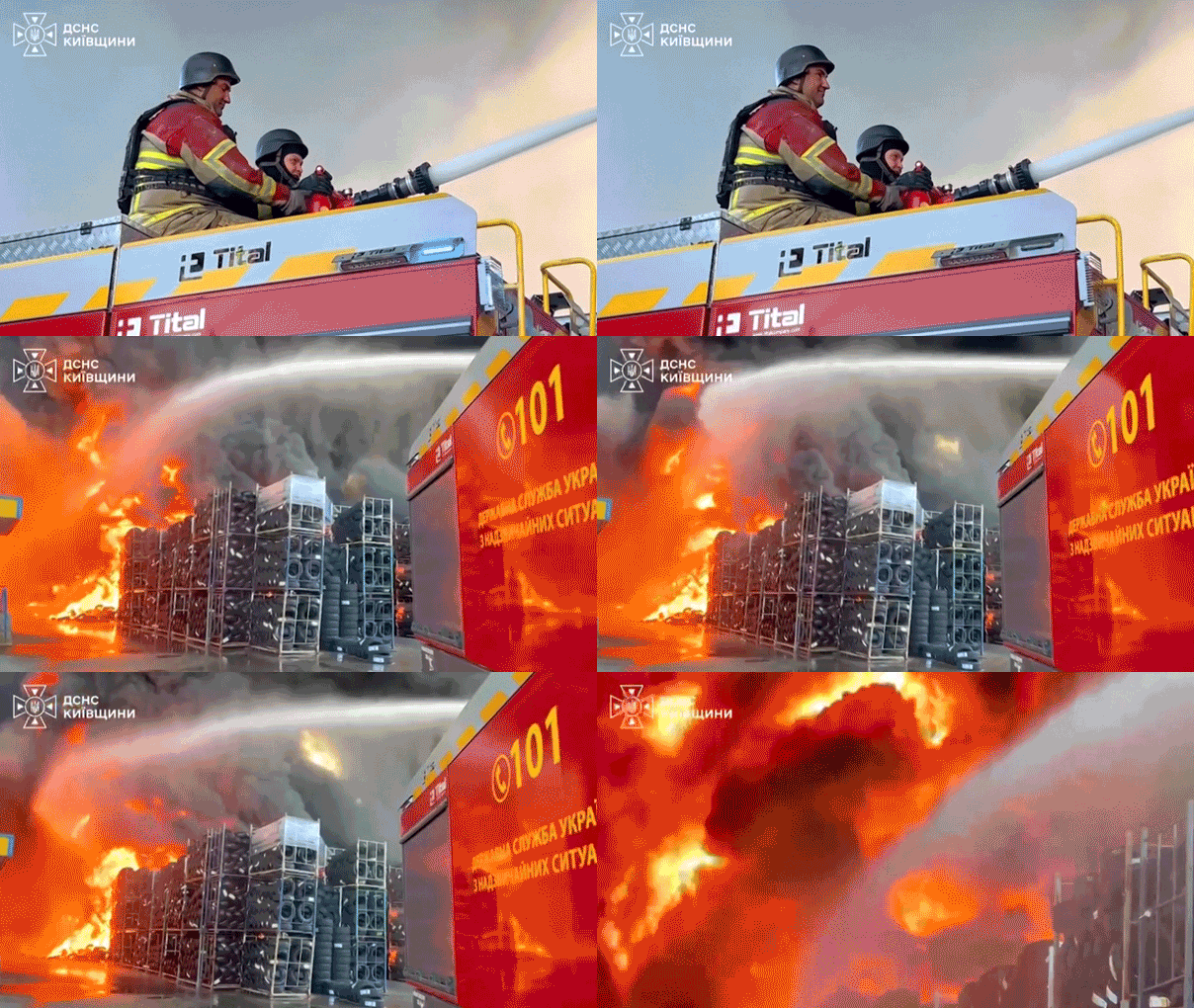
The scale of the recent attacks is staggering. According to Zelenskyy, the nearly 1,500 drones launched over four days represent an intensity not seen before in the conflict. These are not all simple, slow-moving devices; more than half are jet-powered, making them faster and harder to intercept. The attacks have struck not only residential areas but also the commercial and logistical infrastructure that keeps the country functioning. Warehouses, retail outlets, and distribution centers have been hit in and around Kyiv, with damage stretching across five consecutive days of drone strikes. The assault on food logistics has been particularly severe. Ukraine’s Agriculture Minister, Taras Vysotskyi, told reporters that roughly 90% of the food logistics infrastructure operated by retail chains had been destroyed. That does not mean Ukrainians will go hungry — retailers are shifting to alternative delivery methods — but it does mean longer lines, empty shelves in some stores, and new limits on purchases. Reports from Ukrainian media described NOVUS locations in Kyiv running short of bread, potatoes, apples, and oatmeal, while the supermarket chain ATB began rationing certain products. For ordinary Ukrainians, this is a visceral reminder that the war is not only about front-line battles; it is also about the ability to feed a family, to find a loaf of bread, to maintain some semblance of ordinary life. Russia appears to be targeting the connective tissue of Ukrainian society, hoping that the strain on daily necessities will eventually erode public morale and support for the war effort. The strategy is brutal in its simplicity: if you cannot break the army, break the people.
Paragraph 3
Yet Ukraine has not simply absorbed these blows. It has responded with an expanding campaign of its own, one that reaches deep into Russian territory and targets the economic foundations of the war effort. Ukrainian drones have struck oil facilities and warehouses linked to major Russian online retailers, including Wildberries and Ozon, disrupting supply chains that ordinary Russians rely on. A logistics hub in Yekaterinburg, deep inside Russia, was also reportedly hit. These strikes are not just symbolic; they are part of a broader strategy to make the war costly for Russia in every sense — militarily, economically, and psychologically. Retired Air Force Lt. Gen. Richard Newton, a former USAF assistant vice chief of staff, told Fox News Digital that he believes the military momentum has increasingly shifted toward Ukraine, particularly because of Kyiv’s expanding use of long-range drones. “My sense is the momentum has swung in Ukraine’s favor over the last year or so,” Newton said. “The Ukrainians have shown tremendous resolve and capability to push back against Russia.” He pointed specifically to Ukrainian strikes against Russian energy production capability and logistics supply chains, calling their use of drone warfare “quite remarkable.” This is a different kind of war than the one Russia expected to win in a matter of days. It is a war of attrition, of innovation, and of nerve. Ukraine may be battered, but it is not passive; it is reaching out and striking at the heart of Russia’s ability to sustain the fight, turning the tables on a country that once seemed invincible.
Paragraph 4
Still, Ukraine faces a critical vulnerability that could determine the course of the coming months. As Russia intensifies its aerial campaign, Ukraine’s air defense systems are being stretched to their limits. The shortage of U.S.-made Patriot interceptor missiles is especially concerning. These systems are among the most advanced and effective tools for shooting down incoming drones and missiles, but they are in short supply, and the demand for them is global. Countries around the world are competing for the same limited stockpiles, and Ukraine is not always first in line. Newton warned that this shortage is the current challenge facing Ukraine, and it is a serious one. Without enough interceptors, Ukraine is forced to make impossible choices about what to protect: military command centers, energy infrastructure, residential neighborhoods, or the warehouses that hold food for millions of people. Every drone that gets through is a reminder of the gap between what Ukraine needs and what it has received from its allies. There have been reports, including headlines in the article, of a major policy shift involving the possibility of allowing Ukraine to manufacture Patriot missiles domestically, but such a process would take time — time that Ukrainians do not have as the drones keep coming. The situation is a delicate balance. Ukraine’s ability to defend its skies is directly tied to the political decisions made in Washington and other allied capitals. Every delay, every debate, every hesitation has consequences measured in lives and in the resilience of a nation under siege.
Paragraph 5
Behind the battlefield maneuvers, there is also a deeper, more personal calculus taking place in Moscow. The Economist recently reported that Russian President Vladimir Putin fears ending the war without achieving even what he considers a minimum objective — control of all of Donbas. The report cited an unnamed insider who claimed Putin once said, “They will hang me,” reflecting his belief that losing the war, or even settling for an incomplete victory, could threaten his position and possibly his physical safety. This is not just about territory or national pride; it is about survival. Putin has staked his reputation and his hold on power on the success of the invasion, and the prospect of failure is not merely humiliating — it is dangerous for him personally. The same report noted that dissatisfaction with the war is growing among ordinary Russians, and that the mood among parts of the Russian elite is even more pessimistic. One source argued that nearly five years consumed by the war represents a failure regardless of its eventual outcome. This is a portrait of a leader trapped by his own ambitions, unwilling to accept defeat but unable to see a clear path to victory. The war has already lasted far longer than anyone in Moscow expected, and the costs continue to mount. For Ukraine, this means there is little hope of an easy resolution. Putin cannot afford to back down, and he seems willing to sacrifice whatever is necessary — including the lives of his own soldiers and the well-being of his own people — to avoid the personal consequences of failure. This makes the conflict not just a military struggle but a deeply personal one, shaped by the fears and calculations of a single man.
Paragraph 6
In this dangerous environment, the unity of the Western alliance has never been more important. Newton argued that it is more important now for NATO to remain firm than at any time since the end of the Cold War. A weakened NATO, he warned, emboldens Putin and Russia not only against Ukraine but against the entire alliance. The message is clear: the fight in Ukraine is not just a regional conflict; it is a test of the international order. If Russia is allowed to redraw borders by force and destroy its neighbor with impunity, the consequences will be felt far beyond the Black Sea. For Ukrainians, the support of NATO and the United States is not an abstract diplomatic gesture — it is the difference between having air defense interceptors and watching helplessly as drones descend on residential buildings. It is the difference between being able to deliver bread to a supermarket and standing in line for hours only to find empty shelves. The human cost of the war is measured in shattered homes, interrupted school years, and the constant thrum of anxiety that has become part of daily life. Yet the people of Kyiv continue to go to work, to ride the metro, to send their children to school, even as the sirens wail. They are exhausted, but they are not broken. And in that stubborn resilience lies the real answer to Putin’s strategy of attrition. The drones will keep coming, the air raid alerts will keep sounding, and the war will continue to evolve. But as long as Ukrainians refuse to surrender to fear, and as long as the West remains steadfast in its support, the hope is that the momentum Newton described will carry the day. The road ahead is uncertain, and the sacrifices are immense, but the alternative — a world where aggression is rewarded and freedom is abandoned — is unthinkable. The battle for Ukraine is, in the end, a battle for the kind of world we want to live in.