


Paragraph 1
There is a kind of electric tension that settles over a city when it knows something is about to break. Paris, in these late autumn days, feels exactly like that. Despite official prohibitions on gatherings in the capital, protesters have again taken to the streets, filling squares and boulevards with chants, banners, and a simmering sense of grievance that refuses to be contained by paperwork or police lines. The Paris Police Prefecture has denied a stream of formal requests for permits allowing demonstrations in various parts of the city, and in doing so has offered a stark explanation: the October riots, which saw thousands arrested and violent clashes between protesters and law enforcement, revealed something darker in the crowd. In their official order, translated from French, the police wrote that these events demonstrated the intention of certain individuals to target the institutions of the Republic itself, specifically through actions directed against public buildings and state services, all in an effort to undermine the foundations of French democracy. It is a heavy accusation, one that frames the protests not merely as public anger but as a coordinated challenge to the state’s very legitimacy. And yet, for many ordinary people who have come out to march, the official language feels distant and cold. They are not thinking about overthrowing institutions. They are thinking about how to pay for groceries, how to keep their homes warm, how to watch their children grow into a future that seems narrower than the one their parents had. The ban on protest, to them, is not a protective measure; it is one more sign that the system does not hear them. So they come anyway, drawn by a combination of desperation, solidarity, and the stubborn belief that being visible is the only remaining form of power. The streets become a kind of mirror, reflecting both the anger of a nation and the fear of those who govern it. Each demonstration is a negotiation, not only between protesters and police, but between two different visions of what freedom and order should mean. And as the sun sets over the Place de la Concorde, the air is thick with uncertainty, with the knowledge that nothing has been resolved, and that tomorrow, the conversation will continue—in living rooms, in workplaces, and on the cobblestones where everything is laid bare.
Paragraph 2
The heart of this particular standoff has settled around some of Paris’s most symbolically charged locations. The Place de la Concorde, with its sweeping views of the Champs-Élysées and its long history of revolutionary fervor, was supposed to host a gathering of the Yellow Vests, the grassroots movement that first exploded onto the national scene in 2018 over fuel taxes and economic inequality. But the authorities refused, citing security concerns and the risk of violent spillover into adjacent government buildings. It was a decision that did not sit well with the movement’s core activists. Despite the ban, prominent Yellow Vest figures decided to show up anyway, determined to reclaim their voice. Among them were Benjamin Ball, a member of the Yellow Vests coordination group, and spokesperson Azelma Sigaux. According to Agence France-Presse, both were arrested early on Saturday afternoon in front of the National Assembly, just steps from the Place de la Concorde. Their arrests, captured in photographs that rippled across social media, became a rallying cry for supporters who accused the government of silencing dissent under the guise of public safety. There is something almost poetic about the setting: the National Assembly, the very chamber where laws are debated and passed, became the backdrop for the unmistakable image of citizens being led away for exercising what they consider a fundamental democratic right. For the protesters, the arrests only deepened their conviction that the Republic they are accused of undermining is, in fact, the one that has already abandoned them. They see the police order not as a neutral act of bureaucratic caution but as an attempt to erase their presence from the public square, to make their suffering invisible. And so the confrontation becomes ritualistic: the authorities declare a zone off-limits, the demonstrators declare it sacred, and the two sides collide in a dance of tension and release that has repeated itself throughout French history. Each side claims the mantle of legitimacy. Each side points to the other as the source of violence. And in the middle are ordinary citizens, some sympathetic, some angry, many just trying to find a way home through the chaos. The arrests, the jeers, the scuffles, the moments of quiet defiance—all of it paints a portrait of a society that cannot quite agree on the rules of its own democracy.
Paragraph 3
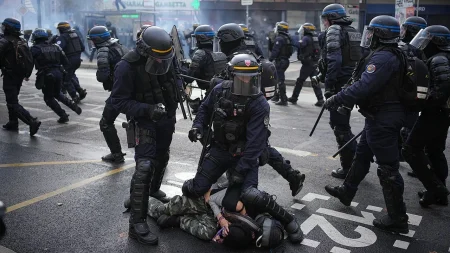
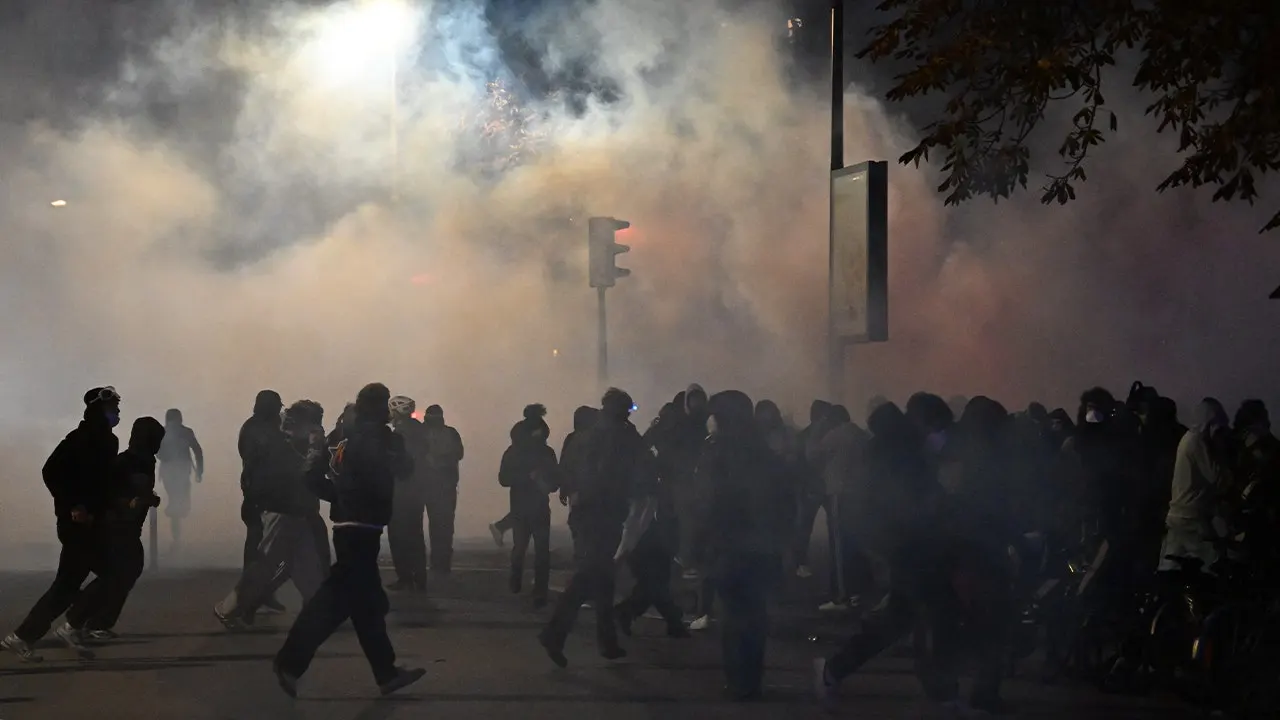
The unrest on Saturday was never confined to Paris. France’s Interior Ministry anticipated that 170,000 people would take to the streets nationwide, marking the fourth consecutive week of protest and demonstrating that this movement has deep roots beyond the capital. In response, the government deployed an extraordinary 70,000 security forces to try to contain the demonstrations, a number that speaks to the genuine fear of what these gatherings might become. Interior Minister Laurent Nunez, visibly cautious, warned that “the risk is exactly the same as on previous Saturdays,” and instructed authorities “not to lower their guard.” His words, reported by Agence France-Presse, reflected a government bracing itself for the worst while hoping for the best. And indeed, the images that emerged from the day were a painful mixture of peaceful expression and violent confrontation. In Paris and elsewhere, videos and photographs showed masked figures hurling projectiles at police, while clouds of tear gas drifted across streets that had been turned into makeshift battlefields. Fires burned in various spots, sending smoke spiraling into the gray sky. Police response teams, often in full riot gear, moved in to detain those they considered the most dangerous elements, while more moderate demonstrators waved flags and shouted slogans in a desperate attempt to be heard above the din. For every scene of chaos, there was another of quiet stubbornness: families with children, students with notebooks, elderly pensioners with gloves and scarves, all refusing to leave despite the stinging gas and the roar of helicopters. The sheer scale of the security operation is worth pausing over. Seventy thousand officers is not just a police presence; it is a military-style mobilization, a sign that the state sees these protests not as a nuisance but as a potential crisis. Yet the response, at least in the eyes of the protesters, is also a confession of weakness. If the government truly had the confidence of its people, they argue, it would not need to surround every square with armed officers and barbed-wire barriers. The sight of so many uniforms in their neighborhoods does not reassure them; it alienates them. It turns every protest into a standoff between citizen and state, reinforcing the very divide that the movement is trying to call attention to. And so the spiral continues: each weekend, more violence; each weekend, more security; each weekend, more anger. The streets of France have become a stage for a national argument about inequality, representation, and the limits of order, and no one seems to know how to bring the curtain down.
Paragraph 4
At its core, the movement that has consumed France in recent weeks is not abstractly political. It is rooted in the everyday struggles of ordinary people: the cost of living, the difficulty of making ends meet, the gap between the promises of economic progress and the reality of stagnant wages and rising prices. Demonstrators are not only railing against specific policies but against the feeling that their lives have become less secure, less full of possibility, than those of their parents. This sentiment has broadened the movement well beyond the original Yellow Vest activists. Student organizations and teacher unions have joined the mass rallies, their presence adding a youthful urgency and an educational perspective to the otherwise broader working-class and middle-class unrest. Young people march because they look at their futures and see precarious internships, expensive housing, and a climate crisis that seems to receive little more than lip service. Teachers march because they see underfunded classrooms, overcrowded schools, and a generation of students who are already losing faith in the institutions that are supposed to help them succeed. The convergence is powerful: generations brought together by a shared perception that the system is rigged against them. And for a brief moment, the differences that usually divide these groups—age, income, profession—melt away in a common rhythm of protest. There were signs on Saturday that the government is beginning to feel the pressure. On Monday, French Prime Minister Sebastien Lecornu was scheduled to meet with leaders from the various unions to discuss wages and purchasing power, a gesture that could be interpreted as a step toward dialogue. But the unions themselves were quick to dampen any hopes of an easy resolution. Calling for fresh strikes on Tuesday, union leaders insisted that they are “in a position of strength” and that the government is “in a position of weakness and starting to yield.” This is the language of confrontation, not compromise. It suggests that the unions, having tasted the power of mass mobilization, are not willing to settle for a few concessions. They want structural change, and they believe the streets are the only way to get it. For the government, this presents a profound dilemma. To negotiate too much is to invite accusations of capitulation and to weaken its authority. To refuse to negotiate is to risk further escalation and the possibility of even more violent demonstrations. The tête-à-tête at the prime minister’s office, if it happens, will be a delicate dance between listening and posturing, between acknowledging real grievances and preserving the appearance of control. But in the meantime, the strikes are already being planned, and the momentum of protest shows no sign of slowing down.
Paragraph 5
The political fallout of this unrest has been swift and significant, reshaping a landscape that only months ago seemed stable. Perhaps the most striking development is the surge in national polling for Marine Le Pen, the leader of the far-right National Rally and the deputy leader of the National Assembly. Since the student and union protests began in mid-September, Le Pen has risen steadily in public opinion surveys. After announcing her candidacy in October, she is now widely seen as likely to force a runoff in the next presidential election, a prospect that sends shivers through the French political establishment. Her rise is not accidental. Le Pen has positioned herself as the voice of the forgotten France, the champion of those who feel left behind by globalization, immigration, and the metropolitan elites who seem to run the country from Paris. During the protests, she has been careful to express sympathy for the marchers while carefully distancing herself from any violence, using the unrest as evidence that President Emmanuel Macron’s policies have failed and that only she can restore order and dignity. Her critics, of course, see this as opportunistic exploitation of a national crisis. They point to her history of xenophobic rhetoric and argue that her solutions would deepen divisions rather than heal them. But for many protesters, the normal political categories no longer matter. They are angry at the established parties, both left and right, and Le Pen’s outsider status, even if she has been in politics for decades, gives her a certain credibility among those who feel that the entire system is corrupt. President Macron, for his part, has blamed the protests on “ultra-left groups whose aim is to bring down the Republic,” a charge that echoes the police prefecture’s language and suggests a government that sees conspiracy rather than genuine grievance. This framing has done little to calm the situation. If anything, it has intensified it, by suggesting that the authorities do not take seriously the economic pain that is driving many people to the streets. The battle is thus not only about wages and prices but about the very narrative of what is happening in France. Is this a rebellion of the desperate, or a coup attempt by radicals? The answer likely depends on where one sits. But the political consequences are real and measurable. Le Pen is rising, Macron is defensive, and the center is crumbling. The protests have opened a space for radical alternatives, and in that space, the future of French democracy is being contested.
Paragraph 6
As the fourth week of protests comes to a close, France finds itself at a particularly delicate crossroads. The streets are quieter now, but the silence is uneasy, broken by sporadic confrontations and the distant sound of sirens. The government’s security operation has succeeded in preventing some of the worst violence, but it has not succeeded in addressing the underlying anger that fills the squares each weekend. The planned meeting between the prime minister and union leaders offers a glimmer of hope, but the announcement of fresh strikes suggests that the two sides are still far apart. There is a sense that everyone is waiting for something—a breakthrough, a catastrophe, a gesture that changes the dynamics. For the protesters, the fight is about dignity as much as economics. They want to be seen, to be heard, to be acknowledged as citizens whose concerns matter. For the police and the government, the fight is about preserving public order and defending the institutions of the Republic against what they perceive as a serious threat. In such moments, dialogue often feels impossible, because each side speaks a different language and holds a different truth. Yet history suggests that countries like France have weathered similar storms before, through a combination of patience, reform, and the gradual recognition that no movement can sustain itself indefinitely without either success or exhaustion. The question is how much damage will be done in the meantime. The fires that burned in Paris will not be forgotten quickly, nor will the arrests, the tear gas, or the families who have been caught in the chaos. There is a certain melancholy in watching a nation that has always prided itself on liberté, égalité, and fraternité struggle to live up to those ideals in the face of profound disagreement. But there is also something hopeful in the fact that so many people are willing to take to the streets, to make their voices heard, to demand more from their leaders. Democracy is messy, and French democracy has always been messier than most. In the end, perhaps the only way through is to find a way to listen—to distinguish between the violence of a few and the legitimate pain of the many, and to respond with policies that address the root causes of discontent rather than simply attempting to suppress its symptoms. Until then, the protest will continue, in one form or another, because the conditions that created it remain. The Republic, like its people, is resilient, but it is also tired. And in that tiredness, there is both danger and the possibility of renewal.