


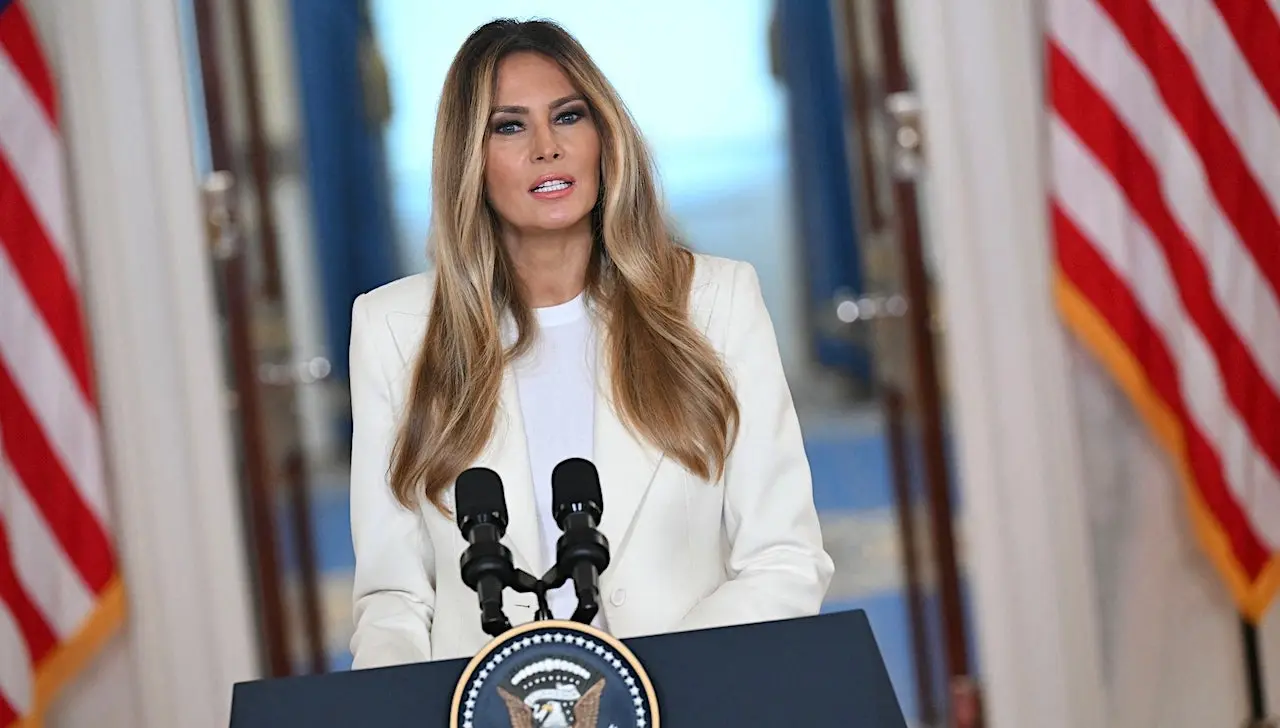
On Thursday, an unusual and quietly historic scene unfolded at the White House. In a room where presidents and foreign leaders usually speak through carefully guarded diplomatic channels, first lady Melania Trump stood side by side with envoys from Russia and Ukraine—two nations locked in a brutal war that has killed tens of thousands and displaced millions. They were not there to announce a grand peace treaty or a final territorial settlement. Instead, they gathered to talk about a single, beleaguered city: Oleshky, a Russian-occupied area in the Kherson region of southern Ukraine. The announcement was, in global terms, modest: a local ceasefire, an opening for humanitarian aid, a safe corridor for frightened civilians who have spent years under occupation and shelling. Yet the symbolism was enormous. For the first time in a long time, representatives of both warring countries stood on the same platform, in the heart of American power, and spoke not about weapons or borders, but about children, families, prisoners, and the possibility of choosing something other than war. Melania Trump called the moment a “spark” in a world of darkness. It was an unusual phrase for a diplomatic event, but perhaps an appropriate one. Big transformations rarely begin with grand declarations; they begin with small, fragile gestures that prove people on opposite sides of a conflict can still share a sliver of common ground. This was such a gesture, and the fact that it happened at the White House made it impossible to dismiss as mere symbolism.
Melania Trump has largely stayed out of the political arena during her time in public life, but on this day she stepped forward as a diplomat in her own right. She explained that she first became aware of the humanitarian catastrophe in the Oleshky region in September and directed her representative, Marc Beckman, to begin quiet discussions with both Russia and Ukraine on her behalf. Remarkably, both countries agreed to work with her as an “exclusive intermediary” to establish a ceasefire in Oleshky and the surrounding areas, deliver humanitarian aid, and create a safe evacuation route for civilians. In her remarks, she chose language that was less about policy and more about moral clarity. “We have chosen humanity over war,” she said. “Undeniably, the lives of innocent people must transcend the division of war. I hope Oleshky inspires greater peace. Every significant transformation begins with a small spark.” She added that “together, we can create something more enduring than a temporary ceasefire,” and described Oleshky as “a spark in a world of darkness capable of illuminating the best in humanity.” The words were striking because they did not sound like a political calculation. They sounded like a plea from someone who had seen the human cost of war and decided to do something about it. Whether one sees her involvement as a savvy diplomatic intervention or as a carefully staged humanitarian moment, the effect was undeniable: a first lady using her platform to push not for victory, but for mercy.
The Russian delegation’s presence and tone only added to the extraordinary nature of the event. Kirill Dmitriev, a Russian special envoy, spoke from the White House—a rare and deeply symbolic moment in itself, given the frost that has characterized U.S.-Russia relations since the full-scale invasion began in 2022. Dmitriev said that Russian President Vladimir Putin appreciated President Donald Trump’s efforts to stop the fighting and supported several initiatives regarding prisoner exchanges and the release of American prisoners on humanitarian grounds. “President Putin also appreciates President Trump’s peacemaking effort and his team working on a peace plan to resolve Ukrainian crisis,” Dmitriev said. He went on to stress that cooperation between Russia, Ukraine, and the United States matters not only for the nations directly involved, but for the entire world. “Let us continue making great humanitarian contributions. We can together, let us build a future of peace, partnership and prosperity for the benefit of our families, our children and future generations.” Then, in a moment that was both personal and politically unusual, he turned his attention to the first lady: “Dear Melania, you saved and touched so many lives.” Those words carried weight, especially in a context where Russian officials rarely offer public gratitude to American figures. Behind the diplomatic language was a simple human truth: even in the midst of geopolitical conflict, there are people locked in prisons, families waiting for news, and children who deserve a chance to grow up without the sound of explosions. The recent release of an American teacher who had been imprisoned in Russia on Ukraine-related charges, after Trump pressed Putin, served as a reminder that prisoner diplomacy can move forward even when broader peace remains elusive.
Then came the Ukrainian voice, and it was perhaps the most emotional of the afternoon. David Arakhamia, the leader of Ukrainian President Volodymyr Zelenskyy’s political party, addressed the first lady with unmistakable gratitude. He said that when the initiative began, only about five percent of people believed it could succeed, while ninety-five percent were skeptics. After the ceasefire took hold, those numbers reversed completely. “Now, after it happened, it’s switched completely: 95% of the people believe that we can do things like that, and 5% are still skeptical,” he said. He described the ceasefire as the “biggest de-escalation since 2022,” the year the full-scale war began. And he offered a line that could easily become a mantra for those who refuse to accept permanent conflict: “Peace is now a matter of when, not if.” Those are bold words, especially from a Ukrainian official whose country has endured occupation, missile strikes, and unimaginable civilian suffering. But Arakhamia’s confidence was not rooted in naive optimism. It was rooted in the experience of watching ordinary people in Oleshky slowly emerge from fear and begin to reclaim their lives. He thanked the first lady sincerely, from the heart, and made clear that her intervention had done more than pause fighting—it had shifted a psychological landscape. For Ukrainians, any break in the violence is precious. It means that grandparents can step outside without fear, that parents can check on their homes, and that children can remember what it feels like to play in daylight. Arakhamia’s words suggested that peace is not just a political arrangement; it is a felt experience, something that ordinary people begin to believe in when they see the fighting stop, even if only for a moment.
The most human part of Arakhamia’s remarks came when he described what happened in Oleshky in the days after the ceasefire took hold. “On the first day, people in the area did not believe it was happening,” he said. “They stayed in their homes, waiting to see if the clock was ticking backward. The next day, they started walking around their homes. The day after that, they came to see their broken homes and find their belongings.” It is easy to become numb to the language of war—casualty numbers, territorial lines, diplomatic communiqués. But this description brought the war back to its human scale. Imagine hiding in a basement for months, afraid to move, afraid to breathe too loudly, uncertain whether the next shell will land on your roof. Then imagine a sudden silence. Imagine peeking out of the door, unsure if it is real. Imagine walking through streets you once knew, past houses that are now piles of rubble, searching for anything that survived. That is what the ceasefire meant in Oleshky. Arakhamia said it was “really emotional to watch and supervise, to understand what we are doing. I think we are creating momentum where both sides are learning the little mechanics of how to keep the peace when the peace comes.” That phrase—“the little mechanics of peace”—is worth pausing over. Peace is not just a signature on a document. It is the slow, awkward, fragile process of people relearning how to live without fear. It is humanitarian aid convoys rolling into towns where children have not seen fresh food in months. It is evacuation routes for the elderly who want to die in the places where they were born. It is prisoners coming home and families being reunited. The presence of Dmytro Lubinets, Ukraine’s human rights ombudsman, at the White House event underscored this point: the ceasefire was not just a military arrangement, but a humanitarian one.
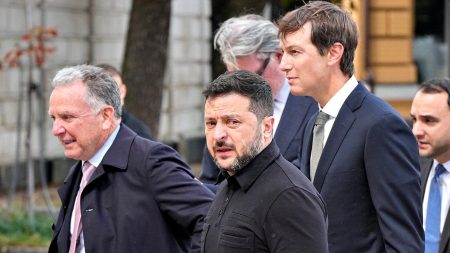
In the end, this event may be remembered as a small footnote in the long and painful history of the Russia-Ukraine war, or it may be remembered as the moment when peace began to feel possible. There are still enormous obstacles ahead. Russia and Ukraine remain deeply divided over territory, sovereignty, and the future of the occupied regions. Many previous ceasefires have collapsed under the weight of distrust and continued attacks. The Oleshky agreement is limited, and no one should pretend it is the same as a comprehensive peace. Yet the broader diplomatic wheels are turning. The United States is set to mediate upcoming Ukraine-Russia talks in Abu Dhabi, and envoys like Steve Witkoff and Jared Kushner have been preparing for high-stakes meetings in Kyiv after consultations with Russian officials. President Trump has pressed Putin on prisoner releases and humanitarian issues, and Russian officials have, for the moment at least, signaled a willingness to engage. All of this suggests that the ceasefire in Oleshky could indeed be what Melania Trump called it: a spark. Wars do not usually end in a single grand moment. They end when enough people on both sides decide that the suffering has become unbearable, and when a few brave individuals take the risk of reaching out across the divide. The first lady’s initiative was risky. It could have failed, and it could have been dismissed as political theater. Instead, it gave people in one occupied city a few days of safety. It gave prisoners hope. It gave diplomats a reason to keep talking. And it gave the world a reminder that even in the darkest moments, humanity can still choose a different path. “Together, we can create something more enduring than a temporary ceasefire,” Melania Trump said. That is the real test. The ceasefire in Oleshky will not end the war by itself, but it may prove that peace is not impossible. Sometimes, that is enough to begin.