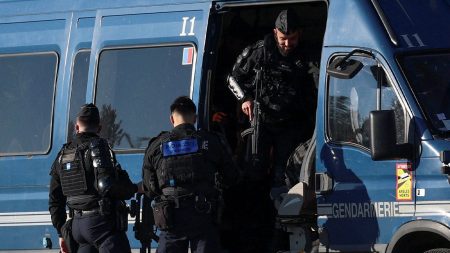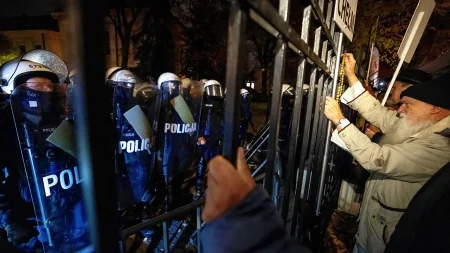



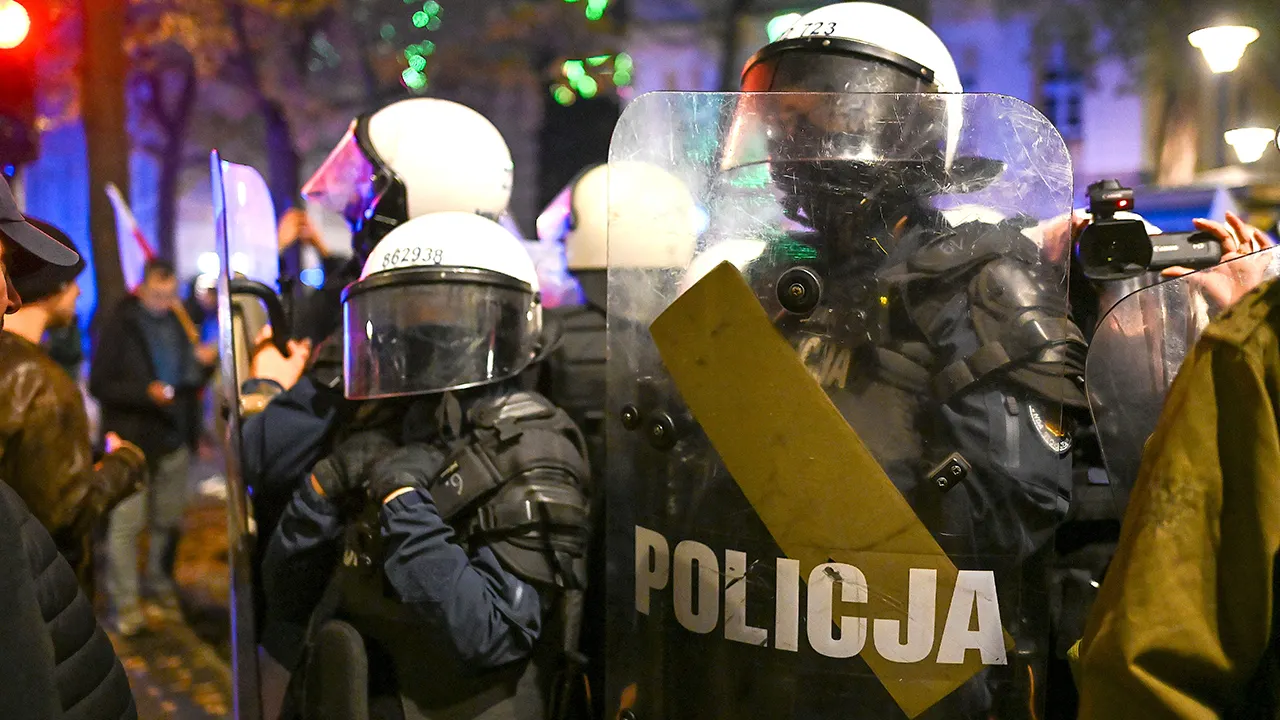
Late Friday night, the heart of Warsaw became the stage for a scene that felt less like a routine political dispute and more like a constitutional earthquake. Outside Poland’s Constitutional Tribunal, riot police formed lines against protesters who had gathered in anger and alarm, while inside, a judicial body that was already deeply fractured took a dramatic step that would send shockwaves across the country and beyond. The tribunal announced the suspension of its own president, Bogdan Święczkowski, and his deputy—a move that supporters of Prime Minister Donald Tusk’s government framed as a long-overdue effort to cleanse the judiciary of politicized influence, but that critics condemned as an illegal seizure of power by a government willing to bend the rules to get its way. As the chaos unfolded, President Karol Nawrocki, who was flying to Senegal, abruptly turned his plane around and headed back to Warsaw, a potent symbol of just how serious the moment had become. By Monday morning, the air was thick with accusations. Marcin Przydacz, head of the International Policy Bureau in Nawrocki’s office, appeared on European television to denounce the government’s actions in stark terms, insisting that even lawyers friendly to Tusk were saying there was no legal basis for what had happened. The crisis, he suggested, was not merely a political disagreement but a fundamental collapse of constitutional order—one that had already begun to poison Poland’s diplomatic corps, with ambassadors resigning in protest.
To understand why this confrontation has hit so hard, it helps to step back from the immediate drama and look at the years of accumulated tension that led to this boiling point. Poland’s Constitutional Tribunal has not been a neutral, functioning institution for a long time. For more than a decade, it has been caught in the crossfire of a bitter battle over judicial independence, with the previous Law and Justice government and the current Tusk-led coalition each accusing the other of trying to pack the courts with loyalists. Simone Rodan-Benzaquen, a senior envoy to Europe at the Foundation for Defense of Democracies, put it plainly: “This crisis didn’t begin on Friday. Poland has been living with a deeply compromised Constitutional Tribunal for more than a decade.” Parliament has continued to appoint judges under the constitution, but many of those appointments have been blocked from actually taking office, leaving the tribunal in a kind of institutional limbo. Tusk’s defenders argue that he inherited a broken system and is simply trying to make it work again, while his critics see a prime minister who is using the mess as cover for a power grab. The standoff has created a bizarre situation where the very institution meant to resolve disputes has become the thing being disputed. Rodan-Benzaquen warns that this is not a simple case of Tusk trying to pack a functioning, independent court ahead of an election. There is a genuine institutional crisis that predates his government, and a legitimate question of how to resolve it—but that does not mean every method used to resolve it is automatically acceptable. Her caution reflects a broader unease: even people who sympathize with Tusk’s goals are worried about the means.
The human side of this story is impossible to ignore. This is not just about legal paragraphs and constitutional clauses; it is about real anger, fear, and a deep sense that the country’s democratic fabric is unraveling. Friday’s protests were not abstract demonstrations. People came out into the night because they believed something foundational was at stake, and their emotions spilled over into scuffles with police, leading to three detentions before the night was over. For critics like Nile Gardner, director of the Margaret Thatcher Center for Freedom at the Heritage Foundation, the scene was chillingly reminiscent of darker chapters in history. He told Fox News Digital that the events had all the hallmarks of a Soviet-style coup operation, accusing Tusk of deliberately waiting until President Nawrocki was out of the country before striking. “My former boss, Margaret Thatcher, would have been absolutely appalled by what we’re witnessing in Poland. This is clearly a crisis for Poland and an attempted coup by Donald Tusk.” Gardner went even further, saying the tactics were straight out of the Putin playbook and that Poland was in an incredibly dangerous situation, with blame placed squarely at Tusk’s door. These are strong words, and they reflect how deeply polarized the country has become. But there is another side to the story. Others reject the coup characterization entirely. Boštjan Udovič, chair of international relations at the University of Ljubljana, sees Tusk’s actions as an attempt to restore the situation to what the constitution and international institutions demand, following years of what many saw as the PiS government’s erosion of judicial independence. He suggests that Tusk may have hoped the transition would be easier, and instead he has found himself in the middle of a storm.
Amid the accusations, Tusk himself has tried to strike a tone of legalistic firmness, defending his government’s actions as a necessary restoration of the rule of law. He insists that the problem is simple: the president must recognize judges who were legally elected by parliament, because that is what the constitution stipulates. In his view, the tribunal and the presidency have been improperly blocking those judges from taking their seats, and now they are paying the price for their obstruction. Tusk accused Nawrocki of choosing forceful confrontation, which could cost Poland very dearly, and warned that a democratic state under the rule of law cannot yield to violence. This framing casts the government as the defender of democracy, not the aggressor, and it resonates with those who believe the tribunal became a partisan weapon under the previous administration. But the response from abroad has been anything but unified. The European Commission has largely backed the Polish parliament’s authority to appoint judges, with European Commissioner Michael McGrath saying that selecting new judges lies within the powers of Poland’s parliament. Yet other voices, like French opposition leader Marine Le Pen, have accused Brussels of applying a double standard—remaining silent, she argues, when the constitutional balance of a member state is gravely threatened, even while claiming to defend democracy and the rule of law. This split reflects the uncomfortable reality that the crisis in Warsaw is not just a domestic matter; it has become a test case for how Europe responds when one of its own members seems to be slipping into institutional chaos.
Meanwhile, the diplomatic fallout has been quiet but devastating. At least three Polish ambassadors have resigned in protest, a remarkable sign of how deeply the events have shaken the professional foreign service. Krzysztof Szczerski, Poland’s permanent representative to the United Nations since 2021, resigned on Monday, following the weekend resignations of the ambassadors to China and Romania. These are not elected politicians or partisan operatives; they are career diplomats who have spent years representing Poland abroad, and their decision to step down suggests that the crisis has eroded trust at the most basic levels of governance. It is one thing for opposition politicians to raise alarms, but when ambassadors—people who are usually careful to stay out of domestic political battles—choose to walk away, it sends a powerful message about how serious this moment is. The United States has also weighed in, with Ambassador Tom Rose posting on X that America is on Poland’s side and urging restraint. “Our concern is for the stability, security, and democratic future of a country we are proud to call our friend and ally… Poland has come too far and accomplished too much to let political differences, no matter how strongly felt, put any of that at risk.” That plea for restraint, coming from an ally, underscores how worried even friendly nations are about where this path could lead. It also highlights a tragic irony: a country that has so often been praised for its democratic resilience and its role as a bulwark of freedom in Eastern Europe is now struggling to maintain the very values it has championed.
As the dust begins to settle on that shocking Friday night, the larger question remains unresolved and perhaps unresolvable in the short term. Rodan-Benzaquen captured the essence of the dilemma: one side claims to be defending constitutional order against the abuses of the other, while the institutions that should arbitrate the dispute have themselves become the object of the dispute. That is the cruelest twist of all—when the referee is no longer trusted by either team, the game cannot go on, and everyone starts making up their own rules. With parliamentary elections in Poland only a year away, the battle over who gets to define the rule of law may prove more consequential than the confrontation that unfolded this weekend. The events of Friday night were not a climax; they were a flashpoint, a visible eruption of tensions that have been building for years and will not be easily smoothed over. For the people who poured into the streets, for the ambassadors who resigned in quiet protest, for the judges and politicians who traded accusations of illegality and authoritarianism, this is not an abstract debate about legal theory. It is a deeply personal struggle over what kind of country Poland wants to be—a struggle that will likely determine not just the next election, but the country’s trajectory for years to come. The world is watching, and the only thing certain is that the road ahead will be rocky, because when the very meaning of law and order becomes a partisan battlefield, the damage can take a generation to repair.