


1. The President’s Return: A Nation on Edge
The presidential jet had barely crossed Polish airspace when the call came from Warsaw. Karol Nawrocki, Poland’s head of state, was en route to Senegal for an official visit, his schedule filled with meetings meant to bolster trade and diplomacy. But as the cabin lights dimmed and the aircraft cruised over the Atlantic, his phone buzzed with news that would change everything. Police had entered the Constitutional Tribunal, the country’s highest judicial authority, and its president had been suspended. Protesters had gathered, objects were thrown, and the political order was trembling. Nawrocki didn’t hesitate. He ordered the pilot to turn around, canceling the trip thousands of miles away. “At such a moment, the President must be in Poland,” he wrote on X, a statement that echoed with a gravity rarely felt in modern European politics. For a man who had spent months navigating a fractured political landscape, this was not just a diplomatic inconvenience—it was a moment of national reckoning. As the plane descended back into Warsaw’s gray winter skies, Nawrocki knew he was returning to a country that stood at the precipice of a constitutional crisis, one that had been brewing for years and was now boiling over in the streets and the halls of power.
2. A Long-Simmering Conflict: The Battle Over Poland’s Courts
To understand the events that forced a president’s plane to turn around, one must look back at the tangled history of Poland’s judicial system. Since 2015, the country’s courts have been a battlefield between the national-conservative Law and Justice party (PiS) and the pro-European coalition that now governs under Prime Minister Donald Tusk. PiS, which ruled for eight years, implemented a series of reforms that critics argued placed judicial appointments and disciplinary procedures under political control. The European Union responded with legal action, imposing fines on Poland and sparking a bitter tug-of-war over the rule of law. When Tusk returned to power in 2023, he promised to undo these changes and restore the judiciary’s independence. But his efforts have been repeatedly blocked by two PiS-aligned presidents, including Nawrocki himself, who vetoed reforms and refused to appoint judges backed by the current parliament. The Constitutional Tribunal, in particular, became a symbol of this deadlock. Its president, Bogdan Święczkowski, a PiS appointee and former deputy justice minister, refused to seat three judges nominated by the new government, arguing that their elections were procedurally flawed. For Tusk’s coalition, this was an unacceptable obstruction. For PiS, it was a defense of legal continuity against a partisan takeover. The standoff had been simmering for months, but on this Friday, it erupted.
3. The Storming of the Tribunal: A Night of Chaos and Prayer
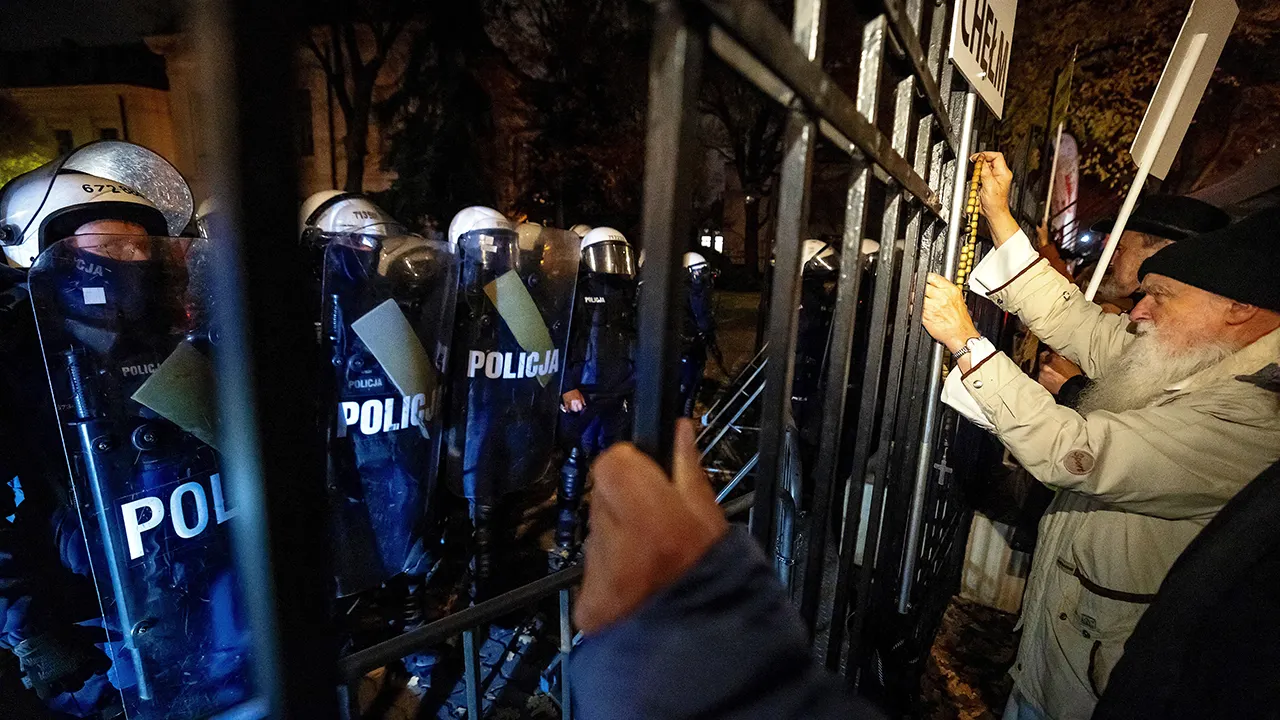
The scene outside the Constitutional Tribunal in Warsaw on that fateful evening was almost surreal. Hundreds of demonstrators had gathered, some kneeling in prayer, others hoisting posters with sharp slogans: “Tusk—a symbol of anti-Polish sentiment” and “Down with the commies and Tusk’s regime.” Police in riot gear formed a cordon around the building as a crowd chanted and threw dangerous objects—likely bottles and stones—at the officers. Inside, the tension was even more acute. The suspended president, Święczkowski, had been notified that he was being relieved of his duties, effective immediately. In his place, a judge whose oath had never been accepted by President Nawrocki declared herself the new head of the Tribunal. She ordered the police to secure the premises, effectively seizing control of the institution. For the government, this was a decisive move to unblock a paralyzed court. For the opposition, it was nothing short of a coup. The images that emerged from that night were stark: police officers standing guard at the doors of a constitutional body, protesters waving flags and rosaries, and the chilling realization that Poland’s democratic institutions were no longer functioning as they once had. The government claimed it was restoring the rule of law; the opposition swore it was witnessing its destruction. Both sides were convinced they were protecting Poland, and that conviction made the night all the more explosive.
4. Leaders Speak: A Chorus of Rage and Defiance
The political reactions came fast and furious, each one more incendiary than the last. Prime Minister Donald Tusk, who had staked his premiership on judicial independence, posted a message that blended resolve with defensiveness. “Restoring the rule of law is our duty,” he wrote. “After years of PiS-led lawlessness, this is a difficult process, sometimes painful, and it requires decisive action. There is no other way.” He framed the suspension as an essential step in dismantling the previous regime’s grip on justice. But his opponents saw only authoritarian overreach. Former Prime Minister Mateusz Morawiecki, now positioning himself as an alternative leader ahead of November’s parliamentary elections, called it “the forceful takeover of the Constitutional Tribunal.” He warned that “justice cannot be achieved through violence,” and accused Tusk of using “Belarusian methods” to silence dissent. Zbigniew Ziobro, a former justice minister, went even further, declaring that “a coup d’état is underway.” He compared the move to forcibly seizing the Prime Minister’s Office, writing, “If someone were to forcibly break into the Prime Minister’s Office and take it over, we would all know what to call it… This is a blatant, criminal attack on the constitutional order.” Ziobro called for loud, firm, and fearless resistance, his words echoing the combative spirit of PiS’s base. In his own statement, Morawiecki pointed out the paradox: “A judge whose oath was never accepted by the President Nawrocki has declared herself head of the Constitutional Tribunal and suspended its leadership, while police secured the building. This is not how the rule of law is restored.” He concluded that replacing one disputed set of rules with a more radical one only invites future governments to do the same.
5. America Watches: A Friendship Tested
Amid the chaos, an external voice carried particular weight: that of the United States. Ambassador Tom Rose, representing Washington in Warsaw, issued a carefully worded statement that sought to balance solidarity with restraint. “The events unfolding tonight at Poland’s Constitutional Tribunal are very serious indeed,” he wrote. “We appear to be witnessing an unprecedented confrontation over the government’s use of state power and the independence and authority of a constitutional institution. Both sides offer sharply different accounts of what happened and why.” Rose acknowledged the danger of thousands gathering outside the Tribunal, warning that “the last thing Poland needs is a confrontation that spirals into something far worse.” His words were a deliberate attempt to cool the temperature, yet they also underscored how high the stakes had become. He affirmed that America stands on Poland’s side, but insisted, “It is not our place to judge or interfere in its internal affairs. Our concern is for the stability, security, and democratic future of a country we are proud to call our friend and ally.” For many Poles, this was a familiar refrain—a superpower watching from a distance, hopeful but not intervening. But for others, it was a reminder that Poland’s internal struggles were now a matter of international concern. The U.S. statement served as both a warning and a comfort, a signal that while Poland alone must resolve its crisis, it does so under the watchful eyes of its allies.
6. The Human Cost: Fear, Hope, and the Road Ahead
Beneath the political rhetoric and legal arguments, there is a human story that often gets lost. Ordinary Poles woke up the next morning to headlines that seemed to scream of a country on the brink. In cafes and kitchens, people argued with friends and family over who was right—was it necessary to break a few rules to save the judiciary, or was this the beginning of something far more dangerous? Some feared that Poland was sliding into a hybrid regime, where courts become tools of whoever holds power. Others expressed relief that the deadlock might finally be broken, allowing a fairer system to emerge. The protesters who knelt in prayer outside the Tribunal were not just political pawns; they were citizens terrified of what their country was becoming. And the judges who made the fateful decision to suspend Święczkowski were not just bureaucrats—they were people facing immense pressure, torn between legal conscience and political reality. As Poland looks toward parliamentary elections in November, this crisis will shape every vote and every conversation. The memory of police at the doors of the Constitutional Tribunal will not fade quickly. For some, it will be a rallying cry for reform; for others, a symbol of oppression. In either case, the country has been changed. The president’s flight was interrupted, but the journey toward some resolution—or further fracture—has only begun. Poland’s friends abroad, like Ambassador Rose, can only hope that the country finds its way through this storm without losing the democratic essence that has defined its post-communist era. For the Polish people, the challenge is not just to choose sides, but to remember that the institutions they fight over are ultimately meant to serve them—and that no political victory is worth the destruction of the rule of law itself.