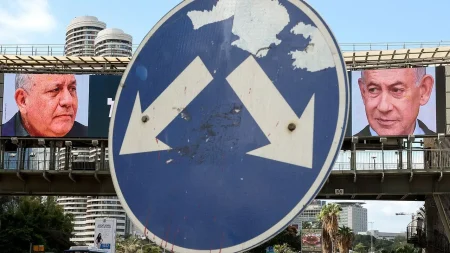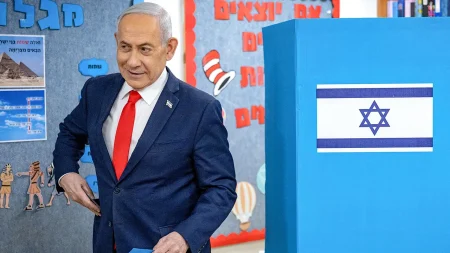



TEL AVIV, Israel — Israel woke up Wednesday to a political picture that looked very different from the celebrations of the night before, as votes continued to be counted in the country’s first national election since the Oct. 7, 2023, Hamas massacre. Prime Minister Benjamin Netanyahu’s right-wing and religious bloc had gained ground during the count, but it still did not have enough seats to form a government, leaving the country facing the possibility of yet another prolonged political deadlock. With roughly 70 percent of ballots counted, Netanyahu’s bloc stood at 54 seats in the 120-seat Knesset, while the main opposition held 47 seats and Arab parties held 19, according to partial results carried by Israeli media. Netanyahu’s Likud was the largest single party with 27 seats, while former military chief Gadi Eisenkot’s Yashar party was second with 20. Both men had claimed victory during a tense election night, and as day broke, Israelis were left trying to make sense of rapidly shifting numbers and what they might mean for the future of the country. Many had expected a close race, but the uncertainty over who would be able to put together a governing coalition left voters feeling unsettled. The election was widely understood as a referendum on Netanyahu’s leadership and his political future, taking place after months of national trauma, ongoing fighting, and a looming confrontation with Iran. At polling stations, voters described a profound sense that this election was about more than ordinary politics. The memory of Oct. 7 remains raw, and much of the national conversation has been consumed by questions about responsibility, security, and the fate of the hostages still held in Gaza. The outcome could determine whether the country continues in the same direction or embarks on a major shift, which is why so many people stayed up late watching the returns come in and checking their phones for updates.
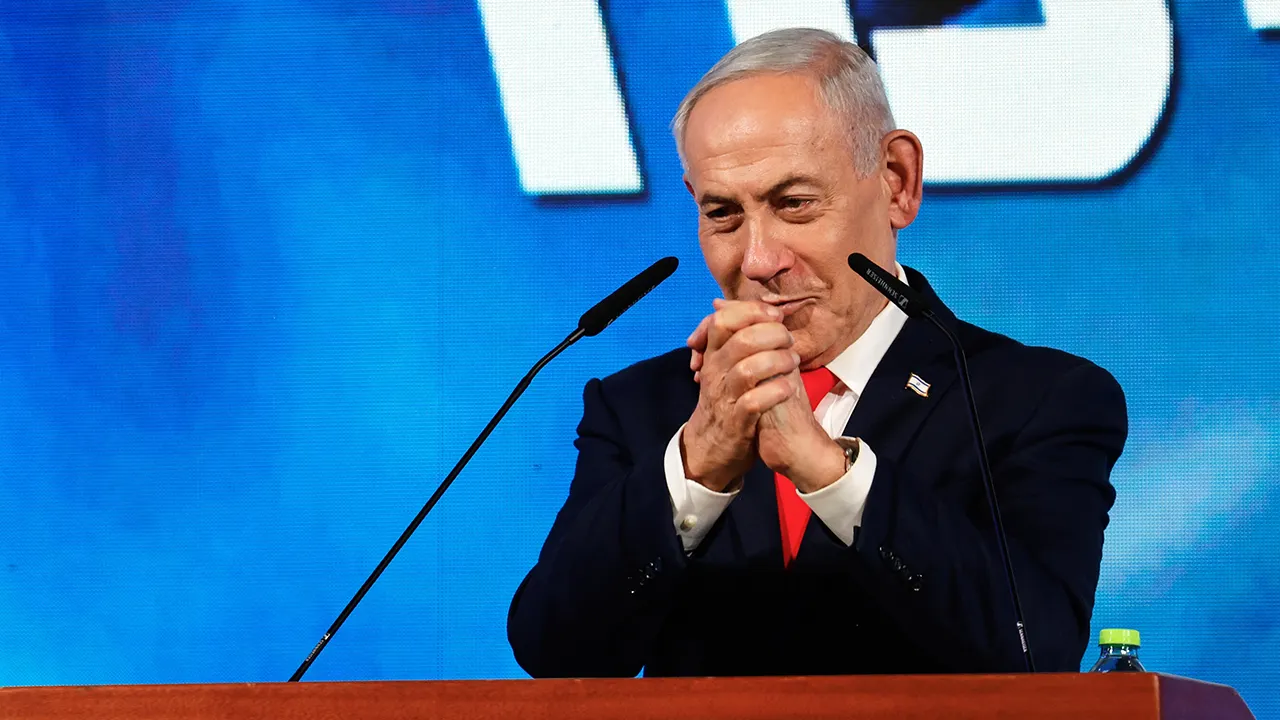
On Tuesday night, initial exit polls painted a picture that looked promising for Eisenkot and sparked celebrations at his campaign headquarters in Tel Aviv. Those numbers seemed to suggest that the opposition could break through, and Eisenkot urged Netanyahu to accept the results and step aside. But later, as more real ballots were counted, the momentum shifted. From his headquarters in Jerusalem, Netanyahu declared that Likud had emerged as the country’s largest party and called for the formation of a strong right-wing government. The changing headlines left people across the country with a familiar sense of whiplash. After years of repeated elections and political paralysis, many had hoped this vote would finally provide clarity. Instead, the election quickly turned from a simple question of who won to a much more complicated battle over coalition math and political alliances. Neither side could yet claim a decisive victory, and the eventual shape of the next government may not become clear for weeks. The night reflected the deep emotional divide inside the country. Eisenkot’s supporters gathered in Tel Aviv with the energy of a movement that believed change was possible. They chanted about a new beginning and the need for leadership that could be trusted after the failures of the past. Netanyahu’s supporters assembled in Jerusalem with just as much passion, insisting that he was the only one capable of standing up to Iran and keeping the country safe. The scene was less a single national moment than two parallel events, each side convinced that the other would be a disaster for the country. That polarization has only grown since Oct. 7, and it was on full display as the results shifted before everyone’s eyes. By Wednesday morning, commentators warned that exit polls were unreliable and that the final numbers could still change, especially because the votes of soldiers and other special ballots were still being counted. That uncertainty made the atmosphere even more tense, as both camps tried to claim momentum and prepare the public for possible coalition negotiations.
Adding another layer to the drama, former President Donald Trump moved Wednesday morning to take credit for Netanyahu’s stronger-than-expected showing. In a post on Truth Social, Trump shared a statement from Irving C. Schwartz, a supporter, who claimed that once Trump endorsed the Israeli prime minister, “the whole tide turned” and what looked like a possible defeat turned into “a big come-from-behind stalemate, or even a WIN for Netanyahu.” Speaking to reporters later, Trump said he had heard the exit polls were wrong and that Netanyahu did very well. “When the endorsement went out, it helped him a lot,” Trump said. He also suggested that top people in Israel were saying the prime minister had done much better than expected. Whether Trump’s endorsement actually moved voters is impossible to measure, but his eagerness to claim a role in the outcome reflected how closely the election was being watched from Washington and how intertwined the two politicians remain. Netanyahu has long cultivated a relationship with Trump, and the former president’s public support gave the prime minister a boost in the intense final stretch of the campaign. For Netanyahu, having Trump’s approval is a powerful signal to right-wing voters that he remains the central voice of conservative leadership. For Trump, being connected to an Israeli election victory reinforces his image as someone who shapes events around the world. Some Israeli analysts questioned whether Trump’s intervention changed many minds, but it almost certainly energized a base that may have otherwise stayed home. The episode also highlighted how the fates of the two leaders have become entangled. Trump’s political resurgence in the United States and Netanyahu’s struggle for survival in Israel mirror each other in ways that both men seem to recognize. They have attacked similar targets, including court systems and media, and they share a willingness to frame every election as a battle between the establishment and the people. Earlier in the campaign, Vice President JD Vance declined to endorse Netanyahu despite Trump’s strong backing, underscoring the complicated politics surrounding the race. With the outcome still unclear, Trump’s decision to insert himself into the story ensured that the outside world would be watching just as nervously as Israelis.
One of the most consequential storylines to emerge from the partial count was the growing power of Arab parties. According to the results, the Joint List held 13 seats and Ra’am, led by Mansour Abbas, held six, giving Arab parties a combined 19 seats. That makes them a potentially decisive force in the race to form a government. Abbas said figures from both sides of Israel’s political divide had already approached him, telling Channel 12 that “everyone is talking to us, not just the change bloc.” Yair Golan, leader of the Democrats, went further and explicitly called for a new government in cooperation with Arab parties. He insisted that the vote of an Israeli citizen in Tira is worth exactly the same as the vote of an Israeli citizen in Givat Shmuel, and he rejected Netanyahu’s tendency to distinguish between Jewish and Arab political blocs. But the opposition was not united on this question. Eisenkot has previously ruled out bringing Ra’am into his coalition, and Netanyahu has warned against any government that depends on Arab parties. The debate exposed a deep tension within Israeli politics: to win, a candidate may need allies that parts of his base are not willing to accept, and the parties themselves have their own red lines. The 19 seats held by Arab lawmakers could be the key to unlocking a majority, but they also carry political risks for anyone who chooses to rely on them. Arab parties have long existed on the margins of government formation, and even when they hold large numbers of seats, they are often treated as unsuitable partners. Abbas broke with that tradition in the past and has shown a pragmatic willingness to work with whoever can deliver benefits to his community. That pragmatism now makes him one of the most powerful figures in the post-election landscape. While some voters view Arab parties as essential partners for a functioning democracy, others see them as fundamentally outside the national consensus. The debate over their role is not new, but this election may force Israelis to decide once and for all whether they are willing to build a government with them.
With the counting still underway, political analysts pointed to three possible paths forward. Netanyahu could try to expand his current coalition by peeling off at least seven lawmakers from outside his right-wing and religious bloc, bringing him to the 61 seats needed for a conventional parliamentary majority. That would require either defections from the opposition or support from parties that have so far refused to sit with him. Alternatively, Eisenkot could attempt to secure enough parliamentary recommendations, potentially including those of Arab parties, to persuade President Isaac Herzog to give him the first chance at forming a government. Those recommendations would not necessarily mean Arab parties joining his coalition, but he would still need their support in a confidence vote. The third possibility was the one Israelis have come to dread: another deadlock. If neither leader can assemble a majority, the country could face yet another election, prolonging the political instability that has defined Israeli public life for years. It was also worth noting that, even with Netanyahu’s bloc at 54 seats, the parties outside it collectively held 66 seats in the current count, giving the opposition a numerical path to challenge him if they could find a way to work together. That is a big if, given the ideological gaps between center-left parties, right-wing parties that refuse to sit with Netanyahu, and Arab factions with competing agendas. The final result will not be official until Nov. 4, when Herzog will consult with the parties and choose a lawmaker to try to form the next government. That person gets 28 days to negotiate a coalition, with a possible 14-day extension. Until a new government takes office, Netanyahu remains prime minister, running the country in a kind of political limbo. In the meantime, the coalition talks will likely be intense and messy, driven by personal rivalries, policy disagreements, and the enormous pressure that comes from leading a country at war.
For ordinary Israelis, the morning after the election was filled with a mixture of relief that the voting was over and anxiety about what comes next. The campaign had taken place against the backdrop of a still-ongoing war, the threat of a larger conflict with Iran, and the deep trauma of Oct. 7. Many voters went to the polls saying they wanted a government that could restore security and unity, but the partial results suggested they had delivered a deeply divided parliament instead. As the count continues, including ballots cast by soldiers and others using special voting procedures, the potential for further shifts in the numbers remains. After years of deadlock and five previous elections, the country has grown accustomed to uncertainty, but that familiarity has not made it any easier. There is a human dimension to all of this that is easy to lose in the arithmetic of coalition politics. Parents gathered around televisions with their children, reservists called back to service followed the results from bases, and families of hostages held in Gaza watched with a particular sense of urgency, hoping for a leader who could bring their loved ones home. The election was not only about policy; it was about the kinds of promises a society makes to itself after a terrible loss. The next few weeks will be a test of whether Israel’s political system can produce a stable governing alliance or whether it will collapse again into political paralysis. For now, both Netanyahu and Eisenkot are preparing for a long legal and political fight, and the public is left to wait. Whoever ultimately forms the next government will inherit a country facing enormous challenges, and getting there will require not just political skill but the patience of a nation watching closely, hoping that this time, the process will lead somewhere.