


The global shift to cleaner energy is often told through stories of electric cars, wind turbines, and battery gigafactories. But beneath those big, shiny machines lies a quieter, more technical race over the ingredients inside the batteries themselves. Group14 Technologies, a next-generation battery materials company based in Washington state, is trying to win that race by thinking on a global scale. This week, the company announced $169 million in new funding and plans to build a manufacturing facility in Sagunto, Spain, a town near Valencia. The announcement is part of an ambitious strategy to create a production network that spans North America, Europe, and Asia. “In order to be a global player in a global industry, we need a global footprint, which means it’s not about picking one specific region and going all in,” said Rick Luebbe, Group14’s CEO and co-founder. “We really need to grow all regions.” That worldview reflects a moment when governments and companies are increasingly anxious about supply chains for critical technologies. For decades, the world leaned heavily on Asia, particularly China, for batteries and the materials that go into them. Now, the United States and Europe are trying to build their own manufacturing capabilities, and Group14 is positioning itself to be part of that reshaped map. The company’s path has not been simple, and its latest announcement comes alongside signs of struggle and adjustment. But Luebbe’s message is one of patience, persistence, and the belief that building a foundation for the future requires planting flags in many places at once.
The core of Group14’s business is a material that could change how batteries perform. Traditional lithium-ion batteries use graphite in the anode, the negative electrode where lithium ions are stored during charging. Graphite works well, but it has limits. It cannot hold as much energy by weight and volume as silicon, which can absorb many more lithium ions. That means silicon offers a path to batteries that are lighter, smaller, and faster to charge. The catch is that silicon swells dramatically when it absorbs lithium, which can crack the battery over time. Group14 says it has solved that problem by creating a silicon-carbon composite that captures the benefits of silicon while managing the expansion. The result, according to the company, is a material that can replace graphite in lithium-ion anodes and enable higher energy density and faster charging. Those qualities matter for several industries. Electric vehicles obviously benefit from longer range and shorter charging times. Consumer electronics, such as smartphones and laptops, can use the extra energy density to make devices thinner and more powerful. And increasingly, data centers are interested in batteries that can respond quickly to sudden surges in power demand, especially as artificial intelligence servers drive electricity consumption through the roof. Right now, Group14’s material is mostly going to consumer electronics customers, who tend to qualify new materials faster than automakers. But the company is actively working with automotive partners and keeping an eye on the booming data center market. For Luebbe, the appeal of Group14’s technology is not just in making one product better, but in creating a flexible material that can serve a whole ecosystem of energy-hungry applications.
The latest funding round is a strong signal that investors believe in that vision, even if the road to profitability has been long. The $169 million comes from a European investor, though the company did not name the firm. It extends Group14’s Series D round, which had already raised $463 million, and brings the company’s total funding to nearly $1.5 billion. That is a staggering amount for a startup, but it reflects the capital intensity of what Group14 is trying to do. Building chemical plants and advanced manufacturing facilities is expensive, and scaling up battery materials production takes years. The new facility in Spain, targeted to begin production in mid-2029, is part of that long game. Luebbe explained that the site in Sagunto offers three important advantages: access to clean energy, a skilled labor force familiar with the chemical industry, and proximity to automotive customers. Spain is the second-largest vehicle producer in Europe, behind Germany, which makes it a natural hub for battery suppliers. Group14 already has a foothold on the continent, having acquired Germany’s Schmid Silicon Technology Holding in 2023. That acquisition was about securing a European source of silane gas, a key ingredient in the company’s battery material. By owning the supply of that input, Group14 can reduce its dependence on distant suppliers and better control its costs and quality. The move into Spain is also a reaction to the geopolitical moment. Just as the United States has poured money and policy into boosting its domestic battery supply chain, Europe is pursuing its own efforts to avoid reliance on Chinese imports. Luebbe made clear that Group14 wants to be part of that solution, and that the time to act is now. “Building chemical plants takes a long time, and so you’ve got to think ahead and be able to establish that global footprint and development strategy,” he said. “We’ve learned a lot in the lifetime of Group14.”
That lifetime began in 2015, when a small team set out to reinvent the battery anode. Six years later, the company opened its first commercial-scale factory, called Battery Active Materials-1, or BAM-1, at its headquarters in Woodinville, Washington. That was a meaningful milestone: taking a material out of the lab and into real production is notoriously difficult. But BAM-1 was only the beginning. In 2023, Group14 broke ground on BAM-2 in Moses Lake, a central Washington town best known for its proximity to cheap hydropower. The project received a major boost from the federal government, including $100 million from the Bipartisan Infrastructure Law, reflecting Washington’s desire to onshore more of the battery supply chain. BAM-2 was designed as a much larger facility, with two modules that, at full capacity, would be able to produce up to 4,000 tons of silicon-carbon battery material a year. That is enough for at least 200,000 electric vehicles, depending on battery size and chemistry. The scale of the project made it both exciting and daunting. The original target was to begin production by late 2024. That date slipped to early 2026, and now the company says the first module is expected to come online in mid-2027, after installation and commissioning are complete. The second module has no firm date yet. Luebbe acknowledged that the process has been more difficult than anticipated. “It’s a very complicated infrastructure, and it takes a lot longer than we had anticipated to do the final installation and commissioning,” he said. In the meantime, the delays have had human consequences. Group14 laid off an unspecified number of Washington workers in July 2025 and furloughed additional employees at Moses Lake in January as it shifted resources toward its South Korean facility.
Visiting the Moses Lake site this month, the scene was quiet, almost eerily so. There were no obvious signs of activity, no roaring trucks, no lines of workers filing through the gates. For outsiders, it might have looked like the project had stalled or even been abandoned. But Luebbe says that is not the case. Work is continuing, he insists, and is about to ramp up as the company prepares for the next phase of construction and commissioning. Part of the challenge has been securing the necessary infrastructure, particularly power. Group14 has already contracted enough clean energy to run the site, as well as a planned silane gas facility. That is no small achievement, because Moses Lake and the surrounding region have become a battleground for electricity. Data center developers have flocked to the area, drawn by the same abundant hydropower that attracted Group14. Those data centers, built to support cloud computing and artificial intelligence, have enormous appetites for electricity, and they are competing with industrial projects like BAM-2 for a finite supply of clean power. The situation reflects a larger tension in the clean energy economy: there is plenty of demand for electrified everything, but the grid, the permitting, and the supply chains are struggling to keep up. For Group14, the delays in Washington have been painful, and they illustrate the gap between vision and reality in high-tech manufacturing. Even with money, government support, and a promising product, building physical reality from blueprints takes time. The company has had to make hard choices about where to focus its efforts, and for now, South Korea has taken priority.
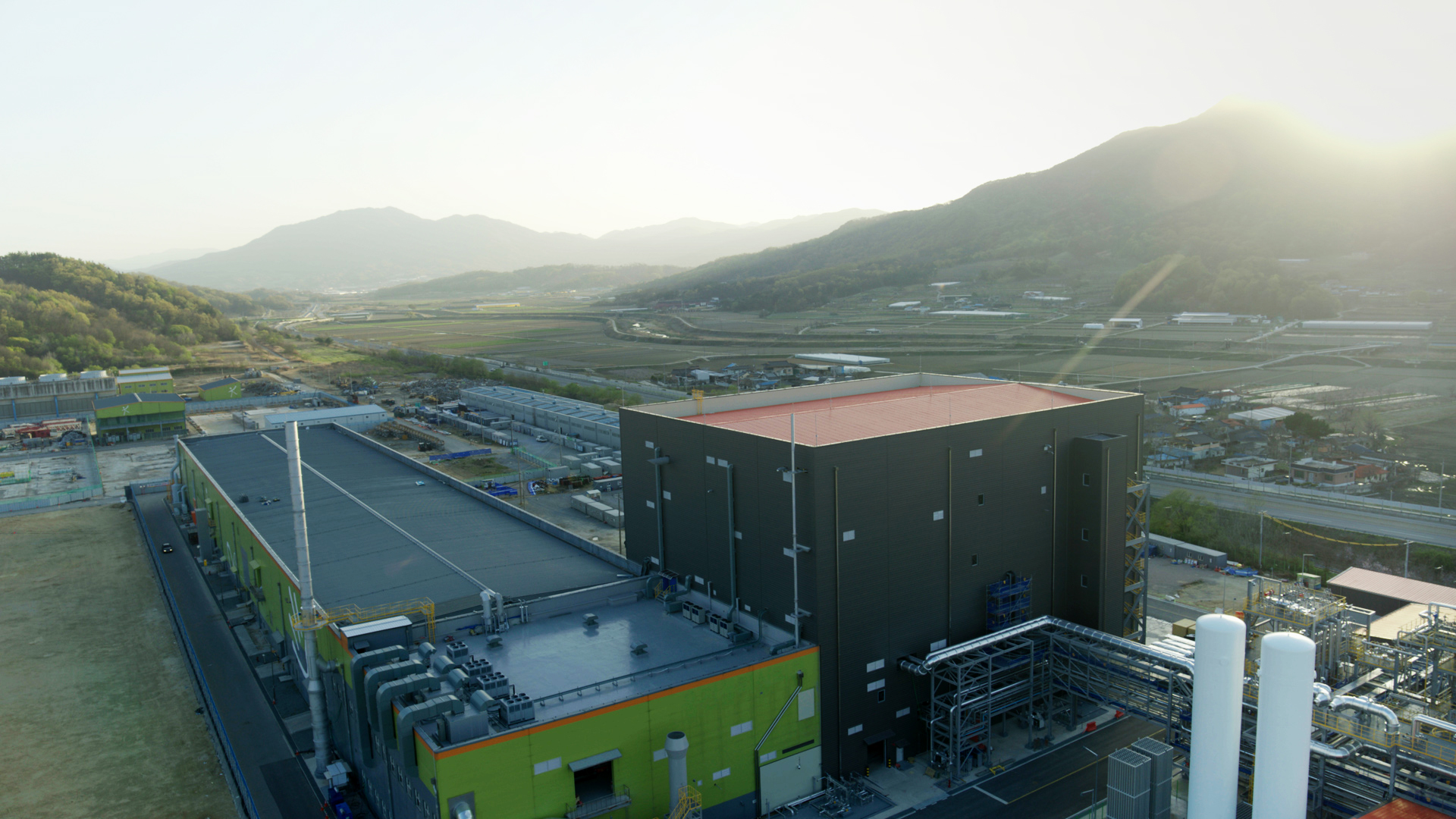
Across the Pacific, Group14’s BAM-3 facility in South Korea is offering a glimpse of what success might look like. What began as a joint venture with SK materials has been producing anode material since 2024. The plant is scaling up steadily and expects to reach its annual capacity of 2,000 tons within about six months. That facility has effectively become the company’s commercial engine, supplying customers while the larger U.S. plant lumbers toward completion. The Korean operation also brings Group14 closer to the Asian battery supply chain, which remains the world’s dominant manufacturing hub. For now, the company’s customers are mostly in consumer electronics, where products like wireless earbuds, smartphones, and laptops are constantly chasing longer battery life and faster charging. Automakers, with their long qualification cycles and safety requirements, move more slowly. But Luebbe sees another opportunity taking shape in the data center world. Battery backup units, essentially large uninterruptible power supplies, are becoming more important as artificial intelligence creates wild swings in electricity demand across server racks. Silicon-anode batteries, with their high power and energy density, could help smooth those spikes and keep critical systems running. “I’m anticipating data center batteries, battery backup units, to be the second biggest market for us behind EVs,” Luebbe said. That potential is part of why the company is pushing so hard to expand globally, even as it works through the frustrations of construction and commissioning. Group14’s story is ultimately one of ambition meeting reality. The vision is bold: a world where batteries store more energy, charge faster, and are made in secure, regional supply chains. The execution is hard, marked by delays, layoffs, and tough strategic choices. But with nearly $1.5 billion in funding, facilities in the United States, South Korea, and coming to Spain, and a product that promises real improvements to an indispensable technology, Group14 has placed itself at the center of the next chapter in energy. The factory gates in Moses Lake may be quiet for now, but the work inside is ongoing, and the journey is far from over.