


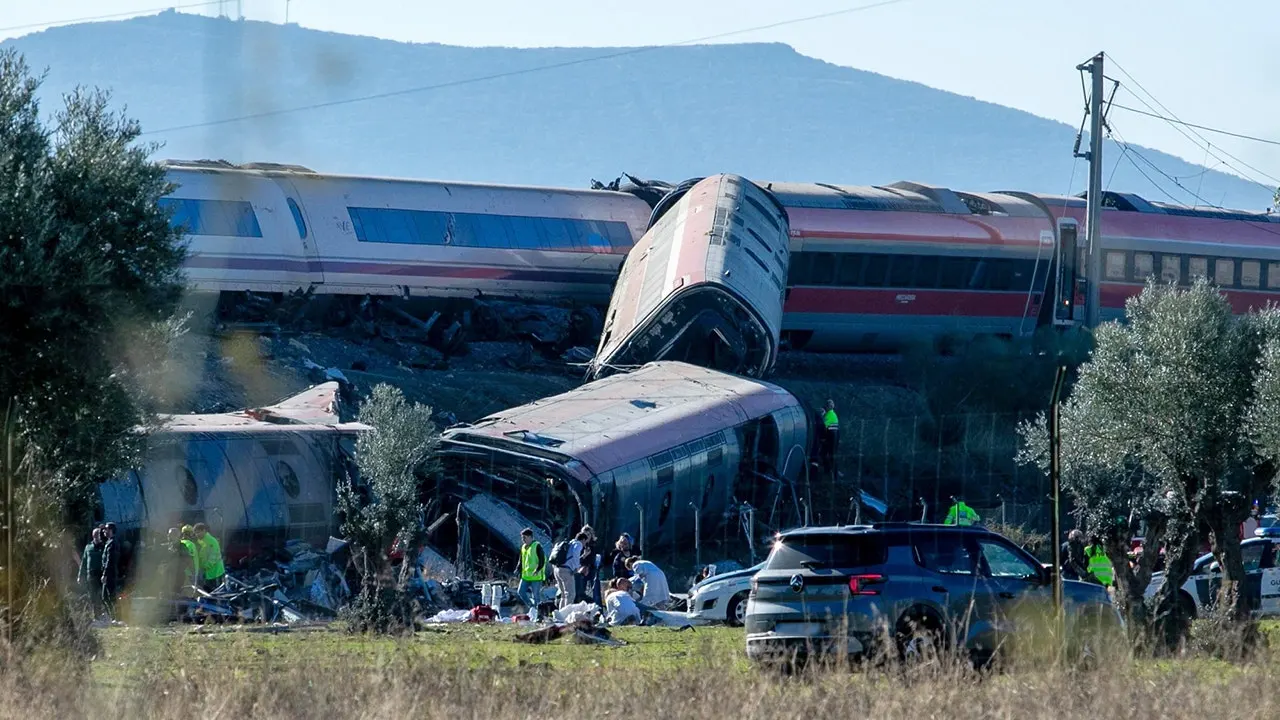
On a bright Wednesday morning in the Spanish countryside, a journey that should have been ordinary turned into a scene of unimaginable horror. A high-speed train carrying hundreds of passengers slammed into the rear of another train that had stopped on the tracks in the province of Toledo, in the region of Castilla-La Mancha. By the end of the day, at least 68 people had lost their lives, and another 58 were being treated in hospitals, their bodies and minds carrying the shock of a sudden, violent collision. The crash happened along the busy Madrid-to-Seville route, a line that carries commuters, families, and travelers between some of Spain’s most beloved cities. Among the injured are believed to be several Americans, according to the U.S. State Department, a detail that reminded the world how universally fragile life is when technology fails. As rescue workers sifted through twisted metal and shattered glass, the scale of the tragedy began to sink in. This was not a minor derailment or a fender-bender between locomotives. It was a high-speed impact that tore through passenger cars, overturned seats, and left people trapped and bleeding. Witnesses described chaos, fear, and acts of desperate kindness, while officials spoke in hushed, somber tones about a disaster that would mark Spain for years to come.
The mechanics of the crash, pieced together by investigators and government ministers, reveal a sequence of events that makes the tragedy all the more painful because it was preventable. Spain’s rail system operator, ADIF, said the collision happened around mid-morning, after a computer malfunction knocked out a critical safety system covering roughly 39 miles of track. The failure forced trains in the affected area to halt, including an IRYO train that stopped on the line with 147 passengers aboard. Behind it, a RENFE train carrying 397 passengers was also brought to a stop. But then came the decision that Spanish Transport Minister Óscar Puente called “inexplicable.” The central rail control center, despite the halted train ahead and a stop signal still active, cleared the RENFE train to resume its journey without any speed restrictions. Puente was blunt: the train should never have been allowed to move, and at the very least, it should have been ordered to creep along cautiously while the safety system remained down. Instead, just over twenty minutes after being cleared, the RENFE train slammed into the back of the stationary IRYO train, knocking two cars off the tracks. Investigators are still calculating the exact speed at the moment of impact, but Puente said it may have been traveling at approximately 124 miles per hour. The engineers themselves, he stressed, were not at fault. They were following instructions from above, trusting a control system that failed them all.
For the passengers inside those trains, the world turned upside down in a heartbeat. One traveler, Ignacio Relaño, described to state broadcaster TVE how the RENFE train briefly stopped, then started moving again, only to suddenly brake hard before the impact. “We all felt the train abruptly slowing down and then the impact,” he said. “The car leaned to one side like it was about to tip over. I hit my nose, everything went flying, luggage, cellphones. Everything shook.” Another passenger told Cadena Ser radio that she was thrown forward in her seat, the force of the deceleration shattering the small table in front of her. In the chaos that followed, she saw things no one should ever see: body parts, trapped people, and blood everywhere. Outside the wreckage, ordinary people became first responders. David Gómez, a construction worker who was laboring nearby with his brother and a colleague, heard the crash and ran toward the scene without hesitation. “People were trying to get out through the windows…. We cut through some fences to access the area and treated people with the first-aid kits we had brought,” he told El País. His voice trembled as he recalled a moment that will haunt him forever: “As I was trying to pull a young woman out, there was a piece of a leg.” It was a gruesome scene, one that rescue teams continued to search for survivors and bodies long after the last echoes of the collision faded. Spanish Health Minister Mónica García warned early on that this would be a tragedy, saying, “It was a high-speed impact, so we are expecting this to be a tragedy.”
The official response was swift and deeply emotional. Spanish Prime Minister Pedro Sánchez visited the crash site, his face etched with grief, and announced three days of national mourning. “Today all of Spain is grieving,” he said. He also made a pointed demand, one that echoed the frustration and sorrow of many citizens: “It is unacceptable for a country like Spain to suffer two high-speed rail accidents in the same year.” His words carried a double weight, because this was not an isolated incident. Back in January, the same two rail companies—RENFE and IRYO—had been involved in a high-speed crash that also raised questions about safety protocols. Now, less than a year later, they were at the center of another catastrophe. The prime minister called for enhanced safety measures across the entire rail system, insisting that a modern nation with one of the most advanced rail networks in the world should not be repeating the same mistakes. Transport Minister Puente echoed that sentiment by focusing on the failure of the control center rather than blaming the train crews. His explanation was meant to reassure the public that the people closest to the danger had not been negligent, but it also exposed a deeper vulnerability: a single computer glitch, compounded by a flawed decision, could override all of the safeguards designed to protect passengers.
Beyond the political statements, the crash touched the heart of Spain’s royal family and the wider international community. King Felipe VI and Queen Letizia released a short statement on X, formerly Twitter, saying they were deeply saddened and concerned by the accident in Urda, Toledo. “We share in the grief of the families and loved ones of those who lost their lives, and we send our heartfelt support to the injured and all those affected,” they wrote. Their words were meant to comfort a nation in shock, but for the families of the victims, grief would not be so easily soothed. The regional government of Castilla-La Mancha confirmed the terrible toll and coordinated with hospitals across the area to receive the injured, some of whom were in critical condition. IRYO, the Italian-owned private rail company, issued a statement saying it had activated its security protocols and was working closely with authorities. But protocols and statements feel hollow when weighed against the loss of life. For the passengers, many of whom were simply trying to reach their destinations—to see loved ones, to begin vacations, to return home from business trips—the journey ended in tragedy. The fact that several Americans were among the injured brought the loss closer to home for many in the United States, a reminder that in an interconnected world, a disaster in one country is a shared sorrow everywhere.
As the days follow the crash, the questions will grow louder. How could a safety system malfunction go unnoticed for so long? Why did the control center clear a train to speed forward when every signal warned of danger? What will it take for Spain—and every country with high-speed rail—to prioritize passenger safety above all else? These are not just technical questions; they are moral ones. The engineers who watched helplessly, the families who received unthinkable phone calls, the rescue workers who pulled bodies from the wreckage, and the survivors who will carry the trauma for a lifetime—all of them deserve answers. But amid the grief, there is also hope in the human spirit. Neighbors rushed to help strangers. First responders worked tirelessly through debris. A nation came together in mourning, determined to honor the dead by demanding change. The royal couple’s message, the prime minister’s vow, and the quiet courage of ordinary citizens all point to the same truth: Spain will not let this tragedy fade into memory without learning from it. In the weeks and months ahead, investigators will release their findings, and officials will likely promise reforms. But no promise can bring back the 68 souls lost, no explanation can fully heal the wounds of the survivors, and no policy can erase the haunting image of a young woman trapped in metal with a rescue worker trying to save her. What remains is the duty to remember, to grieve, and to work toward a future where no train passenger has to fear that the next stop might be the last.