


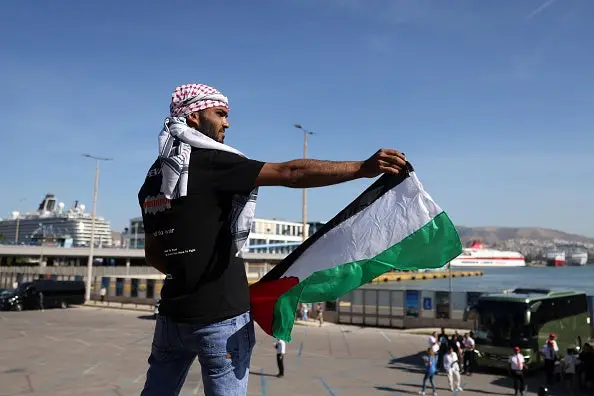
Before sunrise on Friday, dockworkers and activists in more than a hundred port cities are expected to put down their gear, raise banners, and turn some of the world’s busiest commercial harbors into stages for a coordinated political protest. The action, organized under the slogan “No Harbour for Genocide,” has been in the works for months, and it is far from the spontaneous outpouring of anger it may appear to be on a news ticker. According to a detailed investigation, a sprawling network of 106 organizations—communist, socialist, and pro-Palestinian—has spent the past week finalizing plans for strikes, demonstrations, and media campaigns across 113 ports in 22 countries and regions on five continents. From Oakland, California, to Mumbai, India, from the Italian cities of Genoa and Livorno to Piraeus in Greece, Hamburg in Germany, Tangier in Morocco, Veracruz in Mexico, and Marseille in France, organizers are seeking to transform the infrastructure of global trade into a vivid, synchronized spectacle of opposition to Israel, NATO, Western military policies, and the capitalist system itself. The geographic sweep is deliberate: by coordinating actions across Europe, the Americas, Asia, and Africa, organizers hope to turn scattered local grievances into the appearance of a worldwide uprising, a single dramatic image of resistance that can be shared online and broadcast into homes around the globe.
At the heart of this mobilization is what organizers call the “red-green” alliance—red for the far-left political traditions of communism and socialism, green for the color most associated with Islam and the Palestinian cause. The same network has been responsible for a wave of protests beyond the waterfront, including “Acte III,” a new round of demonstrations planned for the streets of France on Saturday. The port shutdowns represent an evolution of that strategy: after months of protests on city streets, university campuses, and bridges, the movement is now moving to the arteries of the global economy. In the United States, the action will spill into the San Francisco Bay Area, where members of ILWU Local 10, a longshore union local, have been activated to join the demonstration. The campaign’s planning is visible online: an anonymous purchaser registered the domain NoHarbourForGenocide.com in March 2025, and the site includes an interactive tracker that maps every port and action. The digital infrastructure is as important as the streets—it gives the protests a shared language, a common set of demands, and a way to project unity even when local conditions differ. Interestingly, the public messaging often frames the protests as “youth” and “student” actions, but the investigation found that only about one in three groups in places like France are actually youth-led; many are backed by unions and established communist organizations, suggesting a more deliberate and institutional hand behind the scenes.
The maritime dimension of the protest campaign has a history that goes beyond Friday’s planned events. For years, anti-Israel groups have used ships to make theatrical gestures against Israel, sending small flotillas toward its shores under names like the “Global Sumud Flotilla.” These voyages typically end the same way: the Israeli military boards the boats, detains the activists, and the participants—sometimes including high-profile figures like environmental activist Greta Thunberg—use the resulting selfies and videos to amplify their cause across social media. Those confrontations at sea have served as a rehearsal of sorts for the coming port actions, demonstrating how a small number of determined protesters can interrupt shipping and generate international attention. Just this past week, activists associated with the flotilla movement used three sailboats to confront a vessel called the Sunaid X, which local unions identified as supplying the American military installation at Sigonella, Sicily. The activists described it as a maritime blockade; Italian authorities saw it differently, seizing the sailboats and referring the protesters to prosecutors for allegedly disrupting a public service. For the organizers, however, the incident was almost certainly seen as a success: it proved that a handful of boats could create headlines, disrupt a military supply chain, and reinforce the idea that the struggle is not merely symbolic but also physical, aimed at the actual machinery of war and commerce.
Behind the scenes, a vast publicity machine is working to tie Friday’s labor action to a broader ideological battle. Pro-communist nonprofits and media organizations, many funded by the American-born, Shanghai-based technology tycoon Neville Roy Singham, have been amplifying the campaign for weeks. BreakThrough News, a pro-communist platform financed by Singham, reported that Italian port workers were “set to play a notable role” in the strike, framing the action as part of a larger story about student activism, austerity, and political unrest across Europe. Another group, Progressive International, which has close ties to Singham-funded organizations and has supported causes such as the Communist Party of Cuba, has published the “Istanbul Declaration,” a trade union statement whose headline reads: “Dockworkers will not become a link in the chain of their wars.” The declaration’s bluntest line, “We do not load death,” has become a rallying cry for the movement. Progressive International has also launched a strike fund to support dockworkers participating in the October 30 action, describing the goal as helping to “stop the imperialist war machine.” The campaign extends far beyond Gaza, linking opposition to American and European policies on Iran, Yemen, Cuba, and Venezuela, and positioning the dockworkers as soldiers in a larger struggle against what one Italian communist statement called “capitalist barbarism.” On Wednesday, thirteen communist youth organizations from twelve European countries issued a joint statement endorsing the strike, declaring that “we strengthen our struggle throughout Europe against our common enemy, capitalism,” and calling for a “socialist-communist society.” The Communist Party of Greece, known as KKE, announced it was dispatching its members to the ports, with its mission statement emphasizing the objective of “the overthrow of capitalism and the construction of socialism-communism.” These declarations, taken together, show how a labor dispute over cargo has been transformed into a global political platform.
The role of Palestinian organizations adds the third major dimension to the coalition. This week, seventeen Palestinian labor and professional organizations within the Boycott, Divest and Sanctions movement officially endorsed Friday’s mobilization, urging dockworkers and transportation workers around the world to refuse to handle military shipments bound for Israel. The signatories include the Palestinian General Federation of Trade Unions, the Palestinian Federation of Trade Unions, the General Union of Palestinian Workers, the General Union of Palestinian Women, and groups representing teachers and postal workers. Their endorsement carries weight: it grounds the far-left, anti-capitalist rhetoric in the concrete realities of people living under Israeli occupation and military action, and it gives the dockworkers’ movement a moral authority that organizers are eager to highlight. Shortly after the Palestinian endorsement was released, communist groups around the world shared it widely, making the symbolic “red-green” alliance concrete and visible. For the organizers, this is the full circle: the dockworker in Livorno, the student in Paris, the activist in Oakland, and the Palestinian trade unionist are all imagined as part of a single global struggle. The language is deliberately universal—phrases like “no harbour for genocide” evoke the historical movements against apartheid in South Africa, while “we do not load death” recalls the wartime resistance of European dockworkers who refused to unload cargo for Nazi Germany. By invoking these memories, the movement places itself in a long tradition of workers using their power at the docks to influence the politics of war and peace.
Finally, there is the question of money, influence, and the private network that makes all this coordination possible. Neville Roy Singham, a Marxist tech entrepreneur, has been under increasing scrutiny for his role in financing the broader ecosystem behind the protests. In 2017, Singham sold Thoughtworks, a software company he founded, for an estimated $785 million. According to the investigation, he has since channeled roughly $285 million into a global web of pro-China and pro-communist organizations, including BreakThrough News, The People’s Forum, and Tricontinental: Institute for Social Research. These organizations have been key players in protests across the United States and abroad over the past decade. Singham’s wife, Jodie Evans, is a co-founder of the feminist peace group CodePink, which has also been active in anti-war and anti-Israel campaigns. The Justice Department has launched a grand jury probe into Singham’s funding of leftist groups, according to the report, raising questions about the influence of wealthy ideological donors on grassroots movements. Singham’s connection to the port-day protests is not direct—he does not appear on any organizing committee—but the organizations he funds have worked tirelessly to provide the messaging, historical framing, and financial support that turn scattered local grievances into a coordinated international event. Ultimately, Friday’s port actions will be watched not only for their immediate impact on shipping but also as a test of whether this carefully built red-green alliance can move from the streets to the docks, from protest to disruption, and from a coalition of the aggrieved into a self-conscious global movement aimed at the very foundations of capitalist society.