

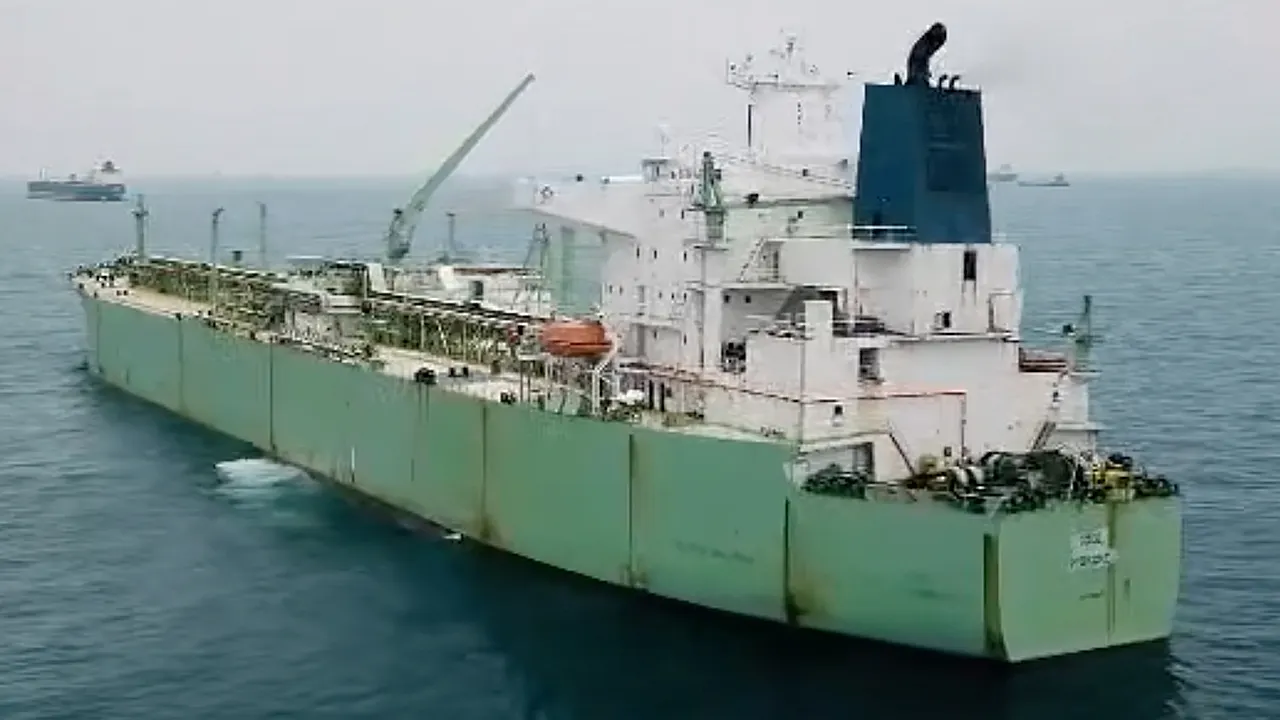
Out in the hazy, strategic waters where the Persian Gulf meets the Gulf of Oman, a quiet tug-of-war is playing out—not between warships, but between a massive American naval presence and a small fleet of aging, shadowy tankers that refuse to stop slipping through. In September, investigators from United Against Nuclear Iran (UANI) chartered a supply boat and sailed roughly 100 nautical miles into a murky offshore anchorage near Malaysia. There, under the cover of a region already crowded with sanctioned commerce, they filmed one of these vessels in action: a modest Handymax tanker called the SOGL, sitting low in the water, packed with about 500,000 barrels of Iranian liquefied petroleum gas. The footage, shared exclusively with Fox News Digital, offers a rare, almost cinematic glimpse into the shadow economy that keeps Tehran’s energy exports alive despite a reinvigorated U.S. naval blockade. According to UANI, the SOGL had loaded its cargo at Assaluyeh, Iran’s sprawling gas-export complex, in late August. It then breached the blockade on September 1 and made the long voyage toward the Malaysian Eastern Outer Port Limits anchorage, known as EOPL—a kind of gray-zone outpost where Iran’s ghost fleet has found a reliable service station. By the time the investigators arrived, the tanker was already receiving supplies and bunker fuel from smaller vessels, a sight that has become routine in these waters. The SOGL later continued to China and discharged its cargo at Xinzhou Port, completing a journey that neatly illustrates both the reach and the limits of American pressure. UANI’s senior analyst, Jemima Shelley, put it bluntly: some ships are getting through. Most are not, but since the blockade was reinstated in mid-July, at least nine small tankers carrying Iranian oil or LPG have slipped past U.S. patrols and escaped the Gulf of Oman. Those nine are enough to show that, even under intense military pressure, Iran has not lost its talent for improvisation.
To understand how the SOGL got so far, you have to look at the geography of evasion. The voyage began in late August at Assaluyeh, an industrial port on Iran’s southern coast that sits near the heart of the country’s gas fields. There, the SOGL took on roughly 500,000 barrels of LPG—a volatile mix of propane and butane that is essential for heating, cooking, and industry, and a profitable export for Tehran. After loading, the tanker steamed into the Persian Gulf, slipped through the Strait of Hormuz, and crossed the Gulf of Oman, apparently moving at a time and along a route that allowed it to slip past American warships enforcing the embargo. By early September, it was far from Iranian waters, heading toward Malaysia. UANI had been watching the vessel before it even arrived, tracking its path across thousands of miles of open sea. On September 16, they moved in for a closer look. “This tanker had loaded its Iranian LPG from Assaluyeh Port, Iran, in late August. It then breached the U.S. blockade and made its way to a Malaysian anchorage,” said Jemima Shelley. “What this shows us is that some vessels are managing to breach the U.S. maritime blockade. Most vessels aren’t, but since the reinstatement in mid-July, we have seen only nine small tankers being successful in their breach of the U.S. blockade and departing the Gulf of Oman laden with oil or LPG.” The destination that made it all possible is the Malaysian Eastern Outer Port Limits Anchorage, a sprawling offshore zone roughly 70 kilometers from Malaysia’s coast. It is not a proper port, but it has become something far more valuable to Iran: a floating warehouse, repair shop, and transfer point. There, tankers can wait for weeks, receive food, water, and fuel, and even move cargo from one ship to another, all while sitting in international waters near a country that appears to have little appetite for cracking down. It was at this anchorage that UANI’s investigators watched the SOGL receive bunkering services—smaller tankers pulling alongside to supply fuel and perhaps other necessities. Then, instead of conducting a ship-to-ship transfer as many ghost fleet vessels do, the SOGL simply turned north, entered the South China Sea, and made for Xinzhou, a port in China that has become a frequent final stop for Iranian energy cargoes. The entire journey, from Iranian port to Chinese buyer, was a masterclass in using geography, legal gray areas, and sheer audacity to keep a sanctioned trade alive.
The U.S. naval blockade, for all its dramatic imagery, is not a fixed barrier. It is a policy with a history, and its latest chapter began on April 13, when Washington first imposed it. That first iteration was temporarily lifted in mid-June, after diplomatic efforts seemed to open a possible path forward. Those efforts collapsed, and on July 14 the blockade was reinstated with fresh determination. Since then, the results have been striking. According to UANI, not a single vessel laden with Iranian crude oil has successfully left the Gulf of Oman and reached an international buyer. That is a major departure from the past, when supertankers carrying two million barrels of Iranian crude were a regular sight on global shipping maps. “The U.S. blockade is an overwhelming success at preventing vessels laden with Iranian oil and petrochemicals from leaving the Gulf of Oman,” Shelley said. “No Iranian crude oil has managed to depart and be a successful export for Iran, which is a huge economic pressure for the Iranian regime.” The pressure is real: Iran, already struggling under sanctions and the cost of regional conflict, depends on energy exports to keep its economy afloat and to fund its military and allied groups. Cutting off crude is the single most effective lever Washington has found. But the blockade is not perfect, and the leakers are almost all in one category: small tankers carrying LPG, not crude. There is a practical reason for this. The U.S. Navy and Coast Guard, along with allied forces, concentrate their enforcement on the largest vessels, because those are the ones carrying the highest-value cargoes and the ones most likely to be carrying Iranian crude under false documentation. A Handymax tanker like the SOGL, with its 500,000 barrels of LPG, is a much harder target. It is smaller, easier to hide among the region’s many commercial ships, and more dangerous to intercept. LPG is a flammable hydrocarbon mixture that, if hit or damaged in a boarding attempt, could explode or release a cloud of gas. Shelley explained that the blockade’s usual first step is to try to turn vessels around, using communication and presence rather than force. But sometimes force is necessary, and force is much riskier when the cargo is volatile. That asymmetry gives the smugglers their window.
What makes these tankers so hard to stop is not just their size but their deliberate invisibility. The so-called ghost fleet has developed a toolkit that turns ordinary shipping conventions into weapons of evasion. The most basic trick is right in the name: disappear. Many of the vessels turn off their Automatic Identification System, or AIS, the transponder that broadcasts a ship’s identity, position, and course to maritime authorities and other vessels. With AIS dark, a tanker becomes a phantom on the radar screens of the very patrols trying to stop it. They also swap flags as casually as a truck driver might swap license plates. The SOGL, for example, has operated under the flags of the Comoros and Zimbabwe—countries not exactly known for their merchant fleets—and is linked in sanctions records to a company called Gravion Maritime Co. Shelley described this as typical: “Most of these tankers are very emblematic of what ghost fleet tankers do and so are flying false flags, which means they’re completely stateless and will have very complicated front companies running them.” A stateless vessel is a legal and operational headache for any navy. It is not clear who owns it, who is responsible for it, or which country’s laws apply. That ambiguity makes it easier for the crew to act with impunity and harder for the authorities to justify interception, especially when the vessel is in a crowded shipping lane or near a country that does not cooperate. The journey itself also follows a well-worn pattern. After loading in Iran, a tanker will often cross the Strait of Hormuz and then, in the Gulf of Oman, conduct a ship-to-ship transfer. In the case of LPG, that is an especially hair-raising maneuver. “They will conduct a very high-risk ship-to-ship transfer because it’s LPG, not crude oil,” Shelley said. The tanker that receives the LPG then attempts the final breach of the blockade, while the original vessel slips back toward Iran or heads to another location. The scene off Malaysia is a direct result of these tactics. The EOPL anchorage gives the ghost fleet a place to regroup, a place where the rules are loose and the services are available, a place where a tanker can wait for the right moment to make the final run to China.
At the center of this gray economy is a stretch of sea that most people have never heard of: the Malaysian Eastern Outer Port Limits Anchorage, or EOPL. It lies about 70 kilometers off the coast of Malaysia, far enough to be outside territorial waters, but close enough to be convenient. UANI’s video shows the SOGL receiving bunkering services there, a small tanker pulling alongside to pump fuel. In the background, other vessels—some Iran-flagged, some carrying other identities—wait in a kind of floating queue. Shelley said authorities in Malaysia appear to be “looking the other way.” Whether that is due to political calculation, economic interest, or simple lack of resources, the result is the same: a haven for sanctioned trade. The anchorage is not just a fuel stop. It is also a floating storage facility. Since the U.S. blockade was reinstated in July, Iran’s stockpile of oil waiting at sea has fallen dramatically, from high levels to somewhere between zero and seven million barrels, according to Shelley. That decline is a sign of how effective the blockade has been at squeezing supply. But the fact that there is still some floating storage, and that tankers like the SOGL are still using the anchorage, shows that the system is not dead. “Often this anchorage is also used for floating storage, which is how Iran managed to survive for so long with the U.S. blockade being reinstated in July,” Shelley said. The ultimate customer for all this effort is China. For years, China has been Iran’s biggest oil buyer, taking roughly 80% of its liquid cargo exports. Since the start of the Iran War, that share has grown even further. Now, Shelley said, China imports almost 100% of Iran’s oil and LPG exports. “It has created a system and trade that has allowed Iran to avoid sanctions, U.S. and OPEC sanctions, whilst China is able to buy highly discounted Iranian oil and LPG.” From Beijing’s perspective, the arrangement is simple: get reliable, cut-price energy without worrying too much about American rules. From Tehran’s perspective, China is the lifeline that keeps the regime afloat. And from Washington’s perspective, the Chinese connection is the reason the blockade can only go so far. The ships may be sanctioned, the ports may be shady, and the crews may be sailing under false flags, but as long as a buyer is waiting, there will always be someone willing to run the gauntlet.
The bigger picture is one of a blockade that has worked better than many expected, yet still leaves a narrow seam open for determined smugglers. Since mid-July, UANI has counted only nine small tankers that successfully breached the blockade and escaped the Gulf of Oman with oil or LPG on board. That is a tiny fraction of what Iran once exported, and it is nowhere near enough to rescue the country’s economy. Yet each successful breach is a reminder that the fight is not over. The G Summer, another U.S.-sanctioned LPG carrier, was separately tracked transmitting signals from the Arabian Sea beyond the American blockade line in April. It broadcast a message saying it had an “all Chinese crew” aboard, and shipping analytics identified Iran as its last cargo country, with Galle, Sri Lanka, as its reported destination. The episode illustrates the international, sometimes contradictory nature of the trade: a ship sanctioned by Washington, staffed by Chinese sailors, carrying Iranian gas, moving through waters patrolled by the U.S. Navy. It is a strange and shadowy world, one where a tanker’s flag means little, its ownership is hidden behind layers of shell companies, and its cargo is as dangerous as it is valuable. The SOGL, for its part, has been added to the U.S. Treasury Department’s Office of Foreign Assets Control sanctions list, a formal symbol of what investigators already knew. But sanctions lists and naval patrols do not always change behavior. As long as the price is right and the route remains open, someone will keep trying. The Malaysian anchorage, the willing Chinese buyers, the false flags, the disabled transponders—all of these are the machinery of a sanction-busting economy that has learned to adapt. UANI’s months-long investigation, and the footage it captured off Malaysia, is not just an exposé of one tanker’s journey. It is a portrait of the shadow networks that allow Iran to hold on, and a warning that the blockade, for all its success, is not yet a complete victory. The crude oil has largely stopped. The liquefied gas has not. And in the gray waters between those two facts, the ghost fleet keeps sailing.