


The Fragile Balance of Power: Netanyahu’s Political Future Hangs in the Balance
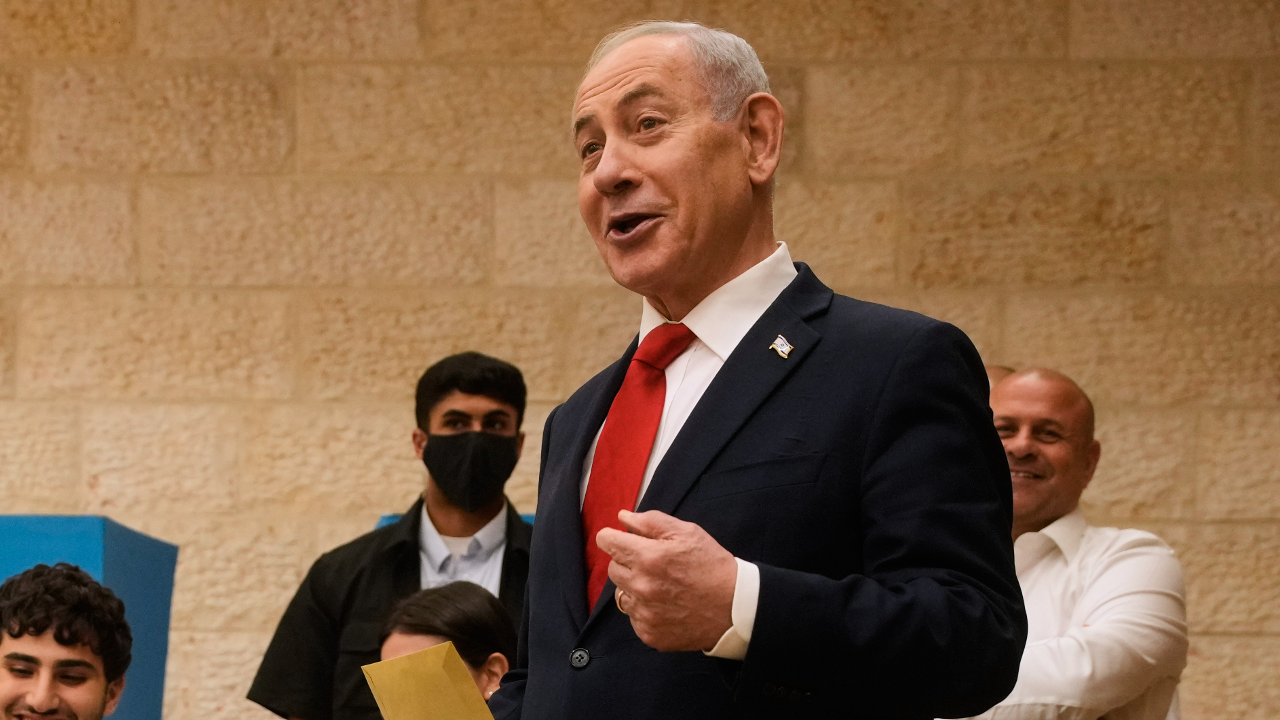
The political landscape in Israel stands at a precarious crossroads as Prime Minister Benjamin Netanyahu faces perhaps the most significant challenge to his authority in his long and controversial career. President Isaac Herzog’s upcoming consultations with leaders from all factions elected to the 26th Knesset will determine who receives the mandate to form the next government, and the outcome remains shrouded in uncertainty. The final election results, certified by Israel’s Central Elections Committee, reveal a deeply fractured political environment where Netanyahu’s right-wing bloc secured 53 seats in the 120-member parliament, while the opposition alliance under Gadi Eisenkot claimed 48 seats. Neither side has reached the critical threshold of 61 seats needed to form a government, leaving the nation in a state of political limbo that could reshape its future direction.
Netanyahu has taken to social media to stake his claim, arguing passionately that the Israeli public desires a government that does not depend on what he characterizes as problematic political allies. He specifically targeted the predominantly Arab parties Ra’am and the Joint List, accusing them of supporting terrorism and rejecting the very existence of the Jewish state. The prime minister’s messaging reflects a broader strategy to position himself as the natural leader of a coalition that excludes these parties while appealing to his base with rhetoric about national security and ideological purity. His statement emphasized that a clear majority of the Jewish public chose Likud as the largest party and expressed his openness to discussions with any party that does not support terrorism. However, the arithmetic of Israeli politics tells a more complicated story, as these two Arab parties have secured a historic combined total of nineteen seats, dramatically elevating their potential role as kingmakers in the government formation process.
The Joint List has signaled through internal sources that they would likely endorse Eisenkot for the mandate to form a government, which would provide him with recommendations from parties representing more than the required sixty-one seats. This development has injected additional complexity into an already convoluted political situation, as the traditional exclusion of Arab parties from governing coalitions collides with the mathematical reality of a divided electorate. The consultations will proceed in ascending order of seat count, beginning with smaller parties and culminating with the major factions, with Herzog facing the delicate task of choosing a candidate whose nomination enjoys majority support among Knesset members. The process grants the selected lawmaker twenty-eight days to assemble a coalition, with the possibility of a fourteen-day extension, creating a compressed timeline for what may prove to be extraordinarily difficult negotiations.
The Opposition’s Path: Eisenkot’s Challenge and the Kingmaker Question
Defense and government affairs commentator Amir Oren has observed that while Herzog technically possesses the formal freedom to select any candidate for the task of forming a government, political convention dictates that he should choose the nominee backed by parties representing a majority of Knesset seats. This logic suggests Eisenkot should receive the first opportunity, though Oren cautions that receiving the mandate does not guarantee success in assembling a viable coalition. The opposition leader faces formidable obstacles in his quest to secure sixty-one seats, as the competing interests within his own bloc may prove irreconcilable. Naftali Bennett of BeYachad and Avigdor Liberman of Yisrael Beiteinu appear unlikely to countenance serving in a government dependent on the Joint List, given that party’s pro-Palestinian positions and its fundamental opposition to Zionism as a political philosophy.
The theoretical possibility exists, however, that the opposition could forge a minority government arrangement wherein Arab parties provide external support without holding formal coalition membership. While Israel has never formed a minority government immediately following an election, such arrangements have emerged during Knesset terms, most notably when an ultra-Orthodox party withdrew from Netanyahu’s current coalition over military conscription disputes yet continued to back the government from outside. This precedent offers a potential template for Eisenkot, though the ideological chasm between the Arab parties and the right-leaning members of the opposition alliance may prove too vast to bridge. The two predominantly Arab parties have already confirmed they would recommend Netanyahu during consultations, presenting Eisenkot with a strategic dilemma about how to approach potential partnerships that could alienate his more hawkish allies.
Dan Diker, president of the Jerusalem Center for Security and Foreign Affairs, has suggested that Bennett and Liberman’s endorsement of Eisenkot signals their movement away from the prospect of a national unity government with Netanyahu’s Likud party. Diker argues that given the imminent confrontation between Iran’s regime and Israel, along with the broader Western world, it would serve the national interest for Netanyahu, Eisenkot, Bennett, and Liberman to find common ground and work together. This perspective reflects broader concerns about regional stability and the need for political continuity during times of heightened security threats, though personal rivalries and ideological differences may prevent such pragmatic cooperation. The Jerusalem Center president’s comments highlight the tension between political calculations and national security imperatives that characterizes Israeli political discourse at this critical juncture.
The Looming Institutional Battles and Political Maneuvering
The 26th Knesset is scheduled to be sworn in on November 10th, and its newly elected members intend to quickly begin forming committees and advancing legislation while Netanyahu’s caretaker government remains in office. This transitional period creates opportunities for political maneuvering as opposition lawmakers seek to consolidate their influence and potentially limit the outgoing prime minister’s power. Diker has observed that those opposed to Netanyahu are making concerted efforts to push him from office, with discussions already underway about replacing the Knesset speaker. The prospect of a parliament where Arab parties hold nineteen seats and can influence legislative outcomes represents a significant challenge to Netanyahu’s agenda and political survival. The opposition could potentially advance legislation that would be highly uncomfortable for the prime minister, further complicating his efforts to maintain relevance and authority during this uncertain period.
Oren has highlighted another potential complication for Netanyahu, suggesting that the caretaker government’s ability to conduct military operations could face political constraints. This limitation could complicate any resumption of hostilities with Iran, even if international actors such as the United States were to initiate such actions. The intersection of domestic political considerations with foreign policy and national security decisions creates a volatile environment where strategic choices may be driven by political calculations rather than purely security-based reasoning. The outgoing government retains formal authority but lacks the political legitimacy of a fresh mandate, potentially constraining its ability to make bold decisions on matters of war and peace.
Former Knesset member Dov Lipman has offered his assessment of the likely path forward, suggesting that Eisenkot appears poised to receive the first opportunity to form a government. However, Lipman notes that most Israelis actually favor a national unity government built around Likud, Yashar, and BeYachad, with smaller parties potentially joining the coalition. The expected sequence would see Eisenkot approach Likud with an offer to join a government under his leadership, a proposal that Likud would almost certainly reject. Eisenkot would then face a difficult decision, as Liberman’s reluctance to serve alongside Arab parties further narrows his options. Lipman predicts Eisenkot will probably fail in his efforts, after which the mandate would pass to Netanyahu, who would encounter equally formidable obstacles in assembling a viable coalition.
The Unity Government Question and Historical Precedents
If both leading candidates fail to form governments, the process would enter a twenty-one-day period during which any Knesset member could attempt to assemble a coalition with the backing of at least sixty-one lawmakers. This extended timeline could create opportunities for creative political solutions that might otherwise seem impossible. Lipman suggests that at this stage, Eisenkot might agree to serve under Netanyahu for a period of two years to avoid sending the country to yet another election, a prospect that few Israelis relish given the repeated electoral cycles that have characterized recent political history. Such an arrangement would represent a pragmatic compromise between rivals who recognize the costs of continued political instability, though it would require significant concessions from both sides regarding policy priorities and power-sharing arrangements.
Professor Gideon Rahat, a senior fellow at the Israel Democracy Institute, has pointed to the 1984-1988 national unity government as a relevant precedent for the current situation. That arrangement emerged during a period of crisis when Israel was still embroiled in the Lebanon War with IDF forces deployed in the country, while the economy faced annual inflation exceeding four hundred percent. Against this backdrop of multiple simultaneous challenges, Likud and Labor forged a national unity government under a rotation agreement that saw Shimon Peres serve as prime minister for the first two years, followed by Yitzhak Shamir for the subsequent two years. This historical example demonstrates that Israeli political leaders have previously set aside their differences to address existential challenges, though such cooperation typically proves temporary as initial unity gives way to renewed partisan conflict.
Rahat cautions that Netanyahu would need to make substantial concessions to persuade opposition leaders that he would honor his commitments, given their experience with the 2020 power-sharing agreement with then-Blue and White party leader Benny Gantz. Under that arrangement, Netanyahu was to serve as prime minister for the first eighteen months, with Gantz serving as alternate prime minister and defense minister before assuming the premiership in November 2021. However, the agreement collapsed after the government failed to pass a state budget by the December 2020 deadline, triggering automatic dissolution of the Knesset and new elections. Gantz never assumed the premiership, an experience that has understandably made opposition leaders skeptical of Netanyahu’s willingness to follow through on power-sharing commitments once he has secured his position.
The Challenges Facing Any Governing Coalition
Any national unity government would face immediate challenges that could strain the coalition from its inception. Rahat notes that such an arrangement would require freezing the judicial overhaul launched by Netanyahu’s government, finding a mechanism to investigate the October 7th events as demanded by opposition parties, and agreeing on a process for Netanyahu to eventually leave office. These are substantial hurdles that would test the willingness of all parties to compromise on deeply held positions. The judicial overhaul has been one of the most contentious issues in Israeli politics, sparking massive protests and raising concerns about democratic checks and balances. Similarly, the investigation into the October 7th events involves questions of accountability and responsibility that cut to the heart of public trust in the nation’s leadership and security establishment.
When it comes to major security and economic issues, Rahat suggests that unity governments can be quite effective, as the incentives for cooperation on existential matters outweigh partisan considerations. However, he also observes that once these major challenges are resolved, coalition partners typically begin fighting among themselves and the sense of common purpose dissipates. This pattern suggests that even if a unity government is formed to address immediate crises, its sustainability over the long term remains doubtful. The Israeli political system’s fragmentation and the deeply polarized nature of public opinion create conditions where broad coalitions are inherently unstable, requiring constant negotiation and compromise that becomes increasingly difficult to sustain over time.
The path forward remains uncertain, with multiple possible outcomes ranging from a unity government that bridges partisan divides to yet another round of elections that would extend the current period of political paralysis. The stakes extend beyond domestic politics, as Israel’s security situation and regional position depend on having a functional government capable of responding to threats and pursuing strategic objectives. The international community watches closely as Israeli leaders navigate these treacherous political waters, understanding that the outcome will shape not only Israel’s immediate future but also the broader dynamics of the Middle East region. The consultations beginning with President Herzog represent the first formal step in determining which direction the nation will take, but the ultimate resolution of the current crisis depends on the willingness of political leaders to make the compromises necessary for effective governance.
The Regional Security Imperative and the Search for Stability
The timing of this political uncertainty could not be more critical, as Israel faces significant security challenges from multiple fronts. The Iranian threat looms large, with the regime in Tehran continuing its nuclear program and supporting proxy forces throughout the region. The risk of military confrontation has increased tensions across the Middle East, creating an environment where political instability in Israel could have dangerous consequences. The country’s adversaries may perceive the current confusion as an opportunity to advance their interests, potentially emboldening hostile actions that would further destabilize an already volatile security situation. Israeli military and intelligence officials require clear political direction and support as they manage these threats, making the formation of a stable government a matter of urgent national importance.
The economic dimension also weighs heavily on political calculations, as investors and markets respond to uncertainty with caution and volatility. Israel’s economy has demonstrated remarkable resilience historically, but prolonged political paralysis could undermine confidence in a country that relies heavily on technology exports and international investment. The relationship with the United States remains a cornerstone of Israeli policy, and Washington’s engagement with whatever government emerges will shape the bilateral relationship and regional dynamics. American officials have emphasized their commitment to Israel’s security while also expressing interest in seeing a functioning government emerge from the electoral process. The complexity of these interlocking factors creates pressure on Israeli political leaders to find common ground and address the nation’s challenges effectively.
As the political drama unfolds, the Israeli public watches with a mixture of anxiety and hope, recognizing that the decisions made in the coming weeks will determine the country’s trajectory for years to come. The robust democratic process that produced this unprecedented electoral outcome reflects the vitality of Israeli democracy, yet it also highlights the difficulties of governance in a deeply divided society. Whatever government ultimately emerges will need to address not only the immediate challenges of coalition formation but also the underlying divisions that produced this political deadlock. The search for a governing formula that can provide stability while respecting the diverse interests and values of Israeli society represents the central challenge facing the nation’s leaders as they work to shape Israel’s future in an uncertain and dangerous region.