


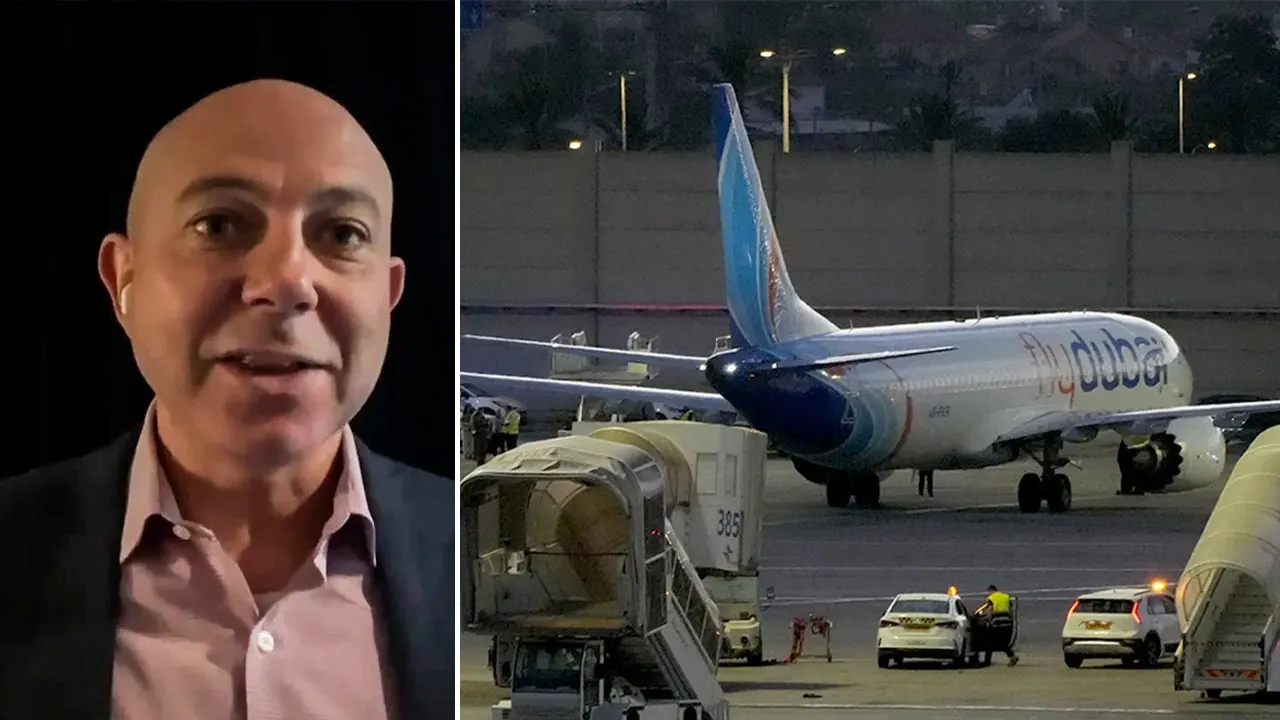
The nightmarish scenario unfolded at 30,000 feet, where a routine FlyDubai flight became a terrifying battle for survival. Eliran Almog, a former Israeli helicopter pilot who now leads an aviation cybersecurity firm, still struggles to comprehend how the near-hijacked aircraft made it down alive. He described the sheer insanity of the event, telling Fox News Digital, “You can’t imagine being in that position. You see the videos, you hear the kids screaming, and people don’t necessarily understand what is happening.” For the passengers onboard flight 1073, there was no warning, no time to prepare. In the span of thirty heart-stopping seconds, the plane plummeted more than 14,000 feet, a violent, stomach-churning freefall that pinned people to their seats and sent luggage and debris flying through the cabin. The g-forces were enormous, and in that moment, many genuinely believed they were taking their final breaths. Almog, who trained for years to remain calm in the most extreme aerial emergencies, admitted that even he would have been shaken. “The g-force on the plane was enormous, and you basically think you are going to die,” he said. The fact that the aircraft did not break apart under the stress of that sudden dive, and that it was later landed with substantial tail damage, is something he calls nothing short of remarkable. What made it even more extraordinary was the sequence of human decisions that turned a potential catastrophe into a story of survival, courage, and improbable skill.
The attack itself was as sudden as it was senseless. The copilot, later identified as 29-year-old Omani national Hamam al-Hammami, allegedly turned on his own captain, Smit Machchhar, stabbing him mid-flight in a moment of shocking betrayal. Captain Machchhar, despite suffering serious wounds, somehow kept enough presence of mind to hit the button that opened the cockpit door. That single action allowed a group of Israeli passengers to rush forward and subdue the attacker, dragging him away from the controls before he could cause even more devastation. As if that were not enough, another miracle was waiting in the cabin: two off-duty FlyDubai crew members were on board as passengers, and they immediately stepped in to stabilize the aircraft. With the captain gravely injured and the copilot restrained, this impromptu flight crew fought to regain control and successfully executed an emergency landing in Saudi Arabia. Almog, reflecting on this rapid chain of events, admitted that even an experienced pilot might not have managed what those crew members achieved. “As a pilot, if I were in this situation, I’m not sure I could have landed the aircraft,” he confessed. Every commercial aircraft is a different machine, with its own unique setup, landing procedures, and limitations. For off-duty pilots to somehow land an unfamiliar plane under the most extreme psychological and physical stress is a feat that defies explanation. Almog emphasized that while the heroism was remarkable, the entire ordeal points to a deeper problem: how did a man with a pilot’s training, a man entrusted with the lives of hundreds, become a threat in the first place?
In the days after the incident, the investigation began to take on a broader geopolitical dimension. Israeli Prime Minister Benjamin Netanyahu, appearing on Fox & Friends, told viewers that the copilot had been exposed to “Islamist radical indoctrination.” President Donald Trump went even further, suggesting that the pilot may have been trained or motivated by Iran’s Islamic Revolutionary Guard Corps. These are heavy accusations, and while multiple countries including Israel and Saudi Arabia are conducting their own investigations, the incident has become yet another flashpoint in the increasingly tense Middle East. For Almog, this is no surprise. He explained to Fox News Digital that geopolitical risk is now the number-one concern for airlines around the world. “If you ask the airlines today what are the main risks that they are looking forward on, it is geopolitical risk,” he said. He pointed to the raw data his company tracks, including GNSS and GPS jamming and spoofing activities. “I can show you the map and you can understand exactly where the conflicts are,” he said, describing how modern aviation has become an invisible frontline where electronic warfare and espionage are as dangerous as any physical attack. When a pilot with potential political or psychological vulnerabilities is placed in the cockpit of a commercial airliner, the stakes become existential. The FlyDubai incident was a stark reminder that no airline, no matter how sophisticated, is immune to the human element. It is not enough to screen for technical skill and flying hours; airlines must now evaluate a pilot’s mental state, political leanings, and personal vulnerabilities, not just once at hiring, but continuously throughout their careers.
Almog, whose professional focus is on protecting aviation from cyber and human threats, believes that the industry has been too slow to adapt. He has spent years advising airlines and related businesses on how to strengthen their defenses, and he sees the FlyDubai case as a wake-up call. “We give a lot of weight in the process to the characteristics of the pilot,” he said. “The technical and cognitive skills are important, but we make sure that the pilot is balanced and resilient in extreme cases.” That initial screening, he argues, is simply not enough. Pilots are people, and people change. They experience family problems, financial stress, psychological burnout, and radicalization. In a world where a single person in the cockpit can destroy billions of dollars of equipment and end hundreds of lives, Almog insists that constant monitoring is essential. “Because aviation is critical infrastructure, we must rethink how we screen pilots — not just initially, but continuously,” he said. “Even for experienced pilots, we need the right tools in place to identify when someone is facing family issues, psychological distress, or developing extreme views that could impose risk. These are practices the industry needs to adopt, and I call on governments and regulators to step in.” But his warning goes far beyond pilots. Almog is quick to point out that a commercial aircraft is a delicate web of systems and people. “Pilots aren’t the only ones who can crash a plane,” he said. “Over 80% of cybersecurity threats come from insiders — many of whom may not even realize they are posing a risk.” It is a chilling thought. The cabin crew serves food and ensures seatbelts are fastened, but they also have access to sensitive areas. Maintenance personnel handle fuel balances, control surfaces, and engines. A single disgruntled or compromised individual in any of these roles could cause a disaster without ever setting foot in the cockpit. Aviation relies on an incredibly complex supply chain, and every single person who touches an aircraft prior to takeoff carries a piece of that responsibility. The industry, Almog argues, needs to expand psychological screening and background monitoring far beyond the pilot corps, covering every person who has a role in flight operations.
The broader landscape of aviation security has become even more complicated as technology evolves. While the public is increasingly aware of cyberattacks involving data breaches and ransomware, fewer people understand how vulnerable aircraft themselves are to digital interference. Almog’s company tracks GPS jamming and spoofing in real time, and the global map reveals a clear pattern: wherever there is conflict, there is electronic warfare. In the Middle East, in Eastern Europe, in the South China Sea, commercial aircraft are being used as unwitting test subjects for advanced jamming systems. GPS spoofing can trick a plane’s navigation systems into believing it is somewhere it is not, with potentially catastrophic consequences. This is not a theoretical risk; it has already caused near-misses and forced emergency landings. But technology alone cannot solve the problem of human intent. A pilot with radicalized beliefs can bypass most electronic safeguards, which is why Almog’s message is so urgent. He praised the resiliency of the passengers on flight 1073, who managed to overcome their terror and act, as well as the incredible heroism of Captain Machchhar, who chose to open that cockpit door despite his injuries. “Ultimately, this was a chain of circumstances that prevented a total disaster,” Almog said. “Beyond personal resilience, it took the courage of the off-duty Indian pilot who opened the door, and the fact that FlyDubai had two other pilots on board who landed the aircraft safely.” He paused, then added, “As a pilot, I can tell you that isn’t easy. Landing an unfamiliar commercial aircraft type under extreme stress requires specialized training, which is why rigorous screening and continuous support for flight crews are so vital.”
In the aftermath of such a harrowing event, the world is left to wonder how to safeguard the future of air travel. The FlyDubai flight 1073 could have been a tragedy on the scale of a major disaster, but instead it became a story of unbelievable bravery and quick thinking. Still, the questions linger. How many other flights are being operated by someone with hidden resentments or radicalized views? How many pilots are struggling silently with mental health issues, afraid to seek help because they might lose their license? How many maintenance workers, baggage handlers, or air traffic controllers are a single bad day away from becoming an existential threat? Almog’s message to the industry is clear: the old systems of trust and periodic checks are no longer sufficient. The aviation industry must invest in continuous psychological monitoring, robust cybersecurity defenses, and a culture where pilots and crew feel supported rather than punished for revealing their struggles. Governments and regulators must step in with new standards, because the private sector alone cannot solve this problem. There is too much at stake. Every day, millions of people put their lives in the hands of strangers, trusting that decades of training, safety regulations, and human decency will carry them safely to their destination. The events on flight 1073 showed just how fragile that trust can be, but they also showed the extraordinary capacity for courage in the face of unimaginable danger. Captain Smit Machchhar, the off-duty pilots, and the passengers who rushed to subdue the attacker all proved that even in the darkest moments, there are people who will rise to the occasion. Almog, speaking from the perspective of a pilot and a security expert, believes this incident will change aviation forever. “You can’t imagine being in that position,” he said, “but we have to make sure that everyone who flies is ready for a world where these risks exist.” It is a sobering thought, but also a call to action. The sky is no longer a sanctuary; it is a battlefield, a laboratory, and a home for heroes. The lessons from flight 1073 must not be forgotten, for the safety of everyone who ever boards a plane.