


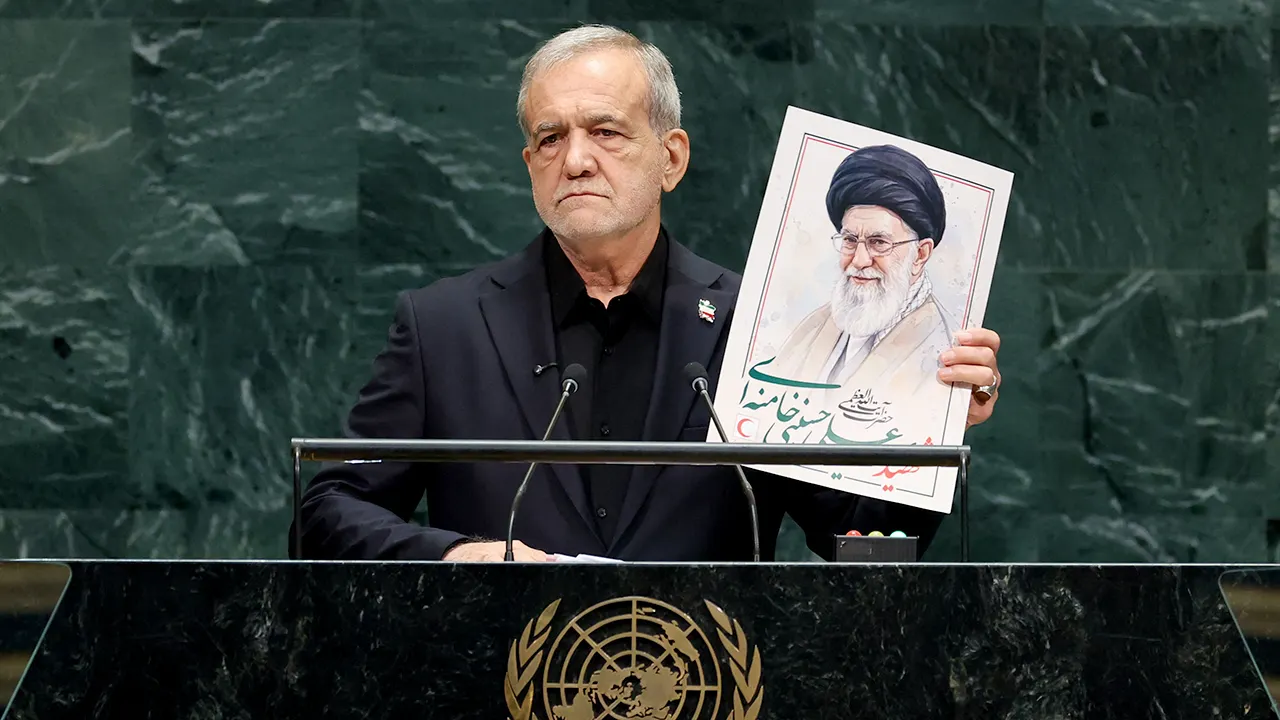
It was a moment heavy with history and hostility. Iranian President Masoud Pezeshkian stood before the United Nations General Assembly on Wednesday and delivered a speech that was less a diplomatic overture than a defiant declaration of survival. For months, Iran had been locked in a bruising war with the United States and Israel—a conflict marked by airstrikes, assassinations, economic strangulation, and countless failed attempts at negotiation. In that cavernous hall, surrounded by ambassadors, dignitaries, and the ghost of every previous crisis, Pezeshkian did not come to ask for mercy. He came to tell the world that Iran would never surrender. With a voice that carried both anger and grief, he insisted that his country had been attacked by the most advanced weapons in the American arsenal, that its people had suffered unimaginable losses, and that, despite all of it, they had refused to bow. “America and Israel attacked us, equipped with the latest technology and weapons systems, and our people stood steadfast. Yes, they did hit us, but we did not bend the knee. We did not bow our head,” he said. It was a remark aimed not only at the audience before him, but at every American official watching from Washington. For Pezeshkian, this was not a moment for nuance. It was a moment to be seen as the voice of a wounded nation, to transform vulnerability into resolve, and to remind the world that Iran was still standing.
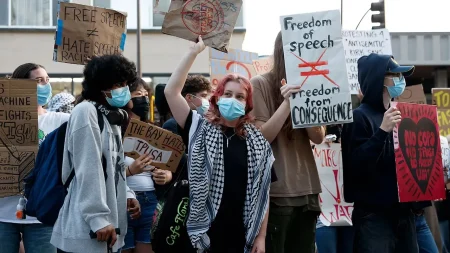
But in many ways, the most powerful response to Pezeshkian’s speech wasn’t happening inside the General Assembly at all. It was unfolding just outside, in the streets of New York, where a crowd of protesters had gathered to jeer his visit. The scene was electric and loud. Chanting, waving Iranian flags, and holding signs that demanded freedom, demonstrators made it impossible for the diplomatic machinery to pretend that the Iranian government was universally welcomed. Among them was former New York City Mayor Rudy Giuliani, who joined a “Free Iran” rally, lending his voice to a coalition that included Iranian exiles, human rights advocates, and ordinary people who saw the regime in Tehran not as a victim but as an oppressor. They spoke about political prisoners, women stripped of their freedoms, and dissidents who had vanished into the country’s notorious prisons. As an emcee announced that Pezeshkian was about to address the General Assembly, the crowd’s boos rose like a storm, almost as if they could reach the stage. Inside, the tension was just as palpable. A member of the U.S. delegation quietly stood up and walked out of the hall as Pezeshkian began criticizing America. It was a small gesture, but in the world of diplomacy, it was a thunderclap. The United States was not going to sit and listen quietly to a man it considered a hostile regime. The walkout spoke volumes: there would be no patience for lectures from Tehran, no interest in hearing about American aggression while the two countries remained locked in battle. For Pezeshkian, the hostile reception in New York must have been a reminder that his image as a reformist, a relative moderate chosen to lead Iran, was not enough to soften the reality of international fury.
Inside the assembly hall, Pezeshkian carefully constructed his narrative of the war as a story of victimhood and survival. He returned again and again to the suffering of ordinary Iranians, describing attacks that he said were carried out with American and Israeli weapons. He spoke of a sports hall in Lamerd that had been struck, an event that he said killed innocent men, women, and children in an act of violence so cruel it defied human comprehension. “The United States using weapons with multiple warheads targeted that sports hall. They martyred, assassinated our scientists, our men, women and children,” he declared. As he spoke, he held up photographs—images of the late supreme leader Ali Khamenei, and photos of schoolchildren who had died in the early days of the conflict. The props were deliberate, an attempt to turn the abstract statistics of war into faces that delegates could not ignore. It was a moment of raw emotional theater in a place that often feels saturated with rehearsed words and empty promises. Yet the claims were not uncontested. U.S. Central Command had previously denied that American forces struck the sports hall, insisting that no U.S. military action had occurred anywhere near that city on the opening day of what was called Operation Epic Fury. This is the nature of modern conflict: every strike becomes a contested memory, every casualty a weapon in the war of narratives. For Pezeshkian, the dead were martyrs. For Washington, they were collateral damage or even propaganda. There was no neutral ground, no shared truth, only the endless echo of accusations and denials. And as Pezeshkian continued to describe a country fighting for its very existence, he made sure that the United States was not just an opponent but the lead villain in his story.
Perhaps the most pointed part of Pezeshkian’s address came when he turned his attention directly to President Donald Trump. He did not speak of Trump as a statesman or a negotiating partner. He spoke of him as a bully. Pezeshkian accused Trump of trying to intimidate Iran, of using military threats and sanctions to force the country into submission. But he insisted that this tactic would never work. “More must be understood by Mr. Trump and those who seek to bully us, that we are ready for dialog and diplomacy and negotiations without accepting the language of force,” Pezeshkian said. It was a carefully crafted sentence—offering the possibility of talks, but only on terms that preserved Iranian pride. He referenced Trump’s own speech to the UN the day before, in which Trump had said he faced a “big decision” between making a deal with Iran or, in his own words, “annihilating the Islamic Republic.” Pezeshkian seized on that language, calling it contrary to the very spirit and charter of the United Nations. “He must know that the resistance of the Iranian people will increase in the face of sanctions, and increased bullying, because all of us under law will never bow our head or bend at the knee,” he said. The phrase “bend the knee” became the central motif of his address. It was defiant, almost theatrical, and clearly designed to rally the Iranian public and intimidate his opponents. In the way he said it, there was a sense that Pezeshkian was not just addressing the world leaders in the room; he was speaking to the Iranian people back home, reassuring them that their government would not surrender, no matter how many bombs fell or how many sanctions multiplied. Whether that message was accurate or not remains a matter of intense debate. But as a piece of political performance, it was effective. He managed to turn the world’s greatest superpower into an aggressor and his own country into a small, brave nation refusing to kneel.
The American response was swift, dismissive, and unyielding. Secretary of State Marco Rubio rejected the Iranian president’s framing entirely, arguing that Iran had no credibility when it came to human rights or the international order. “I think sponsoring terrorist organizations in the region to attack your neighbors, attack energy infrastructure, attack civilian sites is a violation of the UN system. So I don’t know what’s standing. Iran has to lecture anyone on human rights or the international system. When they habitually violate it,” Rubio said. He added that the Iranian regime had murdered thousands of its own people, killed Americans overseas, engaged in acts of terrorism in the Strait of Hormuz, and attacked its neighbors. White House deputy press secretary Anna Kelly echoed that sentiment in an even blunter statement. She described Iran as an “evil country” and said the president was courageously working to ensure that Iran never possesses a nuclear weapon. “The President is courageously ensuring that such an evil country never possesses a nuclear weapon, which will make the entire world safer and more stable,” Kelly said. The stark contrast in rhetoric was breathtaking. In the same city, on the same day, two governments were describing the exact same conflict in completely opposite terms. For Iran, the war was a defensive struggle against foreign aggression. For the United States, it was a necessary campaign to contain a dangerous, terrorist-supporting regime. There was no overlap, no admission of shared responsibility, no hint of compromise. This is the reality of the modern international system: each side believes deeply in its own righteousness, and the UN General Assembly becomes a platform for moral absolutes rather than a forum for problem-solving. The walkout by the U.S. delegate, the shouting protesters outside, the carefully rehearsed rebuttals from officials in Washington—all of it pointed to a relationship that has deteriorated to the point where even the most basic acknowledgment of the other side becomes impossible.
When the speeches are over, when the delegates leave the assembly hall and the protesters begin to disperse, the deeper questions remain unanswered. Pezeshkian’s address was a reminder that the conflict between Iran and the United States is not just a military standoff. It is a clash of identities, histories, and grievances that have accumulated for generations. For Iranians, the memory of foreign intervention, the pain of sanctions, and the loss of beloved figures are not abstract concepts. For Americans, Iran has become a symbol of hostage-takings, terror attacks, and nuclear ambitions that threaten the entire region. Neither side is inclined to give the other the benefit of the doubt, and the UN stage only amplifies that mutual distrust. Trump’s speech the day before had already raised the stakes, warning that if nuclear negotiations collapsed again, Iran would be hit “really hard.” Pezeshkian’s response made clear that Iran would not be intimidated. And so the world remains trapped between two leaders who each believe they are defending their people against an implacable enemy. The international community watches, powerless to force a solution, hoping that reason will prevail before the next round of violence begins. But as the sun set over New York, there was no sense that a breakthrough was near. There was only a persistent, uncomfortable feeling that the words spoken on that stage would soon be followed by actions—and that those actions could bring yet more suffering to ordinary people on both sides. For all its theatricality, Pezeshkian’s speech was a real statement of national will. And the American walkout was a real statement of rejection. Between those two positions lies the uncertain future of a conflict that has already taken too many lives and promises to take many more. The world can only wait, hope, and brace itself for what comes next.